The Lost Village Beneath Fernworthy Reservoir
The quiet Dartmoor reservoir that submerged an older landscape of farms, tracks and forgotten lives.
Introduction
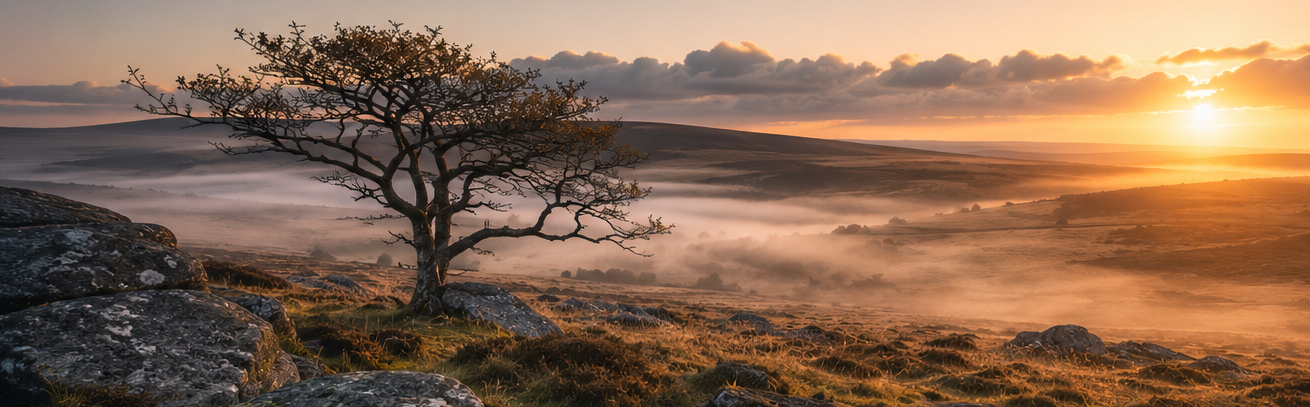
High on north-east Dartmoor, Fernworthy Reservoir appears calm and timeless, surrounded by dark conifers, open moorland and the changing light that gives this part of Devon its particular atmosphere. Walkers arrive for quiet paths, distant tors and reflections across still water.
Yet beneath the reservoir lies the memory of another landscape.
Before the valley was flooded in the early twentieth century, this was a lived-in part of Dartmoor — crossed by old tracks, bordered by rough fields and shaped by scattered farms and smallholdings. Most visitors today never realise that parts of the older valley still survive beneath the water.
“Even after the valley disappeared beneath the reservoir, people still spoke of the old tracks and walls as though the moor had never truly let them go.”
Legend · Dartmoor
Fernworthy Reservoir
British Publishing company Ltd Gloucester
The Legend
The Story of The Lost Village Beneath Fernworthy Reservoir
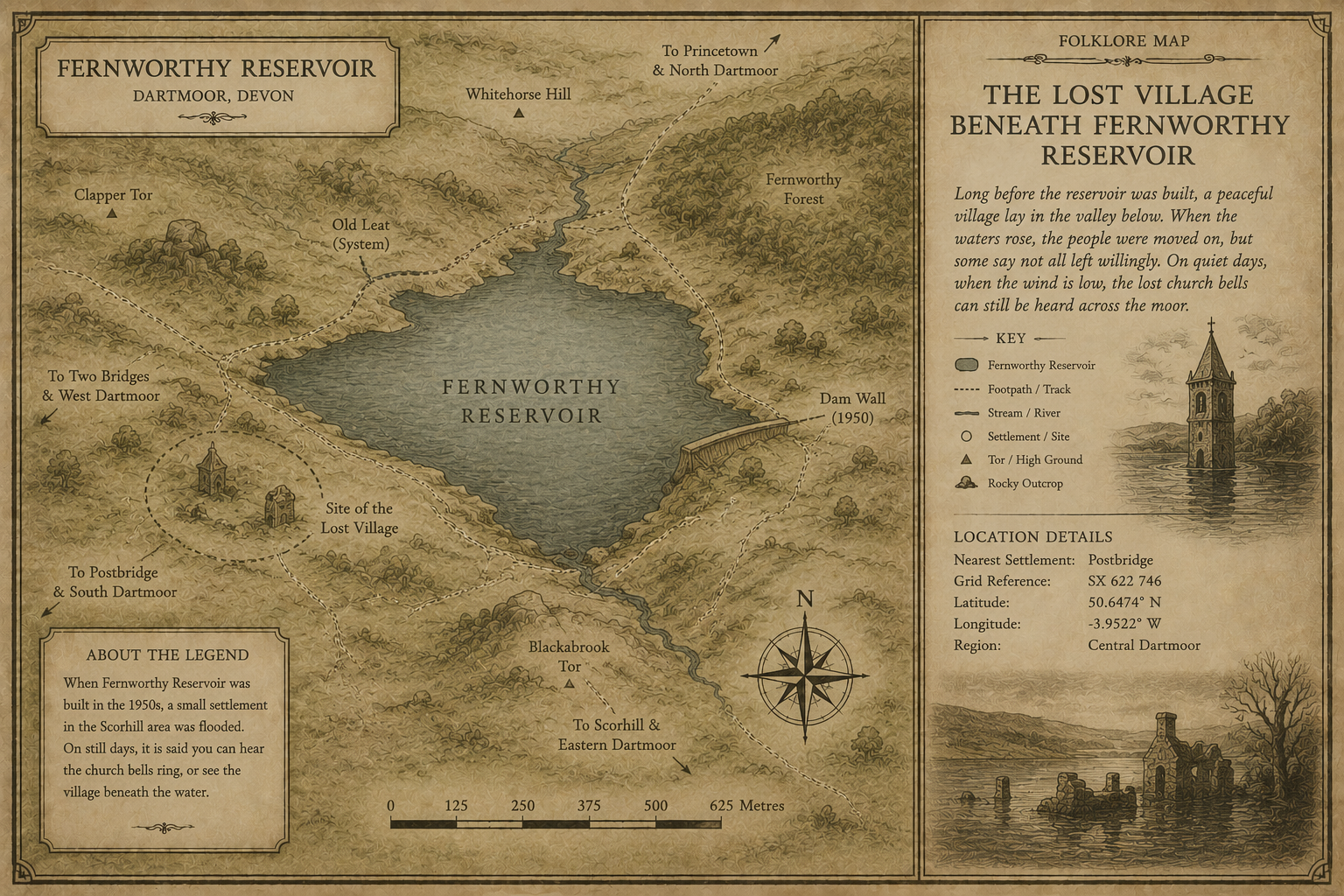
Local stories surrounding Fernworthy Reservoir rarely speak of ghosts directly. Instead, the folklore of the reservoir is tied to absence, memory and the strange feeling many people experience when standing beside water that covers an older landscape.
During particularly dry summers, water levels have occasionally fallen low enough to expose traces of what once existed beneath the reservoir. Old stone walls, boundary lines and fragments of the drowned valley have briefly reappeared before disappearing again beneath rising water.
For some walkers, the sight creates an unsettling feeling — not fear exactly, but the sense of standing between two versions of Dartmoor at once.
Stories passed quietly between locals sometimes describe mist moving strangely across exposed ruins at dusk, or the feeling that old paths still somehow remain beneath the surface. Older residents once spoke of “the drowned valley” as though it had never fully vanished at all.
Whether folklore or simple imagination shaped by landscape, Fernworthy carries a different atmosphere from many other reservoirs on Dartmoor. Even on still days, there is a lingering sense that something older rests beneath the water.
In the field
Fernworthy Reservoir remains accessible on foot today. The landscape that gave rise to this story is largely unchanged — you can still walk the same ground.
Historical Context
In the Historical Record
Fernworthy Reservoir was constructed between 1914 and 1917 to provide drinking water for the growing city of Torquay. The project transformed part of the Dartmoor landscape, flooding a valley that had previously contained farmland, rough grazing and old moorland boundaries.
Although no large village was lost beneath Fernworthy, parts of the earlier landscape disappeared beneath the expanding reservoir, including field systems, tracks and isolated buildings connected to Dartmoor’s long agricultural history.
Like several reservoirs across Britain, Fernworthy created a strange overlap between preservation and disappearance. The surrounding moor remained largely untouched, while the older valley itself was submerged and slowly forgotten by later generations.
The Landscape
Reading the Land
Fernworthy Reservoir sits within one of Dartmoor’s quieter and more atmospheric landscapes. Thick forestry plantations surround parts of the water, while open moorland rises towards nearby tors and prehistoric remains.
The contrast between dark woodland, still water and exposed granite gives the area a naturally reflective mood, especially during mist, rain or fading evening light. It is easy to understand why stories attached themselves to the reservoir over time.
Nearby archaeological sites, ancient stone rows and isolated moorland tracks reinforce the feeling that this landscape carries layers of human history stretching far beyond the reservoir itself.
Visiting Today
Going There
Fernworthy Reservoir is one of the most rewarding quiet walking areas on Dartmoor, particularly for visitors interested in atmosphere, history and changing landscapes.
Circular walks around the reservoir offer views across the water towards surrounding moorland, while nearby paths lead towards prehistoric sites, old clapper bridges and remote tors. Early morning and late afternoon often provide the strongest atmosphere, especially during autumn and winter.
Visitors should remember that water levels can change quickly and exposed ground near reservoir edges may be unstable or boggy. Any visible remains should be treated respectfully as part of Dartmoor’s historic landscape.
On the ground
Folklore comes alive in place. Walk the land slowly, at the right hour, in the right season — and you'll understand why stories like this one took root here.
Sources & Further Reading
South West Water historical records, Dartmoor National Park references, Local oral history and Dartmoor folklore collections. Historic mapping of the Fernworthy valley area Walker accounts and landscape photography from low-water periods
At a Glance
Moor
Dartmoor
Type
Legend
Location
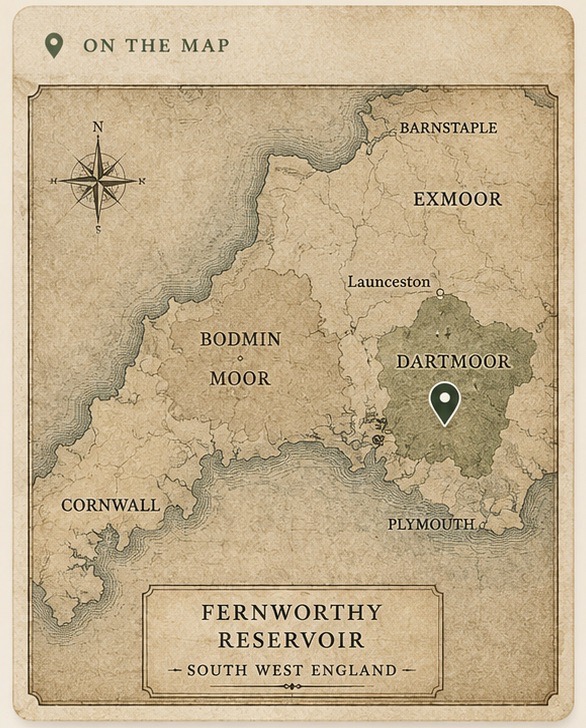
Fernworthy Reservoir
On the Map
Archival illustration
Fernworthy Reservoir