
Dartmoor · South Devon coast
Brixham
A colourful fishing harbour with maritime history and strong South Devon character.
About
Brixham
Brixham sits at the southern tip of Torbay, a town that has organised itself around the sea for centuries. It is not a resort in the usual sense. The harbour is working infrastructure, not backdrop, and the boats moored along the inner quay are there because fishing is still done here, not because they make a pleasant photograph. The smell of salt, diesel, and fish is present in the air most mornings, and that is not a problem to be solved but a fact about what this place is.
Water is the defining element here in a way that goes beyond the obvious. The harbour basin is tidal, and the town responds to it in small, continuous ways. The depth at the inner jetty changes through the day. Boats shift in their moorings. Ropes slacken and tighten. Gulls redistribute themselves along the harbour wall as conditions alter. The movement is constant but measured, and it gives Brixham a quality that purely tourist-facing coastal towns lack: the sense that the water is in charge, and that everything else has arranged itself accordingly.
People come to Brixham for the seafood, which is genuinely good and genuinely local. They come for the coastal path connections, which are extensive and varied. But many come simply because the harbour retains a density of character that is increasingly rare on the English coast. The terraced houses climb steeply from the waterfront. The fish market operates in the early hours. The trawlers return across water that changes colour depending on season and sky.
Character
The feel of Brixham
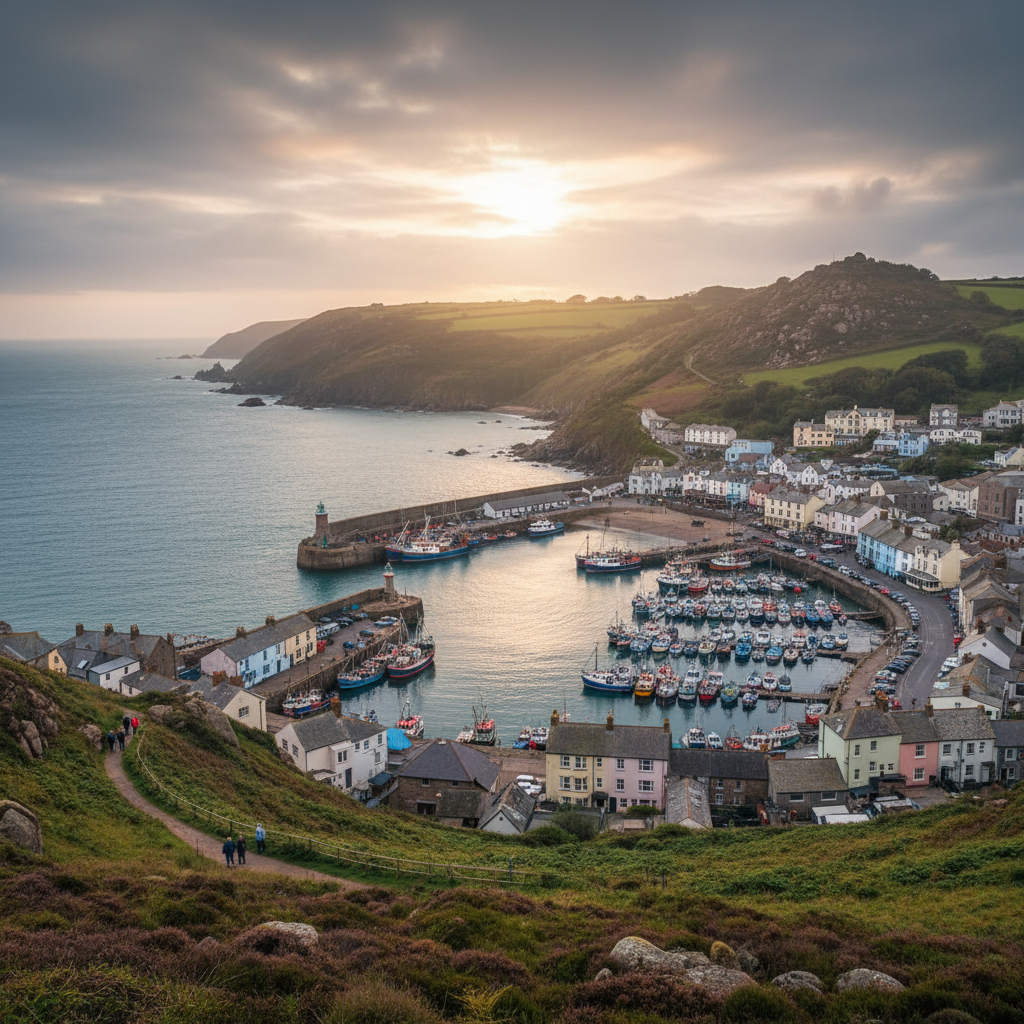
The built environment at Brixham is vertical as much as horizontal. The town rises sharply behind the harbour on ground that does not offer itself easily, and the older streets follow the contours in ways that make them narrow, stepped, and frequently surprising. From the quayside looking back at the town, the effect is of a place that has packed itself in tightly against the hillside, coloured plasterwork and slate roofs stacked upward in pale yellows, greens, and blues that bleach further in summer light.
Brixham has always been a place of arrivals and departures, and that rhythm is visible in the harbour at almost any hour. Trawlers leave in darkness and return through the morning. Day-trip boats load passengers and head south towards the headland or east towards Torquay. Private yachts come and go on tides. There is a quality of transit here that does not feel transient: it is simply the nature of a harbour town that has been sending boats out and receiving them back for hundreds of years. The replica of the Golden Hinde moored in the outer harbour is an exaggerated version of this story, but the story itself predates Drake by a long margin, and the fish market tells it more accurately than any monument.
The social life of the quayside is more layered than it first appears. Early morning belongs to the industry: unloading, ice, crates, fork-lifts on the quay. By mid-morning the cafes and fish stalls are busy, and by afternoon the inner harbour has settled into the quieter rhythm of visitors and day-trippers watching the boats. In the evening, especially in summer, the quay takes on a different register again, slower and more domestic, locals walking dogs along the waterfront as the light drops behind the headland.
First-hand visit
Keith's Take
Something about the way the boats move at their moorings, barely perceptibly but continuously, stays with you longer than the fish or the views.
The clinking of halyards against aluminium masts carries across the inner basin from some distance, a sound that is so particular to harbours that it locates you immediately. Brixham at mid-morning is already into its second act: the trawlers returned hours ago, the auction done, the quayside hosed down. What remains is a working day in its quieter phase, and if you arrive without urgency, the place will show you things a hurried visit misses.
What regular visitors learn, over time, is to read the harbour by what is absent as much as what is present. When a particular boat is gone from its usual berth, it is at sea. When the outer quay is busy with unloading, the catch has been good. When the gulls are concentrated at one end of the fish market, something is happening in the processing sheds. None of this information is offered, and none of it matters practically to most visitors, but paying attention to it changes how you experience the harbour: from backdrop to mechanism.
The daily rhythm here has a quality that takes several visits to internalise. The mornings are industrial and purposeful. The afternoons drift towards the visitor economy: ice cream, boat trips, the replica ship. The evenings, especially in the quieter months, return the harbour to something closer to its own scale. People who come back to Brixham repeatedly tend to time their afternoons for the quayside and their mornings for the walk to Berry Head, or simply for sitting somewhere with a view of the water before the day has fully organised itself.
Keith's Take — a first-hand account from the 3moors team
Map & Getting Here
Getting to Brixham
What to expect
A natural way to spend time here
Walking down from the town centre towards the harbour, the descent is steep enough that you feel the gradient in your legs, and the water comes into view in stages: first a strip of blue between rooftops, then the masts of moored boats, then the full basin spread below you as the road levels and opens onto the quayside. The scale of the inner harbour is smaller than you might expect from a fishing port of this significance, and that compression adds to the sense of density and activity.
Close to the water, the sounds layer up in a particular way: the metallic clinking of rigging against masts, the irregular wash of the harbour against stone, the calls of herring gulls that are working rather than decorative, alert to any moment of inattention from fish stalls or open bins. The smell varies by time of day, heavier with brine and catch in the early morning, lighter and more purely marine by afternoon.
The most rewarding approach is an unhurried one. The quayside repays lingering rather than covering. Sit on the harbour wall and watch how the boats move as a small wake passes through. Walk the outer breakwater if the weather is settled. Buy something from one of the fish stalls and eat it where you can see the boats the fish came from. The place does not reveal itself quickly, and it does not need to.
What makes it stand out
What makes Brixham special
What distinguishes Brixham from nearby Dartmouth or Salcombe is not polish but persistence. The fishing industry here has not retreated into heritage or nostalgia. Brixham's fish market is one of the largest in England by value of catch, and that fact shapes everything downstream: the quality and variety of seafood available, the presence of working boats rather than just leisure craft, the matter-of-fact relationship the town has with the sea. There is no performance of fishing heritage here. The heritage is the present.
Brixham also resists the particular kind of homogenisation that has quietly overtaken several of its neighbours. The inner quay has its gift shops and ice cream stalls, as all harbours do, but the working infrastructure of the port is not hidden or aestheticised. The fish market, the processing facilities, the commercial jetties: these are part of what you see when you walk around the harbour. That transparency about what the town actually does gives it a credibility that is harder to find on stretches of coast where the working life has been replaced entirely by the visitor economy.
Don't miss
Things to see and do
Walk the full length of the outer breakwater on a morning when the sea is running and the spray is light enough to stand in.
Buy fresh crab from one of the quayside stalls and eat it on the harbour wall while the trawlers manoeuvre past.
Watch the fish market from the viewing area in the early morning: the catch comes in before dawn, and the auction floor is worth seeing even from the outside.
Follow the South West Coast Path south from the harbour towards Berry Head, where the path climbs to limestone cliffs and the views back towards Brixham are clear and vertiginous.
Look for the Golden Hinde replica in the outer harbour, then find the actual fish market behind it and compare what those two things say about the town.
Wait at the end of the inner quay as a trawler comes in: the sequence of ropes, the shifting of weight, the quiet competence of the crew is worth a few minutes of attention.
Take the ferry across the bay to Torquay on a clear afternoon and return to Brixham from the water, which is the direction this town was built to be seen from.
Walks from here
Getting out from Brixham
The South West Coast Path runs directly through Brixham, and both directions from the harbour offer rewarding walking. Heading south-east, the path climbs to Berry Head National Nature Reserve within a mile or so, crossing limestone grassland to reach the headland at roughly 60 metres above sea level. The cliffs here are among the highest in South Devon, and the reserve supports guillemots and greater horseshoe bats, both of which are more likely to be seen in spring and summer. The return walk along the same route takes less than two hours at an easy pace.
Heading north-west from the harbour, the path works around the edge of Torbay towards Paignton and Torquay, a flatter and more urban stretch but one that offers sustained sea views and passes through Man Sands and Churston Cove, both of which are quieter than the main harbour beaches. The full walk to Paignton is around four miles and can be returned by bus or, in season, by a small ferry service. For those wanting a longer circuit, the inland lanes above the town connect back to the coast path and allow a loop taking in the higher ground behind Brixham, with views across Torbay that clarify the geography of this stretch of coast.
Good to know
Before you go
Parking in Brixham requires patience in summer. The town is popular and the road layout is tight
arriving before 9am or after 5pm avoids the worst of it. The fish market viewing area has specific opening hours and it is worth checking these in advance rather than arriving speculatively. Several of the best-regarded seafood restaurants and stalls are small and fill quickly at peak times
eating early (before 12.30) or late (after 2pm) makes a practical difference.
The outer breakwater and the stretch of coast path towards Berry Head can be exposed in strong south-westerly winds. The route is well-marked but the surface is uneven in places, and footwear with grip is advisable beyond the immediate harbour area. Berry Head itself is a managed nature reserve with restricted areas during nesting season (typically April through July), and it is worth being aware of these before planning a detailed exploration of the cliffs.
Across the seasons: Summer brings the most visitors and the longest light, and the harbour in July and August has an intensity that some will find energising and others claustrophobic. The quayside is busiest between 11am and 3pm, and the fish stalls and restaurants turn over quickly. Even in peak season, the early mornings at the harbour belong to the industry rather than tourism, and an hour before 8am is a different experience from the same hour returned to at noon. Autumn is when Brixham reasserts its working character most clearly. By late October the day-trip boats have reduced their schedules, the holiday traffic has dropped away, and the harbour settles back into its own rhythms. The light in this period is lower and more raking, the water a deeper grey-green, and the trawlers more prominent against a quieter backdrop. For anyone interested in what the town actually is rather than what it hosts in summer, this is the more revealing season. Winter is quieter still, and the coast path towards Berry Head is often walkable in conditions that would be uncomfortable on the open moor. The headland in January or February, with a sea running and the guillemots returned to the cliffs, has a sparse clarity that is entirely its own. The town does not close, and the fish market and several of the better eating places remain open through the colder months, though hours contract and advance checking is advisable.
Practical info
Practical info
Brixham has several pay-and-display car parks, with the harbourside options filling quickly during summer and on busy weekends. The quayside itself is largely restricted to permit holders and loading, so arriving early is advisable if you want to park close to the water. Out-of-season visits allow more flexibility, but spaces near the harbour remain competitive on fine days year-round. Signed car parks are clearly labelled from the main approach roads into town.
The town centre and harbourfront are well served by cafés, public houses, and seafood vendors, many of which operate year-round given Brixham's working population. Public toilets are available near the harbour. Facilities thin out considerably once you move onto the coastal path above the town, so carrying water and food beyond the quay is sensible. There is no visitor centre as such; the harbour itself functions as the main point of orientation.
The harbour area and quayside are largely flat and accessible on foot, though some surfaces are uneven cobblestone or worn stone steps. Coastal path sections above the town involve genuine gradients and exposed cliff edges, and can be slippery after rain. Sturdy footwear is recommended for anything beyond a quayside walk. The elevated paths offer no shelter in strong south-westerly winds, which arrive with little warning in autumn and winter.
varies
Join the 3moors Community for path conditions & local tips.
JoinWhy this place matters
Brixham — in its own right
What Brixham leaves you with, if you let it, is an awareness of the tidal clock that underlies everything here. The harbour is not the same place at low water as it is at high. The mud and the weed and the lower strakes of hulls, visible at the ebb, are covered and forgotten by the flood, and the boats that sat at uncomfortable angles are upright again. The town does not announce this. It simply accommodates it, as it has for a long time. There is something steadying about a place whose fundamental character is governed by something it cannot control or alter. The tide comes in and goes out regardless of season, footfall, or weather. The trawlers work around it. The harbour arranges itself accordingly. Visitors, when they notice it at all, tend to find it calming. That rhythm, older than the town itself, is what gives Brixham its particular quality of permanence.
Explore more
Discover other places, walks, and hidden corners across Dartmoor.