
Exmoor · North Devon coast
Lee Bay
A tucked-away coastal hamlet framed by steep woodland and rocky shoreline.
About
Lee Bay
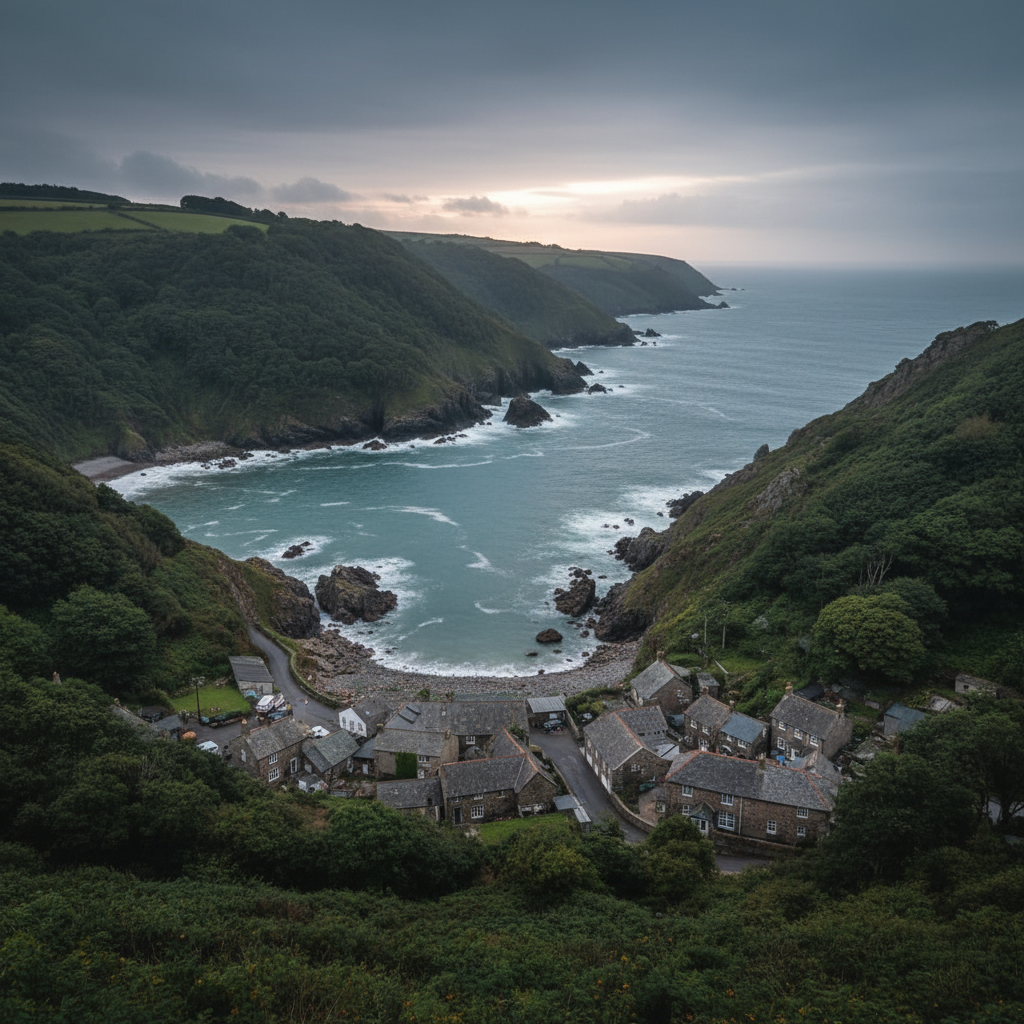
Lee Bay sits at the end of a narrow lane on the North Devon coast, tucked into a fold of land where the hills of Exmoor's coastal fringe drop steeply to the Bristol Channel. It is not a place you stumble upon. The approach requires intention: a single-track road threading through dense oak woodland, the sea hidden until the final descent opens onto a small shingle and sand beach framed by dark rock. The hamlet itself amounts to very little by way of infrastructure, which is precisely the point.
What Lee Bay offers, above all else, is a particular quality of light. On calm mornings, when the Channel lies flat and the tide is low, the water takes on a shifting, pewter-grey luminosity that has nothing in common with the aquamarine brightness further west along the Devon coast. The light here is northern in character, filtered through sea mist and the overhang of wooded cliffs, and it changes quickly. By mid-morning the surface of the water can shift from silver to a deep, greenish blue as cloud breaks over the headland to the east.
People visit Lee Bay because it resists the pressure of popularity. There is no ice cream van, no beach hire, no managed car park close to the shore. The beach rewards those who carry what they need and settle in without expectation. Families come for the rock pools
walkers pass through on the South West Coast Path
Character
The feel of Lee Bay
Lee Bay does not have the broad, open aspect of many North Devon beaches. Its appeal is conditional on its enclosure. The cliffs on either side are not dramatic in the way that Hartland's are, but they are close, and they create a sense of containment that makes the bay feel smaller than it is. The water, when the weather is unsettled, is visibly alive: swell rolls in from the Channel and breaks messily against the reef rock on the western side of the cove. The beach itself is a mix of coarse sand and rounded grey pebble, the kind that shifts underfoot and holds little warmth.
What the bay's position on this stretch of coast actually means is exposure of a particular kind. Lee Bay faces north across the Bristol Channel, and even on warm summer days the wind can arrive without warning, carrying cold air off the water with surprising force. This is not a bay that flatters its visitors. On grey days in early spring or late autumn, with cloud running fast overhead and the sea in motion, the place has an uncompromising quality that demands a certain kind of attention. You feel the weather here in a way you do not on south-facing Devon coves. The light dims early behind the western headland, and in winter the bay can feel genuinely remote despite its moderate accessibility.
The hamlet's built character is minimal: a cluster of period properties set back from the shore, stone-built and unpretentious, with none of the self-conscious prettiness of better-known North Devon villages. There is no pub, no café, no visible commerce. The lane ends and the beach begins, and the transaction between visitor and place is entirely on the landscape's terms.
Map & Getting Here
Getting to Lee Bay
What to expect
A natural way to spend time here
The path down to the beach passes through the oak wood at a gradient that is moderate but uneven underfoot. Tree roots cross the path in places, and after rain the surface becomes slippery where leaf litter accumulates in the hollows. The smell of wet wood and salt arrives together before the sea comes into view, a combination specific to this kind of sheltered north-facing cove. The beach reveals itself in stages: first a gap in the trees, then the line of the water, then the full breadth of the bay as the path levels out onto the foreshore.
At low tide, the reef rock on the margins of the bay becomes the focus. Pools collect in the ledges and channels, and grey sea-washed boulders hold communities of bladderwrack, limpet, and periwinkle. It is worth moving slowly here. Oystercatchers work the waterline with methodical purpose, their calls carrying clearly above the low ambient noise of the swell. Turnstones forage at the tide's edge, flicking pebbles with a speed that makes them easy to miss if you are not watching for them. The bay sits on a flyway for migrant coastal birds in spring and autumn, and the diversity of what passes through can surprise even regular visitors.
The most rewarding way to spend time at Lee Bay is to arrive unhurried and without agenda. The beach is not large enough to absorb crowds, but it is rarely overcrowded. Pick a position above the tideline, where the larger stones have been smoothed by decades of wave action, and let the bay come to you rather than setting off immediately to explore its margins. The place repays patience more than activity.
What makes it stand out
What makes Lee Bay special
Many coves along the North Devon coast sit at the foot of dramatic cliff scenery, drawing visitors for the spectacle of the geology. Lee Bay's distinction is more understated. The quality of its woodland backing is unusual: the coastal oak wood that descends almost to the shore is the same Atlantic oak habitat found in sheltered combes across Exmoor's northern edge, and its survival here, right at the point where land meets sea, gives the bay a layered, enclosed character that cliffs alone cannot provide. The transition between saltwater and ancient woodland is immediate in a way that feels particular to this spot.
Lee Bay is also notably free from the coastal tourism infrastructure that has accumulated around similar coves elsewhere on the peninsula. That absence is not accidental
it reflects the difficulty of access and the nature of the surrounding land, much of which sits within the Exmoor National Park boundary. The result is a beach that remains genuinely low-key, not as a marketing position, but as a consequence of its geography and history. Visitors who know it tend to return quietly and without announcement. It rarely appears on lists.
Don't miss
Things to see and do
Walk the reef at low tide and crouch down to the rock pools on the western side of the cove, where the ledges are deepest and most sheltered.
Watch the oystercatchers working the waterline in the hour before and after low water, when they are most active and least disturbed.
Follow the coast path east from the bay toward Woody Bay, where the oak woodland thickens and the cliff edge offers open views across the Channel to South Wales on clear days.
Sit with your back to the sea wall and watch the light shift across the water in the hour before midday, when the angle catches the surface differently from any other time of day.
Look for turnstones in autumn along the boulder margins: small, restless, easy to overlook against the mottled grey of the stones.
Walk the lane back through the oak wood in early May when the bluebell floor is at its fullest and the canopy has not yet closed over.
Stand at the western edge of the beach and notice how the headland cuts the swell: on days when the sea is running, the line between shelter and exposure is visible in the water itself.
Walks from here
Getting out from Lee Bay
The South West Coast Path passes through Lee Bay, and the section running eastward toward Woody Bay is among the more rewarding stretches on this part of the North Devon coast. The path climbs steeply from the bay through mixed woodland before opening onto cliff-edge walking with clear views northward across the Channel. The return to Lee Bay can be made as a loop by dropping back down through the valley inland of the coast, though this requires navigation and the paths are not all well-marked. Allow three to four hours for a comfortable circuit.
Westward, the coast path runs toward Bull Point and Morte Point, a longer and more exposed section of walking that takes in the lighthouse at Bull Point and the jagged reef scenery of the Morte Slate headland. This is a half-day or full-day route depending on how far you commit, and the return is best managed by arranging transport or retracing steps rather than attempting an inland loop, as the road network in this area offers limited circular options on foot.
For a shorter outing, the wooded combe immediately behind Lee Bay rewards exploration on its own terms. A path follows the stream inland through the oak wood for a mile or so, with the gradient easing as the valley widens. This is a good option in poor weather, when the woodland provides shelter the coast path does not.
Good to know
Before you go
The road to Lee Bay is narrow and requires care, particularly in summer when it carries more traffic than it was built for. Passing places are infrequent, and reversing on the descent is both possible and occasionally necessary. Parking at the bottom is very limited
arriving early in the morning or later in the afternoon avoids the most congested period. Tides are worth checking before visiting: at high water, access to the beach and reef rock is reduced significantly, and the foreshore can be wet and difficult underfoot at all but low tide.
The bay has no facilities: no refreshments, no toilets, no phone signal reliably available. Carry water and food, and be prepared for the weather to change faster than forecasts suggest. The north-facing aspect means the bay loses direct sun earlier than south-facing beaches. A windproof layer is advisable even in summer, and in spring and autumn a proper waterproof is not excessive.
Across the seasons: Late spring is the bay's most generous season. The oak woodland is at its most vivid in May, when the new leaf is still a bright, translucent green and the bluebell floor below it carries colour into early morning walks. The light on the water in May and June has a clarity that the summer haze tends to soften, and the coast path is passable without the summer footfall. Migrant birds move through the coastal strip in April and May, and the rock pools are at their most productive. Summer brings the bay's only real pressure. Weekends in July and August fill the limited parking and push the beach to its social limit. The water temperature is at its highest in August and early September, which draws swimmers, though the sea here runs cold by southern standards regardless of season. The north-facing exposure means that even midsummer afternoons can turn sharp if the wind shifts. Autumn is when Lee Bay reasserts its character. By October the woodland behind the bay begins to turn, and the palette of russet and ochre against the grey-green Channel water has a quality the summer months cannot match. The bay empties quickly after the school holidays, and by late September it is possible to have the foreshore almost entirely to oneself. November and December bring the stormiest conditions, when the swell running up the Channel produces heavy breaking water and the path through the woods becomes a river in heavy rain. That version of the bay is entirely its own thing, and worth experiencing once.
Practical info
Practical info
Parking at Lee Bay is limited and fills quickly in summer, particularly at weekends. There is a small car park serving the hamlet, but spaces are few and the approach lane is narrow, requiring care when passing oncoming vehicles. Arriving early in the morning is the most reliable strategy. Do not rely on roadside options as verges are tight and local access must be kept clear.
Lee Bay is a small hamlet with very few visitor facilities. There is no public toilet, no café, and no shop within the immediate area. Visitors should come fully prepared with water, food, and anything else they need for the day. The nearest services are in Ilfracombe or Combe Martin, both a short drive away.
The path down to the shore involves a noticeable descent through woodland, and the return requires a corresponding climb. The rocky shoreline itself can be slippery when wet or when seaweed is present, so footwear with a firm grip is advisable. Coastal paths in this area can be narrow and uneven. In wet or windy conditions, the exposed clifftop sections require particular care.
varies
Join the 3moors Community for path conditions & local tips.
JoinWhy this place matters
Lee Bay — in its own right
What Lee Bay leaves you with, most of all, is the sense of a coast that is still conducting its own life regardless of who is watching. The wildlife here is not managed for visitors. The oystercatchers and turnstones, the occasional peregrine that crosses the bay at height in autumn, the grey seals that are sometimes visible offshore in winter: none of them have accommodated themselves to human presence in the way that more visited places tend to produce. The bay is used by creatures for whom it is habitat, not backdrop, and that distinction registers in a way that is difficult to articulate but easy to feel. There is a version of the North Devon coast that has been shaped, over decades, by the needs of coastal tourism. Lee Bay has largely escaped that process, and what remains is something more provisional and less certain than a managed visitor experience. The place does not always perform. Some days the light is flat, the wind is cold, the tide is up and the rock pools are underwater. On those days it asks for something from the visitor rather than offering something in return. That, in the end, may be what recommends it most.