Bodmin Moor · West Cornwall coast
Marazion
A broad seafront town facing St Michael’s Mount and Mount’s Bay.
About
Marazion
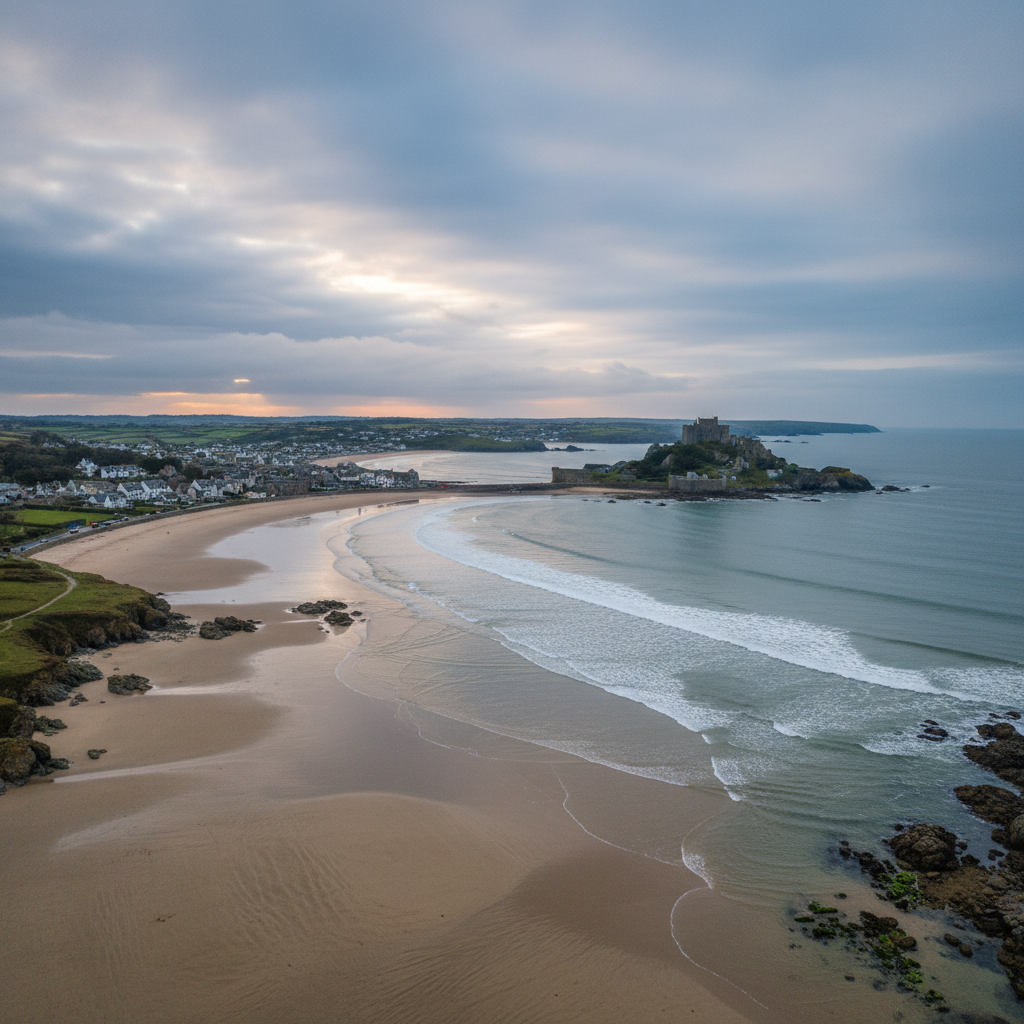
Marazion sits at the eastern edge of Mount's Bay, a broad seafront settlement that looks directly across the tidal flats towards St Michael's Mount. It is the oldest chartered town in Cornwall, though you would not immediately know it from the modest run of shops and houses that face the sea. The town does not announce itself. It simply sits there, low and open, with the bay spread out before it and the Mount rising from the water a few hundred metres offshore.
The shoreline here is wide and gently shelving, backed by a long stretch of beach that reaches from the town westward towards Penzance. At low tide the sand extends far out, and the causeway to the Mount emerges from the water, drawing a line of figures across to the island. At high tide the water comes in quickly and quietly, and the Mount becomes an island again, separated from the land in a way that feels matter-of-fact rather than dramatic.
People come here for the view, and it is a view that holds attention without effort. St Michael's Mount is one of the most recognised silhouettes in the country, and Marazion is the place from which most people first see it at close quarters. But the town offers more than a vantage point. There is a real beach here, suitable for swimming when conditions allow, and the wide open aspect of the bay means that the light is rarely the same twice. On a clear day the Lizard is visible to the south-east, and the whole arc of the bay feels generously scaled.
For those who want to be near the sea without the noise of a larger resort, Marazion has a particular appeal. It is not remote, but it carries a quality of separation from the ordinary tourist circuit that is easy to appreciate once you are there. The town is small enough that you quickly exhaust its streets and find yourself back at the water's edge, which is precisely where most people want to be. That repeated return to the seafront, unhurried and unforced, is part of what makes a visit here feel restorative rather than merely scenic.
Character
The feel of Marazion
The character of Marazion is shaped almost entirely by the tide. This is not a place where the sea is a backdrop. The comings and goings of the water determine what the view looks like, whether the causeway is passable, how far the beach extends, and how the Mount appears against the sky. A visitor who arrives at low tide and returns at high tide will see something close to two different places. That rhythm, repeated twice a day, gives the town a structural patience that is unlike anywhere inland.
The seafront itself is low-key and uncluttered by the standards of a coastal town with this level of visitor interest. There is a car park, a short promenade, a café or two, and the beach. The architecture behind is domestic and modest, with none of the self-conscious prettiness of some Cornish villages. What the town lacks in visual drama it compensates for in openness. The scale of the bay is substantial, and standing on the beach you are aware of being in a large, light-filled space rather than a tucked-away cove.
The tidal rhythm also governs the wildlife of the bay. The mudflats and sandflats exposed at low water attract wading birds throughout the year, with numbers building in winter when the estuary becomes a significant feeding ground. Curlew, dunlin, and bar-tailed godwit work the flats with focused, methodical attention, and the Mount itself is a roosting site for various species. Watching the tide draw back and reveal this activity is one of the quieter pleasures of a visit, and one that rewards a patient observer more than a passing glance.
Map & Getting Here
Getting to Marazion
What to expect
A natural way to spend time here
The path from the main car park to the beach takes less than two minutes, crossing a low grassy bank before the sand opens out ahead of you. There is no dramatic reveal, no sudden drop down to a cove. The beach arrives gently, and the Mount is simply there in front of you, as if it has been waiting. The sand is firm near the waterline and softer further back, and at low tide the exposed flats carry the faint mineral smell of wet sand and salt.
The sounds here are uncomplicated: the draw of water over sand, the occasional cry of a herring gull, the low hum of wind coming in off the bay. On busier days the beach fills with the background noise of families, which is not unpleasant, but it does alter the register of the place. Earlier in the morning, before the car park fills, the foreshore is largely quiet, and the only movement tends to be dog walkers and the waders working the tideline.
The best approach is an unhurried one. There is no circuit to complete, no summit to reach. The beach rewards a pace that allows the view to settle rather than be consumed. Walk towards the causeway, stop when the light interests you, turn and look back at the town with the Mount behind you. The place gives back more to those who are willing to stay for a second tide than to those who come for an hour and leave.
What makes it stand out
What makes Marazion special
What sets Marazion apart from other beaches along this stretch of coast is not the sand or the swimming, both of which are good without being exceptional, but the specific orientation of the place. The town faces almost due south, which means the light falls differently here than on beaches that face west or east. On a bright morning the Mount is lit from one direction, and by afternoon it has shifted entirely. The bay catches the full sweep of the southern sky, and on days of mixed weather the cloud formations over the water can be remarkable, with shafts of light moving across the surface in a way that changes the colour and texture of the sea from minute to minute.
There is also something in the relationship between the ordinary and the extraordinary here. The Mount is a medieval castle and priory rising from a tidal island, and it sits within comfortable walking distance of a town that has a newsagent and a pub. The juxtaposition is so familiar to Cornish visitors that it risks being taken for granted, but it is genuinely unusual. Few places in Britain allow you to eat a sandwich on a public beach while looking at a fortified island with a working harbour and a National Trust property on its summit. The casualness with which the Mount occupies the view is, on reflection, quite extraordinary.
Don't miss
Things to see and do
Walk the causeway to St Michael's Mount at low tide, timing your crossing with the published tide tables rather than guessing.
Watch the tide come in from the beach rather than from the causeway, noticing how quickly and silently the flats disappear.
Take the coast path westward along the shore towards Penzance in the late afternoon, when the light falls low across the bay from behind you.
Look for bar-tailed godwit and dunlin on the exposed flats in winter, working methodically along the waterline.
Sit on the upper beach with the Mount directly ahead and wait for the cloud cover to shift, watching how the light remakes the surface of the water.
Visit the Mount itself on a quieter weekday, arriving early enough to see the harbour before the first boats from the mainland.
Follow the path behind the town to look back across the bay from slightly higher ground, where the full scale of the coastline from the Lizard to Land's End becomes clear.
Walks from here
Getting out from Marazion
The coast path runs in both directions from Marazion, and both routes are accessible without significant climbing. Heading west towards Penzance, the path follows the shoreline closely for most of its length, passing the long beach and arriving in Penzance in under two miles. The route is easy and well-used, with the Mount visible for much of the way back. It makes a natural out-and-back walk, or a linear route if transport can be arranged from Penzance.
Heading east from Marazion the path begins to rise slightly as it moves towards Perranuthnoe, a smaller and less visited beach roughly two miles along the coast. The walking here is more varied, with sections of low cliff and open farmland, and the views back across the bay towards the Mount are among the best available from this stretch of coast. Perranuthnoe has a small café above the beach, which makes it a practical turning point for a half-day walk.
For those with more time, the path continues beyond Perranuthnoe towards Praa Sands and the Lizard peninsula, though this quickly becomes a longer commitment. A shorter option from Marazion is simply to walk the beach at low tide from one end to the other and back, which takes perhaps forty minutes and covers most of what the immediate shoreline has to offer.
Good to know
Before you go
The causeway to St Michael's Mount is passable on foot for roughly four to five hours around low tide, and the timing shifts daily. The National Trust and the Mount's own website publish crossing times, and it is worth checking these before planning a visit that depends on the crossing. The ferry also runs when tides allow, which extends the window of access. Arriving at the Mount without checking the tides is a common mistake that results in either a wait or a wet return.
The main car park at Marazion is large but fills quickly on summer weekends, particularly in July and August. Arriving before ten in the morning avoids most of the congestion. The beach itself is dog-friendly outside the main summer season, and the restrictions applying in summer are posted at the car park. The town has limited facilities beyond the seafront, so those planning a full day should bring food and water rather than relying on what is available locally.
Across the seasons: Marazion in winter is a different proposition from its summer self. The beach empties, the car park costs nothing, and the bay takes on a bleaker, more considered quality. The winter light in West Cornwall is particular: low, lateral, and often very clear, which means the Mount can appear in extraordinary definition against a grey or blue-grey sky. The wading birds are at their most numerous from October through to March, and the foreshore becomes a working estuary rather than a beach in any conventional sense. Spring brings the first visitors and a softening of the light. April and May are good months for the coast path, when the hedgerows above the cliffs are in flower and the weather is variable enough to keep the crowds manageable. The water is cold but swimmable for those accustomed to it, and the causeway crossings are less crowded than they will be in summer. High summer is the busiest period, and Marazion bears the weight of its proximity to St Michael's Mount fairly visibly in July and August. The beach is well used, the car park fills early, and the causeway can feel more like a queue than a crossing. For those who want the iconic view without the congregation, late September and October offer a useful compromise: the weather is often settled, the light is autumnal and warm in the late afternoon, and the summer visitors have largely gone.
Practical info
Practical info
Marazion has a large pay-and-display car park on the seafront, managed by Cornwall Council, which sits close to the beach and the causeway crossing to St Michael's Mount. It fills quickly during school holidays and summer weekends, particularly on fine days when the Mount is accessible on foot. Arriving before 10am gives the best chance of a straightforward space. On-street parking in the town itself is limited and subject to restrictions, so the main car park is the more reliable option.
The seafront area has public toilets, and there are cafés, a pub, and a small number of independent shops along the main street. The beach itself has no lifeguard cover, so swimming is at your own judgement. Facilities are more limited outside the summer season, with some cafés and food outlets operating reduced hours or closing entirely between October and Easter.
The beach and seafront path are easy underfoot on firm sand and level tarmac, making this one of the more accessible stretches of the Cornish coast. The tidal causeway to St Michael's Mount involves uneven cobbles and can be slippery when wet; it is only passable at low tide and requires reasonable footwear rather than flip-flops or bare feet. The broader beach becomes soft sand in places, manageable in trainers but easier in shoes with some grip. Coastal wind exposure can be significant, particularly in spring and autumn.
varies
Join the 3moors Community for path conditions & local tips.
JoinWhy this place matters
Marazion — in its own right
What Marazion leaves you with, finally, is not the Mount, though the Mount is what most people come for. It is something more persistent and less definable: the quality of the light on the water in the hour before the tide turns. The surface of the bay in that moment is neither still nor rough but somewhere between the two, catching the afternoon sun in a way that seems to shift the light rather than simply reflect it. The Mount sits in the middle of this, dark against the brightness, and the effect is one that photographs cannot quite capture because it is as much about duration as about appearance. That quality of light, and the bay's willingness to keep demonstrating it regardless of who is watching, is perhaps what gives Marazion its lasting impression. It is not a place that requires much of its visitors. It asks only that you face the water and pay attention, and it offers, in return, a version of the Cornish coast that is generous without being excessive.
Explore more
Discover other places, walks, and hidden corners across Bodmin Moor.