Dartmoor · North East Dartmoor
North Bovey
A quiet village surrounded by wooded valleys and softer Dartmoor landscapes.
About
North Bovey
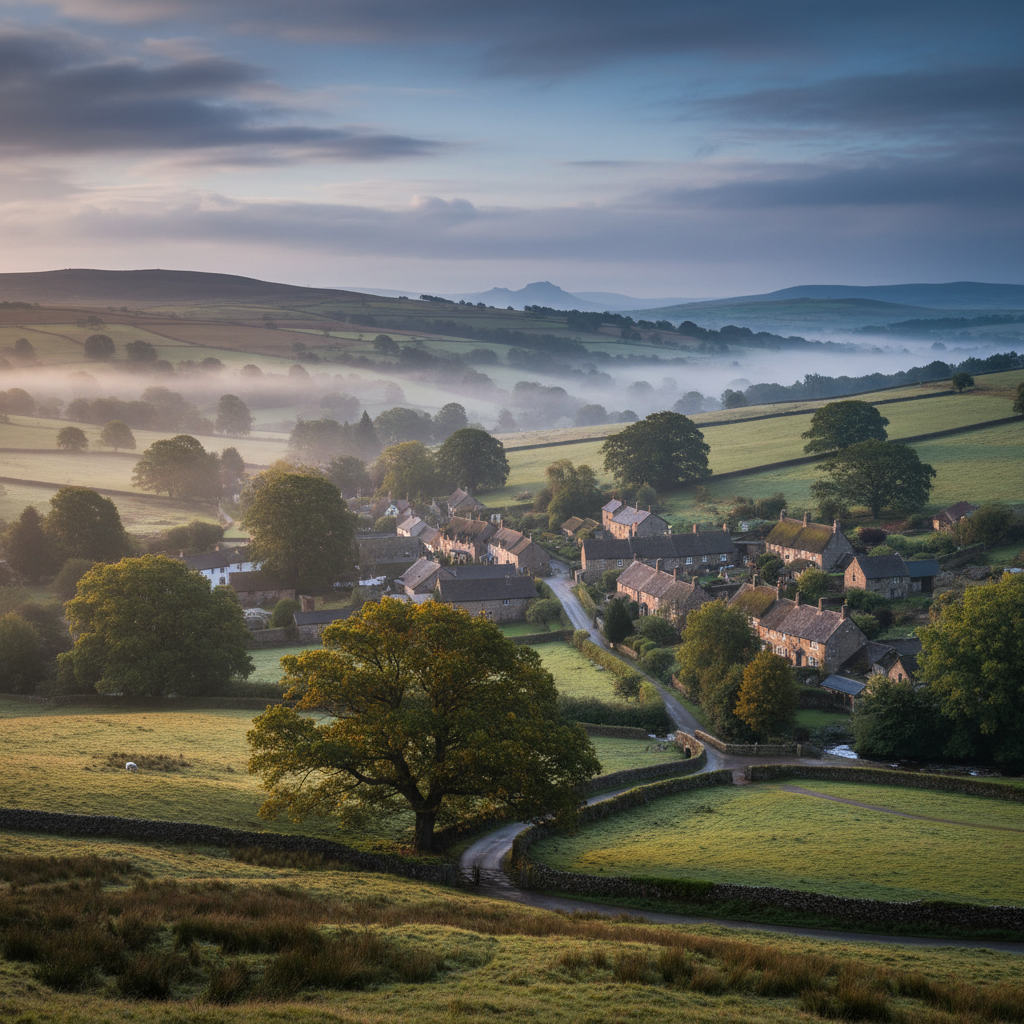
North Bovey occupies a fold in the land that feels set apart from the main business of Dartmoor. It sits on the eastern fringe of the moor, where the harder, more exposed country to the west softens into enclosed pasture, mixed woodland, and the understated drainage network of the River Bovey. The village is not on the way to anywhere else in particular, and that fact has shaped it considerably. You come here because you have chosen to, and the place responds to that choice with a stillness that takes a few minutes to settle into properly.
What you find is not silence in any absolute sense. There are rooks, the distant sound of farm machinery, the occasional vehicle navigating the lanes. But the quality of the quiet here is particular: it is not the absence of sound so much as the absence of urgency. The pace of North Bovey is one that the village seems to set for itself, and it does not adjust readily for visitors. This is, in the best possible sense, not a place that performs for an audience.
People come primarily to walk, to stay somewhere unhurried, and to find the kind of Dartmoor landscape that does not require scrambling or navigational confidence. The valley footpaths that spread out from the village green provide access to some of the finest wooded walking in the eastern moor, and the village itself, compact and self-contained, gives those walks a natural starting point and a reason to return.
Character
The feel of North Bovey
The green at the centre of North Bovey is a genuinely communal space rather than a piece of managed amenity. It is irregular in shape, hemmed in on its edges by stone cottages and a medieval church, and it gives the settlement its proportions. Livestock graze it on occasion. A large oak stands near the centre, wide-limbed and long-established. The space does not announce itself, but it holds the village together in a way that becomes clearer the longer you spend in it.
What is striking about North Bovey as a community is how intact its social architecture remains. The Ring of Bells sits at one end of the green as a working village pub, functioning in the way that such places rarely do any longer: it is where people from the farms and cottages around it actually drink. The church is maintained with obvious local care. The cottages, many of them thatched and granite-built, remain in residential rather than holiday use for the most part. None of this is accidental. It reflects a village that has, by some combination of geography and circumstance, retained a working identity rather than becoming purely a place that other people visit.
That sense of community is felt rather than declared. There are no signs about it, no heritage boards making the case for the village's significance. It is simply there in the way the place holds itself: in the gate left propped open, the wellies by a doorstep, the conversation outside the pub that carries no particular awareness of being observed. North Bovey is a village that is still, in a meaningful sense, lived in.
First-hand visit
Keith's Take
Something about the way the valley held the light in the late afternoon made the idea of leaving feel like a decision that could wait.
A gate in the field above the village had been left open, and three cows had made use of the fact. By the time I noticed them they were already on the lane, moving without urgency toward the green, and the farmer who appeared a few minutes later seemed more amused than concerned. It was the kind of small rural incident that passes in seconds and leaves the landscape exactly as it was, but it fixed the quality of the place for me more clearly than anything I had planned to look at.
What emerged as I moved through the village and then down into the valley was a gradual layering of detail rather than any single revelation. The path beneath the oak canopy was wet from overnight rain, and the sound of my boots on the roots and leaf matter was specific and close, while the river below operated at a different register entirely: broader, more sustained, less aware of me. The two sounds ran alongside each other for a long stretch without quite resolving, and I stopped at one point simply because stopping seemed like the appropriate response.
On the way back through the village, the pub had put a light on in the front window, and a dog was asleep across the doorstep. Neither thing required acknowledgement. The green was empty except for the rooks working the grass near the far wall, and the church tower caught the last of the afternoon light at an angle that made the stone look less like stone and more like something that had simply been there long enough to become part of the hill behind it. North Bovey does not build toward anything. It simply continues, and that, as it turns out, is the point.
Keith's Take — a first-hand account from the 3moors team
Map & Getting Here
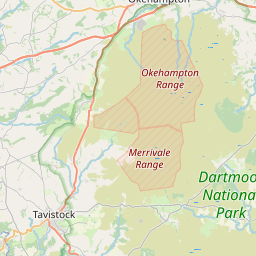
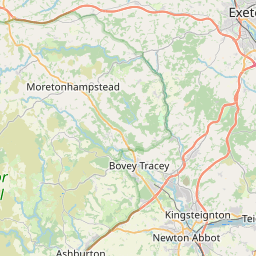
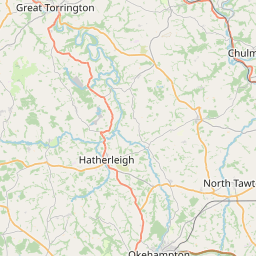
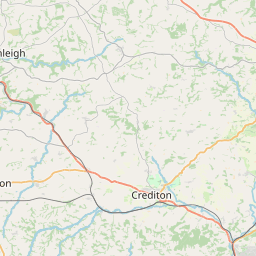
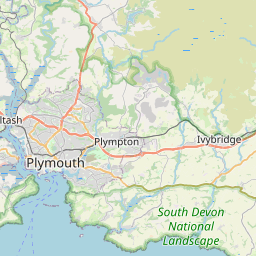
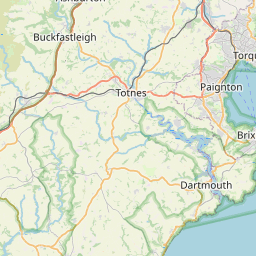
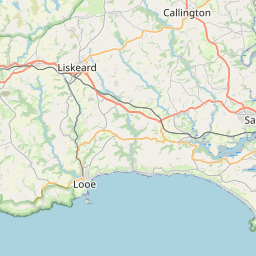
Getting to North Bovey


What to expect
A natural way to spend time here
The landscape setting of North Bovey begins before the village itself. The lanes that approach from the surrounding farmland narrow gradually, the hedgerows rising on both sides until the road feels less like an access route and more like a passage cut through something that would rather close over. The valley deepens as you descend, and the combination of oak canopy, damp stone walls, and the occasional view opening briefly over pasture gives arrival a quality of gradual enclosure rather than sudden destination.
Once on the green, the scale of the place becomes clear. It is a small village by any measure, and its compactness means that the eye settles quickly. The church tower is visible from most angles. The sound of the river is not immediate from the centre, but it is there if you are patient and the traffic noise has dropped off. In summer, wood pigeons work through the oak on the green in a way that is easy to register without consciously registering it, the sound becoming part of the ambient texture of the afternoon.
North Bovey rewards a measured approach rather than an active one. This is not a place where you arrive with a list and work through it. The returns come from staying longer than you planned: a second circuit of the green, a detour through the churchyard, sitting on the bench long enough that the village forgets you are there. The pace at which things reveal themselves here is not fast, and the experience is better for accepting that from the start.
What makes it stand out
What makes North Bovey special
There are a number of villages along the eastern Dartmoor fringe that share something of North Bovey's character: Lustleigh, Manaton, Widecombe to the south and west. What most of them have in common is that their prettiness has been noticed, and the noticing has, to varying degrees, changed them. North Bovey has been noticed too, but it has absorbed the attention without appearing to reorganise itself around it. The village does not feel curated. It feels occupied.
Part of what sustains this is the absence of certain things. There is no car park drawing visitors in on summer weekends, no café with outside seating signalling that the village is ready to receive you, no cluster of information panels explaining what you are looking at. The facilities are minimal by any measure. This is not a shortcoming
it is structural. The lack of visitor infrastructure means that North Bovey remains oriented toward the people who live there rather than toward those who do not, and that orientation is legible in everything from the maintenance of the green to the feel of the pub.
The other particular quality is the church of St John the Baptist, which rewards careful attention in ways that a passing glance will miss. The carved wooden rood screen is the kind of work that is easy to walk past if you are not looking for it, and harder to forget once you have looked properly. In a village of this size, the presence of craftsmanship at that level is notable.
Don't miss
Things to see and do
Walk the River Bovey path south toward Lustleigh and follow it far enough to find where the valley narrows and the light drops through the canopy in bands.
Give the rood screen in St John the Baptist a proper ten minutes, not a glance: move along its length and let the detail of the carving show itself at close range.
Sit on the green under the oak until the village settles back into its own rhythm around you, and notice how little time that takes.
Follow one of the sunken lanes out of the village into the surrounding farmland and look back at the valley from above.
Call in at the Ring of Bells on a weekday afternoon when the bar is quiet and the conversation is local.
Cross the River Bovey at the ford or stepping stones and take the path up the far bank into the mixed woodland, where the tree cover changes and the views open briefly before closing again.
Watch the lychgate frame of St John the Baptist in morning light, when the shadow line moves across the tower and the churchyard is still.
Walks from here
Getting out from North Bovey
The River Bovey offers the clearest and most naturally rewarding walking frame from the village. Heading south, the path follows the valley through mixed oak woodland toward Lustleigh, a route of around four miles that maintains a consistent character throughout: damp underfoot in places, shaded for much of its length, with the river audible and frequently visible to one side. The Lustleigh direction is the more popular of the two, and for good reason
the valley is sustained and the destination worthwhile. Returning via the higher lanes above the valley adds elevation and a different perspective on the landscape.
Heading north, the valley path runs toward Moretonhampstead along similar terrain, though this direction is less frequently walked and the path requires closer attention to the ground. The reward is a greater sense of the valley as working agricultural land rather than purely recreational landscape: fields come down to the woodland edge, the path crosses farm tracks, and the human geography of the place is more legible.
For those wanting higher ground, the lanes and footpaths leading westward from North Bovey eventually reach the open moor above Hayne Down and the Manaton area, where the character of the landscape shifts entirely. This is a longer proposition and requires a map, but it connects the enclosed, wooded country of the village with the open moorland in a way that makes the contrast between the two particularly clear.
Good to know
Before you go
The Ring of Bells is the only source of food and drink in the village and its hours are not always predictable. Checking in advance before a visit centred on lunch or an evening meal is worth the effort. The pub is also the only interior space available to visitors, which means that in cold or wet weather, there is nowhere else to retreat to. Arriving with provisions is wise, particularly for longer walking days.
Lanes in this part of Dartmoor are narrow and used by farm traffic, and the informal parking arrangements near the green are very limited. Arriving on foot from a parked vehicle at Lustleigh or Moretonhampstead and walking in along the valley is a genuinely good option, and avoids the pressure of arriving in a car to find the green full.
Across the seasons: Late autumn is a rewarding time in the North Bovey valley, though it is less frequently mentioned than the spring. By November, the leaf cover has largely gone from the oak canopy and the structure of the woodland becomes visible in a different way: the form of the trees, the gradients of the valley sides, and the movement of the river are all easier to read. The light is lower and the path more obviously wet, but the valley has a quality of openness in this season that the summer months do not offer. Midwinter brings its own version of the valley, quieter and more contracted. The village green, without summer visitors, feels more completely itself. The pub, if open, is the obvious place to be warm, and the walks are shorter by necessity rather than choice. This is a good season for those who want the place without any of the performance that even a small amount of tourist attention can generate. Summer brings green density and warmth to the valley, but also the most visitor traffic. August weekends in particular can change the atmosphere of the green noticeably. The walking is still good, the canopy is full, and the river is lower and clearer, but the sense of arriving somewhere that is not expecting you becomes harder to locate. Those who want North Bovey at its most characteristic should, if possible, time their visit for a weekday in May, September, or October.
Local weather
Practical info
Practical info
There is no formal visitor parking in North Bovey, and the informal spaces near the green are few, unmanaged, and shared with residents going about daily life. Arriving early on a weekday gives the best chance of finding space without inconveniencing anyone. On fine weekends in summer, it is worth considering whether the narrow approach lanes will have absorbed passing traffic before you add to it. If space at the green is taken, backing out of the village and finding a wider verge on the approach road is the practical alternative.
There are no public toilets, no shop, and no food retailer of any kind in North Bovey. The Ring of Bells is the only place in the village where food or drink can be obtained, and its hours are not fixed to a reliable pattern across the week. Arriving with everything you need for the day is sensible, not precautionary. There is no fuel, no cash machine, and no visitor infrastructure of any kind beyond the pub.
The footpaths leading out of North Bovey into the River Bovey valley are generally well-used and not technically demanding, but the terrain becomes softer underfoot as it drops toward the water, particularly after wet weather. Waterproof footwear is advisable on all but the driest summer days. The approach lanes are narrow and occasionally used by farm vehicles at unpredictable hours, so walking to and from any roadside parking requires attentiveness. The valley paths are broadly suitable for most reasonably fit walkers, though pushchairs and wheelchairs will find them impractical beyond the immediate green.
varies
What's on nearby
Events near North Bovey
Join the 3moors Community for path conditions & local tips.
JoinWhy this place matters
North Bovey — in its own right
The landscape that contains North Bovey is doing something unhurried and cumulative that is easy to underestimate. It is not the Dartmoor of the high tors or the wide blanket bog, and it does not ask to be compared to them. This is a valley landscape, enclosed and particular, where the moor's influence is present more in atmosphere than in topography. The granite shows in the walls and the church; the weather comes from the same sky. But the character is shaped by water and tree cover and the long history of agricultural use, and that character is distinct from the open moorland in ways that reward rather than disappoint. What the valley holds, quietly and without emphasis, is a version of the south-western landscape that is older in feel than the moorland itself: the sunken lanes, the enclosed fields, the relationship between settlement and water that has governed where people have lived in this part of Devon for longer than the records properly reach. North Bovey sits within that geography as if it belongs there, because it does.
Explore more
Discover other places, walks, and hidden corners across Dartmoor.