
Bodmin Moor · South Cornwall coast
Polperro
A steep, tightly packed fishing village shaped by smuggling history and narrow lanes.
About
Polperro
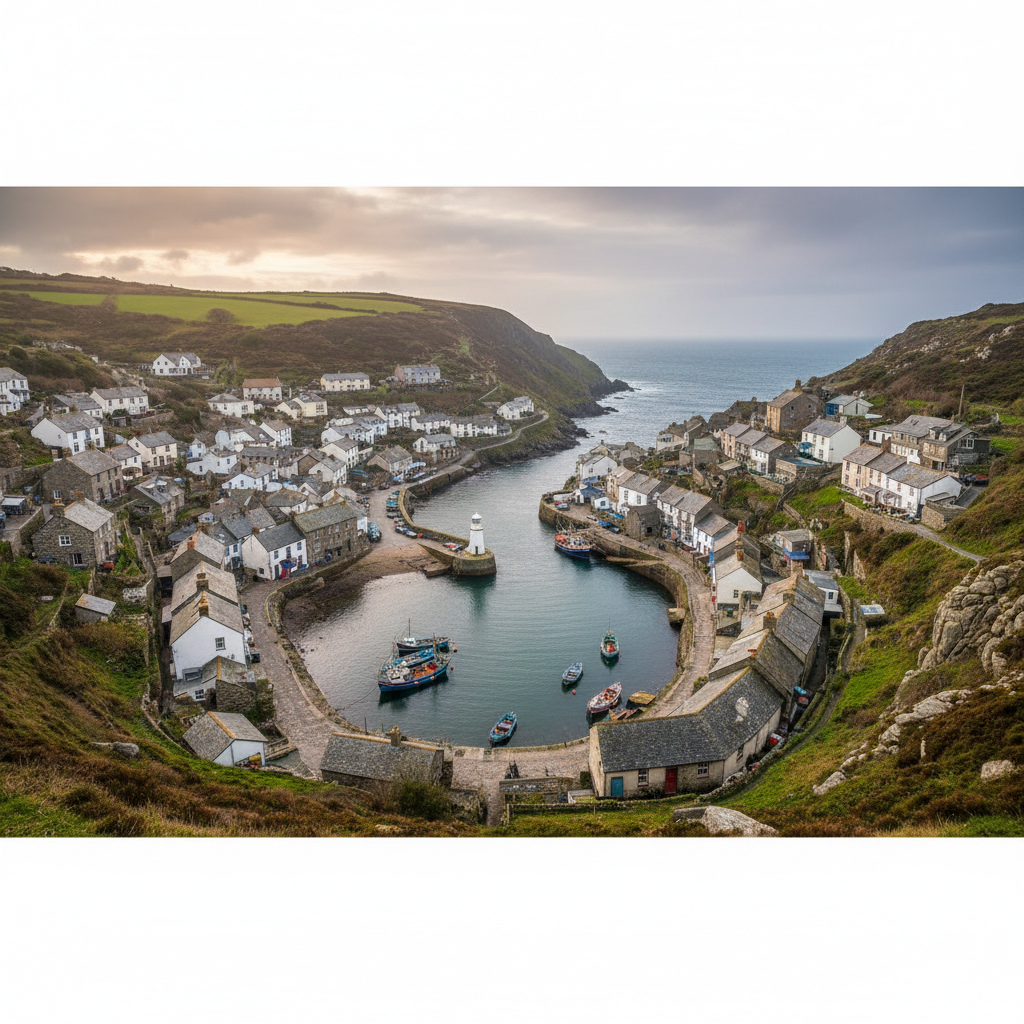
Polperro sits at the foot of a deep, wooded valley where a narrow stream meets the sea, the village compressed into the gap between two headlands as though the landscape itself decided where it should end. It is one of the few places along the south Cornwall coast that has resisted significant expansion, partly because there is nowhere for it to go. The hills close in on three sides, and the harbour occupies most of what flat ground there is. The result is a settlement that feels genuinely contained, shaped by its geography rather than by any planning decision.
That containment produces a particular kind of quietness. Not silence, and not emptiness, but a quality of being held, of sound travelling differently. The stream runs audibly through the centre of the village, footsteps echo off whitewashed walls, and conversations carry further than you expect. Even when the harbour is busy, there are alleys and upper paths where the noise drops away and you are left with the sound of water and the occasional cry of a gull overhead.
People come to Polperro for its harbour, its history, and the dense visual texture of the old fishing quarter. They come because it looks like something from another era, and to some degree it still is. But the quietness that settles over the village outside the main season is its own reward, and it is that quality, rather than any single attraction, that tends to stay with visitors longest.
Character
The feel of Polperro
Polperro is not a village that performs itself for visitors, at least not entirely. There are gift shops and tea rooms, as there are in most Cornish fishing settlements, but the built fabric of the place runs deeper than that. The houses stack up the valley sides in irregular rows, connected by paths too narrow for vehicles, and many of them are still lived in year-round by people with no particular interest in tourism. Washing dries on lines strung between rendered walls. Window boxes are planted and tended. The feel is of a place with a life running parallel to the one on display.
That parallel life is what gives Polperro its community weight. The fishermen who still work out of the harbour, the households that have been here for generations, the local chapel, the village hall, the working boats in the inner harbour alongside the pleasure craft: these are the elements that keep the place from becoming a stage set. It is a community that has been asked to absorb a great deal of visitor attention while remaining itself, and it manages that negotiation with more grace than most.
The social history is woven into the architecture. Smuggling was not a romantic sideline here but an organised and essential part of the local economy for much of the eighteenth and early nineteenth centuries. The cellars, the concealed passages, the connections between properties: many of these were practical infrastructure for moving contraband, and their traces remain in the fabric of the older buildings. The community that built those systems was tight-knit and mutually dependent in ways that shaped how the village thought about itself, and something of that self-reliance is still legible in the way it holds together.
First-hand visit
Keith's Take
Something about the sound of the river running through the middle of the village makes you understand the place before you have seen any of it.
The stream was running higher than usual, and the sound of it filled the lower lane in a way that made conversation difficult. Not a dramatic sound, not a flood, but a persistent and specific rush that bounced off the whitewashed walls and seemed to follow you into doorways. I had been in the village for twenty minutes before I noticed that I was orienting myself by it without thinking, using the sound to locate where I was in the lane network in the same way you might use a church tower in open country.
There was a man untangling rope on the harbour wall with the particular patience of someone for whom this is neither a task nor a performance but simply the next thing to do. He did not look up as people passed. The rope was orange and very long, and he worked from one end towards the other with a rhythm that had no urgency in it. It is a small thing, but it stayed with me longer than the harbour itself, which I had seen in photographs and which matched its photographs closely enough to feel confirmed rather than discovered.
What photographs do not carry is the acoustic quality of the place, the way sound is enclosed and redirected by the valley walls and the close-set buildings, or the specific weight of the air near the harbour mouth, which is salt and something older underneath it. Polperro is worth visiting because it is genuinely still what it was, or close enough. But its quality is not primarily visual, and a camera, useful as it is here, will not take home what the stream sounded like.
Keith's Take — a first-hand account from the 3moors team
Map & Getting Here
Getting to Polperro
What to expect
A natural way to spend time here
Arriving by foot along the coastal path or down through the valley from the car park above, Polperro reveals itself gradually. The lane narrows, the trees close over, and the sound of the stream strengthens before you see it. Then the first cottages appear, and the scale of the place becomes clear: this is not a small settlement that opens out into something larger, but a tight cluster of lanes and passages that stays compressed all the way to the water. Navigation is mostly instinctive, following the stream downhill until it reaches the harbour.
The smell of the inner harbour at low tide is particular and persistent, a mixture of salt water, hull paint, and the kind of biological richness that working harbours carry. It is not unpleasant, but it is specific, and it is one of the things that confirms you are somewhere still functionally connected to the sea rather than simply arranged around it. The colours of the boats and their reflections in the still water of the inner basin are what most photographers come for, and the light in the late afternoon, when the westerly sun reaches the harbour mouth, rewards patience.
The best way to move through Polperro is without a route. The upper paths above the main lane offer different angles on the village and quieter ground, and the paths that rise towards the cliff on either side provide the elevation needed to understand how the settlement sits within its landscape. Take more time than seems necessary. The place is small enough to cover in an hour, but it does not give up its detail quickly.
What makes it stand out
What makes Polperro special
What distinguishes Polperro from other south Cornwall fishing villages is the degree to which it has remained physically unaltered. The core of the settlement, from the bridge over the river to the inner harbour, is essentially unchanged in its layout from the early nineteenth century. The lanes are still too narrow for motor vehicles, a restriction that was not designed for preservation purposes but which has had that effect. Looe, a few miles to the east, has a working town around it. Fowey has expanded significantly up the hillsides. Polperro has not, because it cannot.
The smuggling heritage is also more traceable here than in most comparable places. The village's involvement in the trade was extensive and unusually well-documented, and the physical evidence remains: low doorways, interconnected cellars, the particular layout of properties that allowed goods to move between buildings without appearing on the street. The local museum holds a focused collection of material on this history, and it is one of the few places in Cornwall where that subject is addressed with genuine depth rather than costumed nostalgia.
Don't miss
Things to see and do
Follow the stream from the top of the village down to the harbour mouth, noticing how the lane adjusts around it at each bend.
Stand on the old bridge over the River Pol and watch the tidal movement in the inner basin, which changes the character of the harbour completely depending on the hour.
Visit the Polperro Heritage Museum of Smuggling and Fishing for a measured, locally curated account of the trade that shaped this community.
Walk up to the peak of the headland on the eastern side of the harbour for a view back across the village that makes the valley geography suddenly legible.
Look closely at the older buildings along Talland Street for the low-set doorways and thick walls that speak to a practical history of storage and concealment.
Find one of the upper paths above the lane network and sit for long enough that the sounds of the village separate themselves out: the stream, the boats, the herring gulls, the occasional voice carrying from a kitchen window.
Catch the light on the harbour in the last hour before dusk when the reflections in the inner basin are at their sharpest and the day trippers have largely gone.
Walks from here
Getting out from Polperro
The South West Coast Path passes directly through Polperro, and both directions offer substantial walking from the village centre. Heading west towards Fowey, the path climbs steeply out of the valley and runs along exposed cliff tops with long views back towards Polperro and east towards Looe. The ground is uneven and the gradient significant in the early stages, but the path is well-maintained and the views from the headlands above Talland Bay, reached within thirty minutes of leaving the harbour, are worth the effort.
Eastward, the path follows the cliff edge towards Looe, a linear walk of roughly five miles one way, passing above shingle coves that are accessible by steep steps at several points. The walking is more exposed here than the valley suggests, and wind is a regular feature. Looe makes a reasonable turning point if you are walking with the intention of returning to Polperro rather than arranging transport. For a shorter circuit, the lanes above the village connect with field paths that loop back through the valley above the houses, giving a different and less-visited perspective on the settlement and the wooded clough that contains it.
Good to know
Before you go
The car park above the village is the standard approach for visitors arriving by road, and the walk down into the village from there takes around ten to fifteen minutes. In high summer, that car park fills quickly, and arriving before ten in the morning or after four in the afternoon makes a measurable difference. The horse-drawn vehicle that operates along the main lane in season is a genuine service for those who cannot manage the gradient, but it does not cover the upper paths or the harbour area itself.
The village is genuinely small, and the lanes in the lower quarter are narrow enough that two people with rucksacks will need to pass single file. This is not a limitation to plan around so much as a characteristic to accept. Waterproof footwear is advisable at most times of year, as the lane surfaces near the stream can be slippery after rain and the coastal path above is exposed to whatever weather is moving in from the west.
Across the seasons: Polperro in summer is a different proposition from the village in any other season. July and August bring significant visitor numbers into a space that was not designed to absorb them, and the lanes around the harbour can feel genuinely congested in the middle of the day. The village does not empty completely in the evenings, but the character shifts once the day visitors have left, and late afternoon on a summer weekday is more rewarding than any weekend morning in peak season. The shoulder months, April and May, and again September and October, offer the most settled conditions for a considered visit. The light in October is particular: lower, more directional, and flattering to the rendered walls and the reflections in the harbour. The fishing boats are more likely to be active at this time of year, and the community rhythm of the place is more audible. Winter brings near-solitude to the upper paths and the harbour front, and a different kind of engagement with the village, though some businesses close entirely between November and Easter. Spring arrives noticeably later here than inland. The valley is sheltered but south-facing slopes on the headlands come into early colour, and by late April the coastal path above the village carries enough warmth and growth to feel genuinely seasonal. This is the period when the relationship between the village and its landscape is most apparent, the wooded valley leafing out, the cliff vegetation renewing, and the harbour sitting calm in the longer evenings.
Practical info
Practical info
Polperro has no parking within the village itself, and the narrow approach lane is closed to most private vehicles during the day in the summer months. The main car park is located at Crumplehorn, roughly half a mile uphill from the harbour, from where visitors walk or take a small land train down into the village. This arrangement is well-established and signposted on the approach roads, but it can fill quickly on warm weekends and bank holidays. Arriving before 9am or later in the afternoon gives a better chance of securing a space without a long wait.
The village has a reasonable range of facilities concentrated around the harbour and the main lane leading to it, including cafes, a pub, public toilets, and a small heritage museum. Facilities are more limited outside the core summer season, and some businesses close entirely between October and Easter. There is no large supermarket in the village; the nearest is several miles away. Visitors relying on specific services, particularly accessible toilets or year-round food options, should check ahead.
Polperro sits at the foot of a steep valley and the lanes from the car park to the harbour involve a sustained downhill gradient on uneven, often cobbled surfaces. The same slope must be climbed on the way back, which can be demanding for those with limited mobility or young children in pushchairs. In wet weather the cobblestones and flagstones become slippery, and footwear with a firm grip is advisable. The coastal path sections above the village are narrow and exposed, with loose ground in places.
varies
Join the 3moors Community for path conditions & local tips.
JoinWhy this place matters
Polperro — in its own right
Polperro occupies a narrow place in a demanding landscape, and the landscape has never let it forget that. The hills that funnel visitors down into the village are the same hills that prevented it from becoming something more commercially managed, and the harbour that draws photographers is also a working structure exposed to whatever the channel decides to send in. There is nothing decorative about the geography here. The village sits where it does because the valley offered a landing place and the headlands offered shelter, and those original conditions are still the conditions it lives with. That relationship between settlement and terrain is what the village leaves you thinking about, more than any individual view or historical detail. Polperro is not a large place, and it does not try to appear larger than it is. But the landscape that holds it, the cliffs dropping to the sea on either side, the wooded clough rising behind, the tidal harbour shifting twice daily, gives the village a physical context that very few places of its size can match. You come for the harbour. You leave thinking about the hills.
Explore more
Discover other places, walks, and hidden corners across Bodmin Moor.