
Bodmin Moor · South Cornwall coast
Portwrinkle
A quieter Cornish coastal village with beach access and strong sea views.
About
Portwrinkle
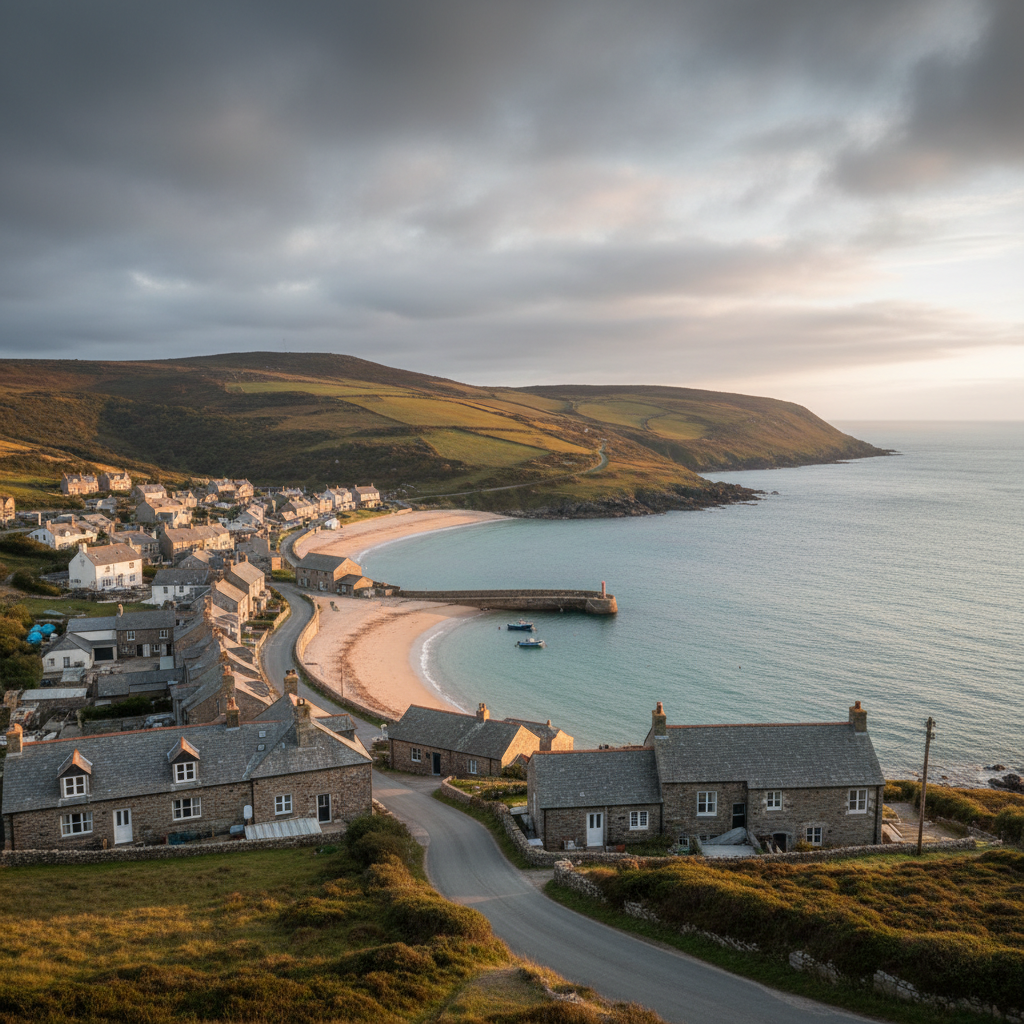
Portwrinkle sits on the Rame Peninsula in south-east Cornwall, tucked along a stretch of coastline that most visitors to the county seem to drive past without stopping. It is a small, quiet place, a handful of houses, a slipway, and a beach that earns its solitude simply by being off the obvious route. The village feels more like somewhere people live than somewhere they come to visit, which is precisely why certain travellers seek it out.
The setting is defined by the cliffs and the sea rather than by anything the village itself provides. The beach at Whitsand Bay extends to the east and west, and on a clear day the views reach across to Plymouth Sound and the distant promontories of Devon. There is a tidal quality to the atmosphere here, not just the water, but the whole place seems to shift with the weather and the season.
People come to Portwrinkle for the walking, the quiet, and the particular kind of Cornish coast that has not yet been smoothed over by tourism infrastructure. There are no amusement arcades, no surf hire shacks, no queue for a car park. What there is instead is a working sense of place, a village that faces the sea on its own terms.
Character
The feel of Portwrinkle
There is a stillness to Portwrinkle that takes a few minutes to settle into. The village does not announce itself. The road narrows, the houses cluster close to the cliff edge, and suddenly the sea is there, wide, unfiltered, and indifferent to the visitor's arrival. It is not unfriendly, exactly, but it is self-contained in the way of small coastal communities that have never depended on passing trade.
The light along this section of the south Cornish coast is particular. In the mornings it comes off the water at a low angle, catching the pale stone of the older buildings and turning the sea a kind of grey-green that is difficult to name. By afternoon on a clear day the colours shift entirely, the bay goes blue, the cliffs warm to a russet and ochre, and Plymouth on the far side of the sound becomes visible as a smudge on the horizon. These are not dramatic revelations
they arrive quietly, the way most things do in Portwrinkle.
First-hand visit
Keith's Take
Portwrinkle is the kind of place you only find because you were looking for it — and then, having found it, you understand why it stays quiet.
I arrived on a weekday in late September when the car park held two other vehicles and the slipway was empty. The sea was a dark grey-blue with a swell running in from the south-west, and the wind carried enough salt to taste on the lip. The village behind me was silent in the way that suggests permanent residence rather than tourism — curtains rather than blank windows, a cat on a wall, someone's washing moving on a line.
The beach at low tide was longer than I had expected — the kind of expanse that makes you recalibrate your sense of how much space there is down here below the cliffs. I walked west for the better part of an hour without meeting another person. The sand was firm and dark near the waterline, looser and paler further up, and the cliff face to my left ran in long diagonals of orange and brown that I had no geological language for but which I found entirely absorbing.
Coming back up to the cliff top in the late afternoon, Plymouth was visible across the Sound in the low light — close enough to seem almost domestic, far enough to feel like another world. That is something Portwrinkle does unexpectedly well: it makes you aware of distances, of the water between things, of how much of what you usually call the horizon is actually just the edge of your attention.
Keith's Take — a first-hand account from the 3moors team
Map & Getting Here
Getting to Portwrinkle
What to expect
A natural way to spend time here
Arriving at Portwrinkle, the first thing most visitors register is how quickly the village ends. There is a car park, small, functional, a slipway running down to the shore, and then the beach itself. The beach here is a mix of sand and shingle depending on the tide, and the quality of the sand changes noticeably between sections. At low tide there is more room to walk
at high tide the sea comes close to the base of the cliffs in places.
The sound is mostly wind and water. On still days the village has an almost suspended quality, the kind of quiet that makes conversation feel slightly too loud. On rougher days the sea dominates entirely, and the spray reaches further up the slipway than seems reasonable. Either way, the sensory experience of being here is largely determined by the weather rather than by anything the village provides.
What makes it stand out
What makes Portwrinkle special
What separates Portwrinkle from the more visited points along this coastline is the absence of the machinery of tourism. Whitsand Bay as a whole is one of the longer beaches in Cornwall, and yet much of it remains genuinely uncrowded, partly because access from the cliff-top road requires a descent that deters some visitors, and partly because the beach sits outside the gravitational pull of any significant resort town. Portwrinkle offers one of the more practical access points to this stretch.
The golf course that occupies the cliff-top land above the village adds an unusual visual note, fairways running to the edge of the cliffs, with the sea as a constant backdrop. It is an odd juxtaposition but a strangely honest one, the kind of detail that feels specific to this corner of Cornwall rather than imported from a coastal postcard. The overall effect is of a place that has accumulated its character slowly, without a great deal of outside interference.
Don't miss
Things to see and do
Walk east or west along the beach at low tide, when the sand is most accessible and the full extent of Whitsand Bay becomes clear.
Descend to the slipway and watch the sea-state change across the course of an hour, the bay shifts noticeably even in moderate winds.
Follow the South West Coast Path along the cliff top for views back over the village and across Plymouth Sound toward Devon.
Look for the golf course boundary where it meets the cliff edge, an unexpectedly striking landscape detail.
At low tide, explore the rock pools at the base of the cliffs toward the western end of the beach.
On clear days, identify the landmarks across the Sound, the breakwater, the Hoe, and the distant outline of Dartmoor on the horizon.
Sit with a flask on the cliff top in the morning before the wind picks up, the light on the water is at its best in the first hour or two after dawn.
Walks from here
Getting out from Portwrinkle
The South West Coast Path passes through the area and provides the most natural basis for a walk from Portwrinkle. Heading west along the cliff top takes you above the length of Whitsand Bay toward Freathy and eventually Rame Head, a walk of some miles that rewards patience with increasingly dramatic cliff scenery and, at Rame Head itself, a medieval chapel on a promontory that is as atmospheric as anything on this coastline. The return can be made along the same path or, if the tide is right, partially along the beach.
Eastward from Portwrinkle the coast path continues toward Downderry and Seaton, with the cliff line less severe and the walking somewhat gentler. This direction suits those who want a longer, more varied route — the path passes through scrub and bracken, with occasional descent to small coves. A circuit combining both directions is not straightforward without retracing steps, so most visitors choose one direction and return the same way, which is not as repetitive as it sounds given how differently the coast looks in changing light.
Good to know
Before you go
Parking is limited and the access road is narrow, arriving early or out of season avoids the stress of meeting oncoming vehicles on a single-track lane. There are no food or drink facilities in the village itself, so bringing supplies is not optional. The beach can be affected by rip currents in certain conditions
the exposed nature of Whitsand Bay means the sea here can be more energetic than it appears from the cliff top.
The cliff path can be slippery in wet weather, and some of the descent routes to the beach are steep enough to require care. Walking boots or sturdy shoes are more useful than trainers on the rougher sections. Mobile signal is unreliable along parts of the coast path.
Across the seasons: Summer brings the greatest number of visitors, but even then Portwrinkle is quieter than most comparable points on the Cornish coast. The beach is most usable between June and September, and the sea temperature, while never warm by Mediterranean standards, is at its most tolerable in late summer. The light in July and August can be hazy rather than crisp, which softens the long-distance views. Spring and early autumn are arguably the better seasons for those who value atmosphere over beach weather. The cliff-top vegetation is at its most alive in April and May, with sea thrift and other coastal flowers adding colour to the paths. In October the light becomes sharper, the crowds thin to almost nothing, and the sea takes on a more serious character. Winter visits are for the committed, the wind can be considerable and some of the paths become muddy, but the solitude is absolute and the views, on clear days, are extraordinary.
Practical info
Practical info
A small car park sits near the seafront and tends to fill quickly on summer weekends, so arriving early in the morning is advisable. Roadside parking in the village lanes is limited and care is needed on narrow bends. Out of season, spaces are generally easier to find. Avoid blocking turning areas near the slipway.
Portwrinkle is a quiet residential village rather than a tourist hub, so facilities are minimal. There is no reliable on-site café or public toilets, and visitors should come prepared with food, water, and anything else they need. The nearest more substantial amenities are likely found in Torpoint or Looe. Check ahead before visiting, as provision can change seasonally.
The village sits on a relatively gentle stretch of the south Cornwall coast, making it broadly accessible on foot once you arrive. Paths down to the beach and along the shoreline are generally manageable but can be slippery when wet or covered in seaweed. The coastal path nearby involves some modest undulation and can be exposed to southerly winds. No specialist navigation is needed, but sensible footwear is recommended year-round.
varies
Join the 3moors Community for path conditions & local tips.
JoinWhy this place matters
Portwrinkle — in its own right
Portwrinkle does not try to make an impression. It sits on its piece of cliff above its stretch of bay and lets the sea do the talking. For visitors accustomed to the more emphatic pleasures of the Cornish coast, this restraint can take a moment to read correctly, but once the pace of the place settles in, it tends to stay with you. What it offers is not a destination so much as a perspective, a quiet point from which to look out at the channel and, if the day is clear, to see Devon on the far side and feel the particular pleasure of being somewhere that most people drove straight past.
Explore more
Discover other places, walks, and hidden corners across Bodmin Moor.