About
Totnes
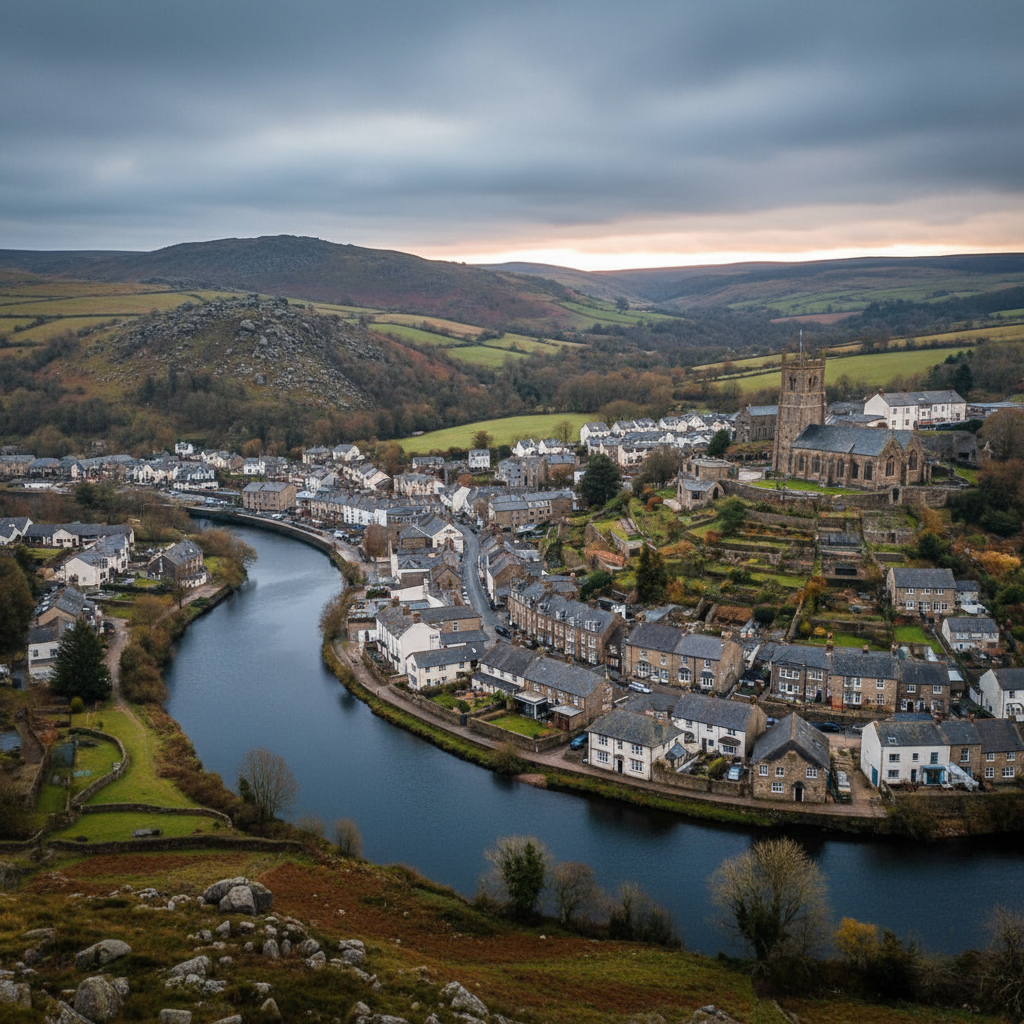
Totnes sits at the tidal limit of the River Dart, where the estuary narrows and the town climbs a steep ridge above the water. It is a place with clear bones: a single main street running uphill from the quay to the castle, flanked by medieval burgage plots that have been built and rebuilt over centuries. The surrounding countryside is soft and green, with deep lanes dropping down to the river and farmland rising towards the southern edge of Dartmoor to the north. It is not a moorland town, but Dartmoor shapes its hinterland, and on clear days the high tors are visible from the upper parts of the town.
The town functions as a working market centre for a wide rural catchment. Farmers, smallholders, and people from outlying villages have been coming here to trade for the best part of a thousand years, and that rhythm has not entirely broken. The weekly Friday market on the high street is not a performance of tradition, it draws genuine local trade alongside the visitors, and the mix of stalls reflects the range of people who depend on this town as a working hub rather than a destination.
In recent decades, Totnes has acquired a strong reputation as a centre for independent culture, progressive food, and alternative living, a reputation that is deserved in part and sometimes overstated. What is more constant, and perhaps more interesting, is the community rhythm that underpins it. The town has organisations, networks, food systems, and civic life that are unusually active for a settlement of its size. People here tend to know each other across different layers of the town's life, and that produces a density of activity that visitors can sense without always being able to name.
The result is a town that rewards slow attention. It is not a picture-postcard settlement preserved for tourism. It is a place that is genuinely in use, with all the untidiness and energy that implies.
Character
The feel of Totnes
Fore Street has a particular texture. The buildings are an accumulation rather than a composition: Tudor timbers alongside Georgian brick, Victorian shop fronts inserted into older structures, a covered arcade that opens without announcement. Nothing quite matches, and the effect is of a town that has been continuously adapted rather than curated. The colour is uneven and the proportions vary from one plot to the next. This is not a street designed to be looked at, but one that has simply kept going.
The local identity here is unusually self-conscious, which is both a strength and an occasional source of tension. Totnes has a clear sense of what it values: independent businesses, local food networks, a scepticism of the generic. The high street has almost no chain shops, which is genuinely remarkable for a town of this size and visitor volume, and it reflects deliberate civic effort as much as good fortune. The independent shops are varied and sometimes eccentric, selling things you would not find elsewhere in the county, and the food offer ranges from long-established cafés to newer places with sourcing policies that reflect the town's wider values.
There is also an older, quieter Totnes that sits alongside the more visible progressive identity. The parish church is large and well-maintained
the grammar school on the hill is one of the oldest in the country
the almshouses off the high street speak of deep-rooted civic tradition. These layers coexist without much friction. The town has enough substance to carry several different identities at once.
First-hand visit
Keith's Take
The town kept giving me reasons to slow down, and I stopped noticing I was doing it.
Halfway up Fore Street, a tabletop of second-hand paperbacks had spilled out onto the pavement from a shop that seemed to extend backwards into the building indefinitely. A woman was reading the back of something and putting it down again. The street narrowed here, and the buildings on either side leaned slightly towards each other in a way that made the sky above seem like a gap rather than an opening. I had not meant to stop.
What emerged as I went further up was a kind of layering. A bakery with a handwritten board. A gap between buildings that turned out to be a passage, and the passage turned out to lead to a courtyard where a man was unloading produce from a van in no particular hurry. The castle motte appeared above the roofline without warning, a steep green mound with the keep at the top, and then disappeared again as the street curved. The town was not revealing itself all at once; it was doing something slower and more particular, offering one thing at a time.
Down at the quay, later, the river was at a middling tide and a heron was standing on the mud opposite, entirely still. A couple were waiting for the ferry with a folded bicycle. The town was up behind me, all its activity compressed into that single ridge, and from here it seemed smaller than it had felt inside it. That compression is part of what Totnes does: it holds more than it appears to from any one vantage point, and the only way to find that out is to keep moving through it.
Keith's Take — a first-hand account from the 3moors team
Map & Getting Here
Getting to Totnes


What to expect
A natural way to spend time here
Moving through Totnes is a matter of gradients. The town rises sharply from the quay, and the act of climbing Fore Street means that the view back over the river appears and changes as you go. Each pause offers a different angle on the water below. Halfway up, the street levels briefly, which is where most of the activity concentrates, and it is easy to spend longer here than planned without having consciously decided to stop.
The lanes off the main street are worth following. Narrow paths cut between the backs of buildings and emerge on unexpected terraces. The smell of cut grass comes from the private gardens that press against the town walls, and in summer the sound of a market stall radio drifts up from the street below. These are the passages that the town reveals slowly, not all at once, and they give it a depth that the main thoroughfare alone would not suggest.
The exploration that Totnes invites is not dramatic. There are no sudden revelations or commanding viewpoints accessible in a short walk that will feel like a destination in themselves. What the town offers instead is a gradual accumulation of small discoveries: a datestone on a wall, a cobbled passage that turns into a view of the castle motte, a bookshop that extends further back than its shopfront implies. This is a place for people who are content to wander without a fixed objective, and who find that kind of attention rewarding.
What makes it stand out
What makes Totnes special
What distinguishes Totnes most sharply from comparable Devon towns is that it has managed to retain a functional local economy alongside its cultural reputation. Ashburton is quieter and more contained. Dartmouth is more obviously picturesque. Totnes is busier, messier, and more genuinely plural. The population includes farmers and artists, retired professionals and people who have lived here for generations without much interest in the town's external reputation. That breadth gives it a resilience that more self-consciously artisan market towns sometimes lack.
The relationship between the town and the river is also particular. The quay at the southern end of town is a working arrival point, still used by the seasonal passenger ferry that connects Totnes to Dartmouth through fifteen miles of river. Sitting at the quay on a quiet morning, the estuary opens out to the south, and the town feels like the last fixed point before the landscape loosens into tidal water and reed bed. That sense of being at a threshold, where the navigable river meets the inland market, is embedded in the town's character in ways that are easy to overlook when you are focused on the high street above.
Don't miss
Things to see and do
Follow Fore Street from the quay to the castle without stopping, then walk it again slowly, this time looking at the building lines rather than the shop windows.
Take the passenger ferry downstream to Dartmouth on a clear morning, and watch the river change character as the banks widen and the town disappears behind the first bend.
Look into the Guildhall, a modest building set back from the street that carries several centuries of civic record in a single small room.
Walk down to the quay at low tide and watch the egrets working the mud at the water's edge.
Browse the covered market arcade off Fore Street, where the stalls vary week to week and the light falls in a particular way through the roof lights at midday.
Find the almshouses in one of the lanes off the main street and stand quietly for a moment: these are not on the main visitor circuit and are often entirely empty.
Climb to the castle keep in the late afternoon when the shadows are long across the rooftops, and take time to look north towards the edge of the moor rather than just down to the river.
Visit on a Friday morning and let the market dictate the pace of the upper street.
Walks from here
Getting out from Totnes
The most immediate walking option is the river path south from the quay, following the Dart downstream along its western bank. The path runs through managed meadows and then into rougher riverside ground, with views back across the water to the woods on the eastern bank. This section is broadly flat and accessible, and can be extended as far as Sharpham, where the river bends sharply and the peninsula of Sharpham vineyards comes into view on the far side. The return is by the same path, which looks quite different in the opposite direction.
Northwards, lanes climb out of the town and into the farmland that forms the transition zone between the South Hams and the southern moor. The footpath network here is well-maintained and allows circular routes of between four and eight miles. The village of Berry Pomeroy lies roughly two miles to the east, reachable by footpath, and the ruined castle on its wooded ridge is a reasonable objective for a half-day walk from the town centre. The path crosses gentle agricultural land before dropping into the heavily wooded valley below the castle.
For those wanting to reach open moorland on foot from Totnes, it is a serious undertaking of ten miles or more to the nearest high ground, and most walkers will choose to drive to a moorland trailhead and walk from there. The town is better thought of as a base for South Hams walking than for moorland access.
Good to know
Before you go
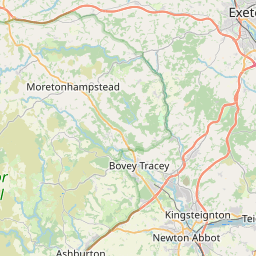
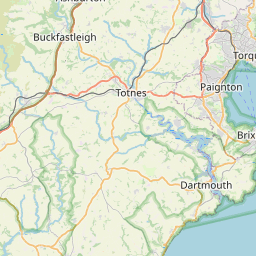
Parking in the town centre is limited and fills quickly on Fridays and at weekends between May and September. The main car park is near the station, which is also served by regular trains on the Riviera Line from Exeter and Plymouth, making Totnes one of the more practical Dartmoor-area towns to reach without a car. The steam railway to Buckfastleigh runs seasonally from the station and is a reasonable half-day option if you have children or simply want an unhurried way to see the river valley.
The town has a good concentration of independent food and drink options, but some of the better cafés and smaller restaurants operate restricted hours or close on Mondays and Tuesdays outside the summer season. It is worth checking ahead if you have a specific place in mind. The Friday market starts early and winds down by early afternoon, so a late morning arrival is a reasonable compromise between missing the stalls and arriving in the thickest part of the crowd.
Across the seasons: The town is quietest in January and February, when the visitor trade drops away and the permanent population is most visible. This is a reasonable time to get a sense of the community rhythm without the seasonal overlay. The market continues through winter, though with fewer stalls, and the cafés and independent shops that make it through to February tend to be the ones with genuine local custom rather than those dependent on passing trade. By late April the energy shifts. The river ferry begins its season, the outdoor spaces around the quay become usable again, and the mix of visitors from the wider South Hams and beyond starts to change the texture of the street. July and August bring significant visitor numbers and parking becomes a genuine inconvenience. The town handles this reasonably well because its streets have enough width and its offer is spread across enough different locations, but the high street on a Saturday in August is not a relaxed experience. Late October is a good time to return. The summer visitors have gone, the light on the river is lower and more amber in the afternoons, and the town settles back into something closer to its working self. The surrounding lanes and hedgerows are in full autumn colour, and the walk to Berry Pomeroy in particular takes on a different quality when the beeches on the castle ridge have turned.
Local weather
Practical info
Practical info
Totnes has several pay-and-display car parks, with the main town centre options located near the station and off Coronation Road. Spaces fill quickly on Friday market mornings and throughout summer weekends, so an early arrival is advisable. On-street parking in the town centre is limited and subject to restrictions. Drivers unfamiliar with the town should expect to walk a few minutes uphill from the car parks to reach the high street.
The town is well served for a place of its size, with public toilets available near the town centre, a good range of independent cafés and food shops along Fore Street, and a pharmacy. As a working market town rather than a visitor attraction, facilities are oriented towards everyday use rather than tourism infrastructure. There are no visitor centre facilities as such, though the local shops and businesses are generally accustomed to answering questions from those new to the town.
Totnes is built on a ridge and its main street rises steeply from the riverside up towards the castle, which means some gradients are unavoidable. The high street itself is paved and manageable in most conditions, but side streets and the path up to the castle can be uneven underfoot and slippery when wet. Flat, comfortable footwear is sensible for a full day of exploring. Visitors with limited mobility should be aware that the steeper upper sections of the town may present difficulty.
varies
What's on nearby
Events near Totnes
Join the 3moors Community for path conditions & local tips.
JoinWhy this place matters
Totnes — in its own right
Totnes does not ask to be admired from a distance. It is a town you have to move through, and through more than once, before it gives up much of what makes it genuinely interesting. The exploration it invites is patient and lateral rather than dramatic: a different lane each time, a conversation with a stallholder that opens into unexpected knowledge of the town's history, a return visit on a day when the light is different and the street reads differently as a result. There is something worth noting in the fact that a small Devon town has managed to sustain the density of independent life that Totnes has, without becoming either a museum piece or a boutique destination for a narrow demographic. It is imperfect and uneven and sometimes too aware of its own reputation. But it is alive in the way that matters most: people come here because they need to, as well as because they want to, and that distinction is what holds a town together over time.
Explore more
Discover other places, walks, and hidden corners across Dartmoor.