Bodmin Moor · North Cornwall coast
Trebarwith Strand
A dramatic tidal beach framed by cliffs and coastal walking country.
About
Trebarwith Strand
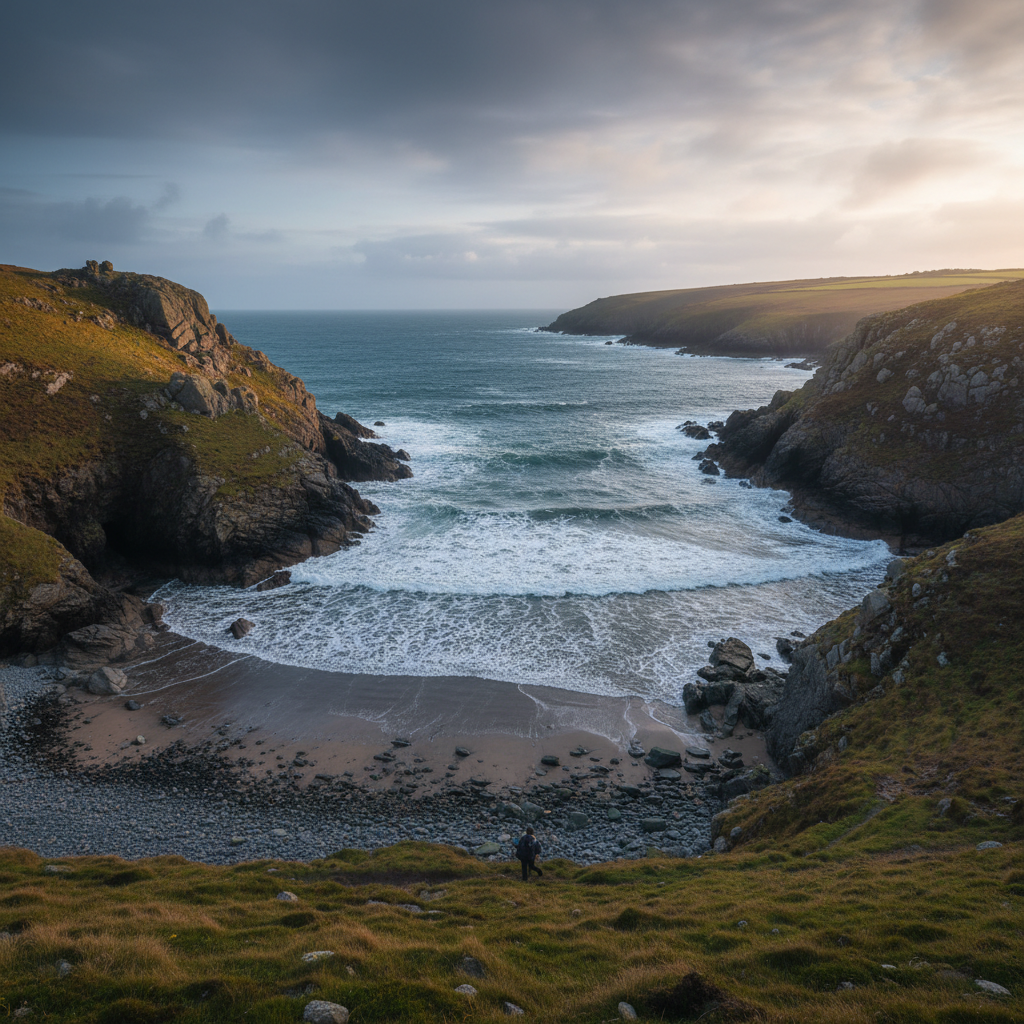
Trebarwith Strand sits on the north Cornwall coast between Tintagel and Port Isaac, tucked into a narrow valley where a small stream meets the sea. It is the kind of beach that rewards those who make the effort to find it, the lane down is steep and the car park sits well above the shore, so arrival feels earned rather than incidental. At low tide, a broad expanse of sand opens up flanked by dark slate cliffs, making it one of the more photogenic stretches of coastline in this part of Cornwall.
The beach draws a mixed crowd: surfers who appreciate its Atlantic swell, walkers connecting sections of the South West Coast Path, and people who simply want a beach that hasn't been entirely smoothed over by accessibility and convenience. The village itself is modest — a pub, a seasonal café, a scattering of cottages, and that modesty is part of what preserves the character of the place. There's no amusement arcade, no beach hire kiosk in high summer bustle
what you get is the coast more or less on its own terms.
What most visitors don't fully anticipate is how dramatically tidal Trebarwith is. At high tide, the beach can disappear almost entirely, leaving the cliffs rising straight from the water. This isn't a place to set up a windbreak for the afternoon without checking the tide tables. The rhythm of the tides defines the experience here more than at many busier Cornish beaches, and that rhythm is worth respecting.
Character
The feel of Trebarwith Strand
Trebarwith Strand has a quality that's increasingly rare on the Cornish coast: it feels genuinely unsettled. The cliffs are not decorative backdrops
they press in close, and the sound of waves echoing off dark slate gives the cove an acoustically as well as visually enclosed feeling. Even on a calm day there's a faint sense that the sea here is operating on its own agenda, independent of anyone's holiday plans.
The human layer is thin. The Port William pub at the head of the beach is a landmark rather than a hub, busy enough in summer, but it doesn't overwhelm the place. The valley behind the beach is narrow and green, carrying that characteristic Cornish combination of lush hedgerow and exposed headland in uncomfortable proximity. You are simultaneously sheltered and exposed, which is part of what makes Trebarwith feel so particular.
There is a melancholy to the place that's not unwelcome. The old slate quarry workings visible in places along the cliffs, the occasional ruins, the way the coast path runs close to the cliff edge — all of it points to a landscape that has been worked and worn rather than preserved in amber. It's a working coastline in the deeper historical sense, even if the work now done here is mostly the work of weather on rock.
First-hand visit
Keith's Take
Standing at the tide line at Trebarwith, watching the beach narrow behind you as the Atlantic reclaims it, you get a clear sense of who's actually in charge here.
I came down the lane on a Tuesday in October, the hedgerows already turning and the sky doing that specifically north Cornish thing of being simultaneously overcast and luminous. The car park was almost empty. Below, the beach was maybe two-thirds of the way to low tide, enough sand to walk, enough water to remind you it wasn't really your territory.
The sound hit first, before I'd properly rounded the last bend in the path: that full, low, resonant roar of Atlantic swell meeting a confined space. Not aggressive, exactly, just insistent. The kind of sound that makes conversation feel like an interruption. I walked out to the wet sand and stood there for longer than I'd planned, watching a set of waves come through with that particular slow inevitability that open-ocean swell has, each one arriving as though it had been travelling a long time to get here, which of course it had.
The cliffs on both sides were doing what dark slate does in overcast light, absorbing rather than reflecting, making the pale sky above them look almost theatrical by contrast. There were two other people on the beach, far enough away to be shapes rather than individuals. A dog was investigating the rock pool margin at the base of the southern cliff. Everything felt appropriately scaled, the beach big enough to lose yourself in, small enough to hold in a single gaze. I took a photograph that won't do it justice. They rarely do, here.
Keith's Take — a first-hand account from the 3moors team
Map & Getting Here
Getting to Trebarwith Strand
What to expect
A natural way to spend time here
The drive down, or walk down, if you've parked at the top, sets the tone. The lane is single-track and steep, with high hedgerows pressing in on either side. When the beach finally comes into view it arrives as a small revelation: the sea framed by cliff faces, the sand (if the tide is right) stretching out in a broad arc below you. The scale of it surprises people, because nothing about the approach suggests the openness that waits at the bottom.
On the beach itself, the dominant sensory experience is sound. The Atlantic doesn't arrive quietly at Trebarwith. Even on days when the swell is modest, there's a persistent low roar that fills the cove and makes conversation at normal volume something of an effort near the waterline. The wind tends to funnel through the valley behind, which can make it feel colder than expected even in summer, a layer you didn't plan to need often turns out to be necessary.
At high tide, particularly in winter or during Atlantic storms, the character of the place shifts completely. The beach is gone, the sea fills the cove, and the waves break directly against the cliff base. It's dramatic in a way that demands respect rather than proximity. The coast path above offers a safer vantage point from which to watch conditions that, from sea level, would be genuinely dangerous.
What makes it stand out
What makes Trebarwith Strand special
What sets Trebarwith apart from other north Cornwall beaches isn't the sand itself, though it's good sand, but the specific geometry of the place. The cove is narrow enough to feel enclosed but opens to full Atlantic exposure, meaning the wave energy that arrives here is not diluted by headlands or shoals in the way it might be further around the coast. The swell hits with purpose. For surfers, that's a selling point
for anyone simply watching the sea, it's hypnotic.
The slate cliffs are genuinely distinctive. Unlike the softer sandstone formations further east or the granite of the far west, the dark Devonian slate here is layered and fractured in almost architectural formations, tilted at steep angles by ancient geological forces. At low tide, these rock platforms extend outward from the cliff base and reward careful exploration, rock pools of some depth and variety occupy the more sheltered corners.
It's also honest in a way that matters. Trebarwith hasn't been heavily curated for visitors. The lane is too narrow, the parking too limited, the tides too demanding for the place to absorb truly large numbers. That limitation is, paradoxically, the thing that keeps it worth visiting.
Don't miss
Things to see and do
Walk the South West Coast Path north toward Tintagel for cliff-top views back over the cove and access to some of the most dramatic coastal scenery in north Cornwall.
Explore the rock pools along the slate platform at low tide, they hold anemones, small crabs, and occasional blennies in the deeper sections.
Surf the beach break, which works best on a mid to larger Atlantic swell from a westerly or north-westerly direction — a board hire or lesson is worth considering if you're not already experienced.
Watch the tide come in from the coast path above, the speed at which Trebarwith disappears under water is genuinely striking and worth witnessing at least once.
Visit in the hour before sunset when the low light catches the wet sand and slate faces at their most photogenic.
Look for the remnants of old slate quarry workings on the cliff faces above the southern end of the beach.
Walk south toward Port Isaac along the coast path, which offers a quieter route than the road and passes through some excellent clifftop walking.
Sit at the Port William pub terrace with a drink and watch the sea, on a clear evening the light over the water is excellent.
Walks from here
Getting out from Trebarwith Strand
The most natural circuit from Trebarwith Strand follows the South West Coast Path in both directions before returning inland through the valley. Heading north, the path climbs steeply from the beach and runs along the cliff edge toward Treknow and then Tintagel, a walk of roughly three to four miles one way that passes through some of the most atmospherically charged coastal scenery on the north Cornish coast. The headlands here are broad and exposed, with views north toward Boscastle and south toward Trevose Head on a clear day. Tintagel, with its castle ruins, makes an obvious turning point and adds historical interest to what is already a visually strong walk.
Heading south, the coast path toward Port Gaverne and Port Isaac is gentler and less visited, winding along cliff tops that feel genuinely remote despite being within easy reach of the car park. Port Isaac is around four miles by the coast path and offers food, drink, and a very different kind of Cornish coastal experience before the return. The return leg can follow the path back or, for variation, cut inland through the lanes via Delabole, a longer but quieter alternative.
For a shorter outing, the valley walk immediately behind the beach is easy and pleasant, the stream that runs down to the beach is bordered by vegetation that's surprisingly lush given the surrounding coastal exposure, and the contrast between the open beach and the sheltered valley floor is part of what makes Trebarwith feel geographically compressed in an interesting way.
Good to know
Before you go
Tide times are not optional reading at Trebarwith. Check before you go and plan your beach time around low tide, the difference between a broad sandy beach and an impassable cove can be a matter of an hour or two. There are tide tables available online for the north Cornwall coast and it's worth bookmarking one. The car park is small and fills quickly in summer
arriving before 10am or after 4pm avoids the worst of the congestion. The lane down is genuinely narrow and reversing on it is unpleasant, go slowly.
Bring a windproof layer regardless of the forecast. The north Cornwall coast generates its own microclimate and the temperature at beach level can feel significantly colder than conditions inland suggest. Dogs are permitted on the beach subject to seasonal restrictions, check current rules before bringing them in summer months. The beach is not lifeguarded, which is relevant if you're surfing or swimming
the currents here can be unpredictable and the swell energy is real.
Across the seasons: Trebarwith in winter is a different proposition from its summer self, and in many respects a more rewarding one. The beach is quiet, the light is low and dramatic, and the Atlantic arrives with a seriousness that feels entirely appropriate to the setting. Storm watching from the coast path above is genuinely spectacular, the waves here can reach considerable heights during major Atlantic lows. This is the season when the geological and topographical character of the place is most legible, unobscured by windbreaks and picnic blankets. Spring and autumn occupy a middle ground that suits walkers and photographers well. The crowds thin noticeably after the school summer holidays end, while the weather remains workable for coast path walking. Autumn swells make for good surf conditions and the light through September and October can be exceptional, long, angled, and warm-toned in a way that summer's higher sun doesn't quite achieve. Summer brings the usual north Cornwall complications: the car park fills early, the lane becomes a pinch point, and the beach on a hot August weekend loses some of its atmosphere to inflatable beach toys and competing speakers. That said, even in peak season the tidal rhythm imposes a natural order, when the tide comes in, the crowds disperse, and the place recovers something of itself. Go early, go late, and know the tides.
Practical info
Practical info
There is a small pay-and-display car park near the beach, which fills quickly on summer weekends and bank holidays, arriving early is strongly advisable. The lane down to Trebarwith Strand is narrow and steep, with limited passing places, so larger vehicles should take particular care. Parking outside the designated area is not recommended given the tight road layout and the risk of obstructing coastal access routes.
A pub and a café operate near the beach and are well-regarded, though seasonal opening hours mean they may not always be available outside summer months, it's worth checking ahead. Public toilets are present in the vicinity of the car park area. Facilities are limited beyond this, so carrying supplies is sensible if visiting outside peak season.
The path down to the beach involves a noticeable descent and can be slippery when wet, particularly after rain or at low tide when seaweed covers rocks near the waterline. Trebarwith is a strongly tidal beach, at high tide the sand disappears almost entirely, and access to certain areas of the shoreline becomes impossible or dangerous. The surrounding cliffs and coast path are exposed to Atlantic weather, and conditions can shift quickly; wind and sea spray are common even on ostensibly calm days. Sturdy footwear is recommended over trainers, especially if exploring beyond the beach itself.
varies
Join the 3moors Community for path conditions & local tips.
JoinWhy this place matters
Trebarwith Strand — in its own right
Trebarwith Strand is the kind of place that makes a stronger impression than its modest infrastructure might suggest. It doesn't offer much in the way of facilities, and the sea here is not gentle, but that's precisely the point. The coast asserts itself clearly, and visitors who come expecting something managed and comfortable tend to recalibrate quickly. What it leaves you with, typically, is a recalibrated sense of scale. The cliffs, the tide, the swell, they're all operating at a register that has nothing to do with the human visit. The beach doesn't care whether you're having a good time. That indifference, experienced alongside the particular beauty of the slate and sand and water, is what people tend to remember.
Explore more
Discover other places, walks, and hidden corners across Bodmin Moor.