
Exmoor · Central Exmoor
Withypool
A small Exmoor village beside the River Barle and open moorland beyond.
About
Withypool
Withypool sits in a shallow fold of central Exmoor, where the River Barle curves through a valley of oak and rush and the lanes narrow to a point where two vehicles must negotiate passage with patience. It is not a place you pass through by accident. The roads that lead here come from other Exmoor roads, and there is no obvious reason to arrive unless you already know what you are looking for. That quality of deliberate arrival gives the village something that more accessible places on the moor have slowly lost.
The village itself is compact without feeling cramped. A handful of stone cottages, a village hall, a post office that keeps its own hours, and the Royal Oak Inn arranged around a small green that doubles as a gathering point and a turning circle. The church of St Andrew stands a little apart, its tower visible across the meadow before the village proper comes into view. Nothing here has been dressed up for visitors, and the sense that Withypool exists primarily for the people who live and work in it is one of its most legible qualities.
Local character runs through this place in a way that is hard to quantify but easy to feel. The farmers who stop outside the pub, the working dogs in the backs of Land Rovers, the conversations that continue across the lane without anyone moving to let you past. There is a community here that predates tourism and will outlast it, and the village carries that self-sufficiency lightly, without hostility. Visitors are welcome in the way that guests are welcome, rather than in the way that customers are welcomed.
People come to Withypool for the river, for the moorland walks that begin on the edge of the green, and for the particular kind of quiet that comes from being genuinely away from anything busy. It is a base as much as a destination, and many who stay nearby return to the village each morning as a starting point rather than treating it as a thing to be seen and ticked off.
Character
The feel of Withypool
The Royal Oak is the social centre of Withypool in a way that has not changed much in living memory. It is a proper Exmoor pub: low ceilings, open fire in the colder months, and a bar that serves both the walking visitor and the local farmer with the same lack of theatre. Evenings here have a rhythm that feels unrehearsed. The village does not perform itself for newcomers, and that absence of performance is precisely what gives it its atmosphere.
What is notable about Withypool across the course of a year is how visibly it changes. Spring comes late at this altitude, and when the bracken begins to green on the higher ground around the village, there is a collective sense of the moor waking up after a long withdrawal. Summer brings walkers and a modest increase in traffic on the lanes, but the village absorbs this without transforming. By October, when the valley oaks go copper and the Barle runs fuller after the autumn rains, the place settles back into something more interior, the days shortening quickly and the evenings drawing people back to the pub or indoors. Seasonal rhythm is not a romantic notion here but a practical reality, shaping when work gets done, when gates go up, when the ground becomes passable again.
The church of St Andrew rewards a quiet visit. Its interior is modest and time-worn, with the kind of accumulated small detail (a worn flagstone here, a faded memorial there) that takes years to accumulate and cannot be reproduced. The churchyard looks across open ground towards the valley, and the view from the gate is one of the more considered moments the village offers, though it is not signposted as such.
Map & Getting Here
Getting to Withypool
What to expect
A natural way to spend time here
The village takes about five minutes to walk end to end, and the first orientation is instinctive rather than planned. The green, the pub, the bridge, the church: these are the four fixed points and they all fall within sight of each other. There is no map required and no decision to make about where to start. The proportions are human in a way that feels deliberate, though of course they are simply old.
Down by the Barle, where the path drops to the water's edge below the bridge, the sound changes. The lane noise drops away and the river takes over, a continuous low murmur that adjusts with the flow. After rain, when the water is up, it becomes something more insistent. On a still morning in late summer, when the water is low and clear, the sound is almost imperceptible and the valley feels unusually contained. This is the kind of detail that earns attention only if you stop moving.
Withypool rewards a patient pace above most things. Those who walk through quickly, note the pub and move on, will have seen the place but not experienced it. Arriving with enough time to walk the river, sit somewhere outside the pub for half an hour, and then take the lane up towards the moor before coming back: that is a morning well spent here, and it tends to be the visit that people remember rather than the one built around a longer itinerary.
What makes it stand out
What makes Withypool special
What distinguishes Withypool from other Exmoor villages of similar size is the immediacy of the open moor. From the green, within a few minutes on foot, the lane gives way to open ground and the village disappears behind a rise. There is no long approach through enclosed farmland, no graduated transition from settlement to landscape. The moor begins abruptly, and the village sits right at its edge in a way that feels unmediated. This is unusual even on Exmoor, where many villages are buffered by fields and hedgerows before the open ground begins.
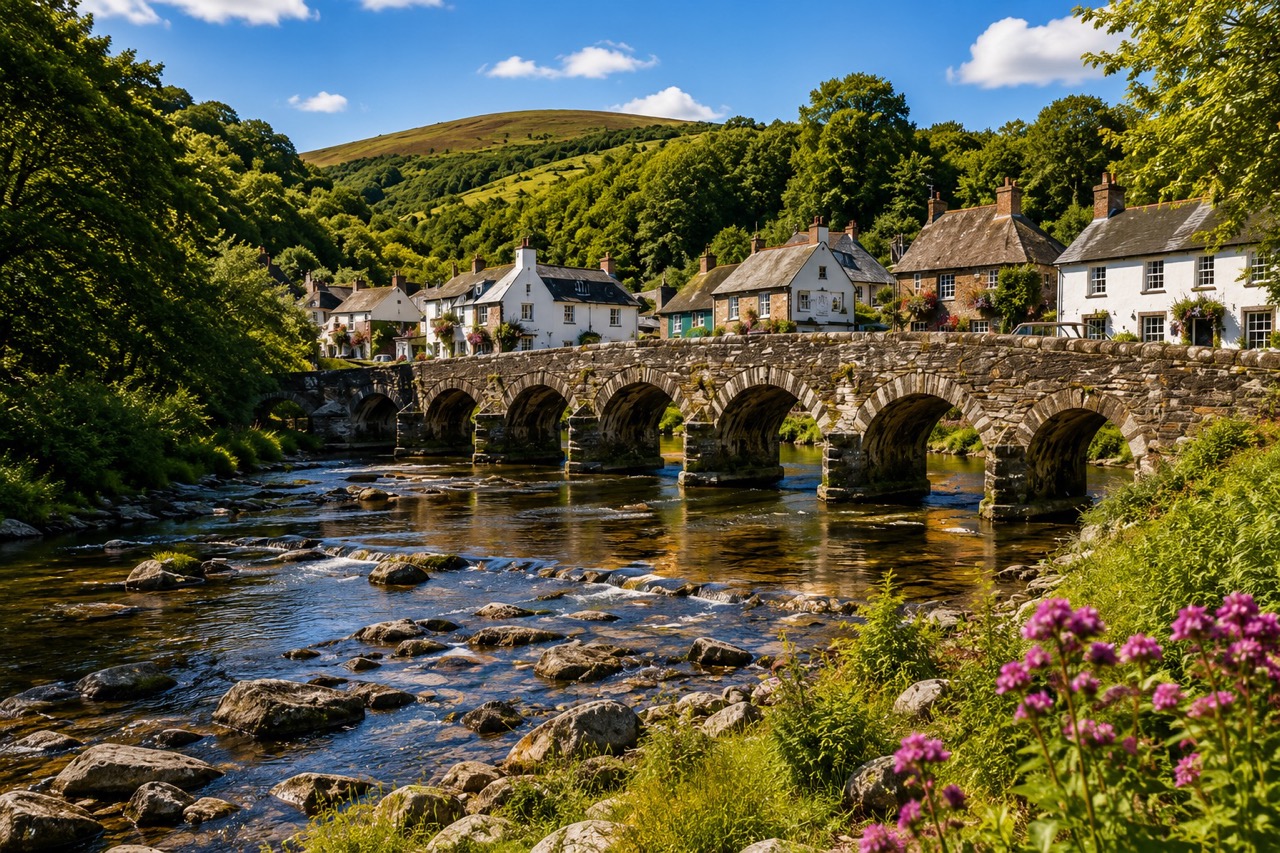
The River Barle is the other quality that sets Withypool apart. The river here is still relatively young in its course, running clear over stones and forming pools deep enough to hold trout. The bridge at the centre of the village is a practical crossing and also, in a quiet way, the best viewpoint in the place. Standing on it at any time of year, there is almost always something to observe: wagtails working the shallows, the colour of the water changing with the light, the line of the valley unfolding downstream through woodland. The combination of river access and open moorland within easy walking distance of a single fixed point is rare, and it is what makes this particular village more than the sum of its modest parts.
Don't miss
Things to see and do
Cross the old bridge and watch the river for ten minutes before doing anything else.
Follow the Barle downstream on the Two Moors Way towards Tarr Steps, as far as time allows.
Walk up onto the high ground north of the village in the early morning, before the valley comes fully awake.
Look for dippers working the stony shallows just below the bridge.
Step into St Andrew's church for the quiet of the interior and the view back across the valley from the churchyard gate.
Have a meal at the Royal Oak in the evening rather than at midday, when the pub settles into its own character.
Take the lane west out of the village until the hedgerows end and the moor opens on both sides, then stop and look back at the valley.
Walks from here
Getting out from Withypool
The most natural walk from Withypool follows the River Barle south along the Two Moors Way towards Tarr Steps, one of the finest medieval clapper bridges in the south-west. The path runs close to the water for much of its length, through mixed oak woodland and open riverside meadow, with the gradient gentle enough to suit most walkers. The distance to Tarr Steps is roughly four miles one way, making it a half-day excursion if you turn back from the bridge rather than arranging transport from the other end.
In the other direction, the land rises quickly to open moorland north and east of the village. A circular walk taking in Withypool Hill gives good views across the Barle valley and, on clear days, towards the higher ground around Dunkery Beacon. The terrain on the tops is rougher underfoot than the river path, with areas of wet ground in all but the driest summers, and navigation becomes more demanding in poor visibility. The walk is nonetheless achievable in two to three hours and returns naturally to the village via field paths and quiet lanes.
For those wanting something shorter, the lane west out of Withypool leads quickly to open moorland and provides a straightforward out-and-back with expansive views for relatively little effort. The transition from enclosed lane to open ground happens within ten minutes of leaving the green, which makes it a useful option when time or energy is limited.
Good to know
Before you go
The Royal Oak operates as both pub and accommodation, but its kitchen hours are not always extensive, so it is worth checking ahead if you are planning to eat there, particularly in the quieter winter months. The post office, which also serves as a basic provisions shop, keeps limited hours and is closed on certain weekdays. Neither of these things is a problem if you arrive prepared, but arriving on a Sunday afternoon expecting facilities is likely to disappoint.
The lanes into Withypool, particularly from the north and east, are genuinely narrow and require care in a larger vehicle. After heavy rain, the low-lying ground near the river can become very wet, and the riverside path demands appropriate footwear at all times of year. The village has no phone signal to speak of on most networks, which is worth knowing if you are navigating by mobile device.
Across the seasons: Winter in Withypool is quiet in a way that goes beyond the absence of visitors. The valley holds mist for long periods from November onwards, and the village can feel entirely cut off from the surrounding moor in poor visibility. The pub comes into its own in these months, and a midwinter evening there, with the fire lit and the darkness complete outside, is one of the more genuinely Exmoor experiences available in a settled place. The river runs high and fast after sustained rain, and the sound of it carries further than in summer. Spring is gradual and then sudden. The valley below the village greens up before the high ground does, and there is a period in April when the riverbanks are vivid with new growth while the tops remain brown and exposed. This contrast is particular to villages that sit at the junction of river valley and open moor, and Withypool makes it especially legible. Late April and May are excellent for birdlife along the Barle. Summer brings the most visitors, though numbers remain modest compared to coastal Exmoor. The river is at its most accessible in July and August, and the walking conditions on the moor are at their most forgiving. Late October, when the oak canopy in the valley turns and the bracken on the higher ground goes the colour of old rust, is arguably the most photogenic period, though the days are short and the weather becomes less predictable. Those who know Withypool tend to return in autumn for precisely that combination of light and colour.
Practical info
Practical info
Parking in Withypool is limited and largely informal. There is a small area near the village green where cars can be left, but it fills quickly on warmer weekends and during school holidays. There are no designated car parks or pay-and-display facilities. Arrive early, particularly if visiting between May and September, and be mindful not to block field gates or passing places on the narrow lanes.
Withypool has a pub (the Royal Oak Inn) which has historically served food and drink, though opening hours vary by season and it is worth checking ahead before relying on it. There is no dedicated visitor centre, no public toilets that can be guaranteed year-round, and no café or shop. Visitors should arrive self-sufficient, particularly for water and snacks if planning walks.
The village itself is on relatively level ground and easy to walk around, but the surrounding lanes and moorland paths can become muddy and slippery after rain. The River Barle valley has some uneven ground along its banks. Waterproof footwear is advisable for anything beyond the village centre, and waterproof layers are sensible at any time of year given Exmoor's tendency for sudden weather changes. The roads leading into Withypool are narrow and steep in places.
varies
Join the 3moors Community for path conditions & local tips.
JoinWhy this place matters
Withypool — in its own right
There is something in the way Withypool goes about its business that stays with you after you leave. The working farm at the edge of the village, the dogs in the yard, the grazed fields running up to the moor boundary: these are not decorative elements of a rural scene but the actual functioning of a place that has organised itself around land and livestock for a very long time. Rural life here is not a heritage feature. It is simply what is happening. That continuity is, in the end, what the village offers that a more curated destination cannot. The rhythm of the year, the relationship between the settlement and the land around it, the sense that the moor imposes its own conditions on what is possible here: all of this accumulates quietly over the course of a visit and tends to leave you with something that is difficult to describe in terms of sights seen or miles walked. Withypool is the kind of place you understand better on the second visit than the first, and better still on the third.