Bodmin Moor · West Cornwall
Zennor
A remote-feeling Cornish village tied to wild coastlines and old legends.
About
Zennor
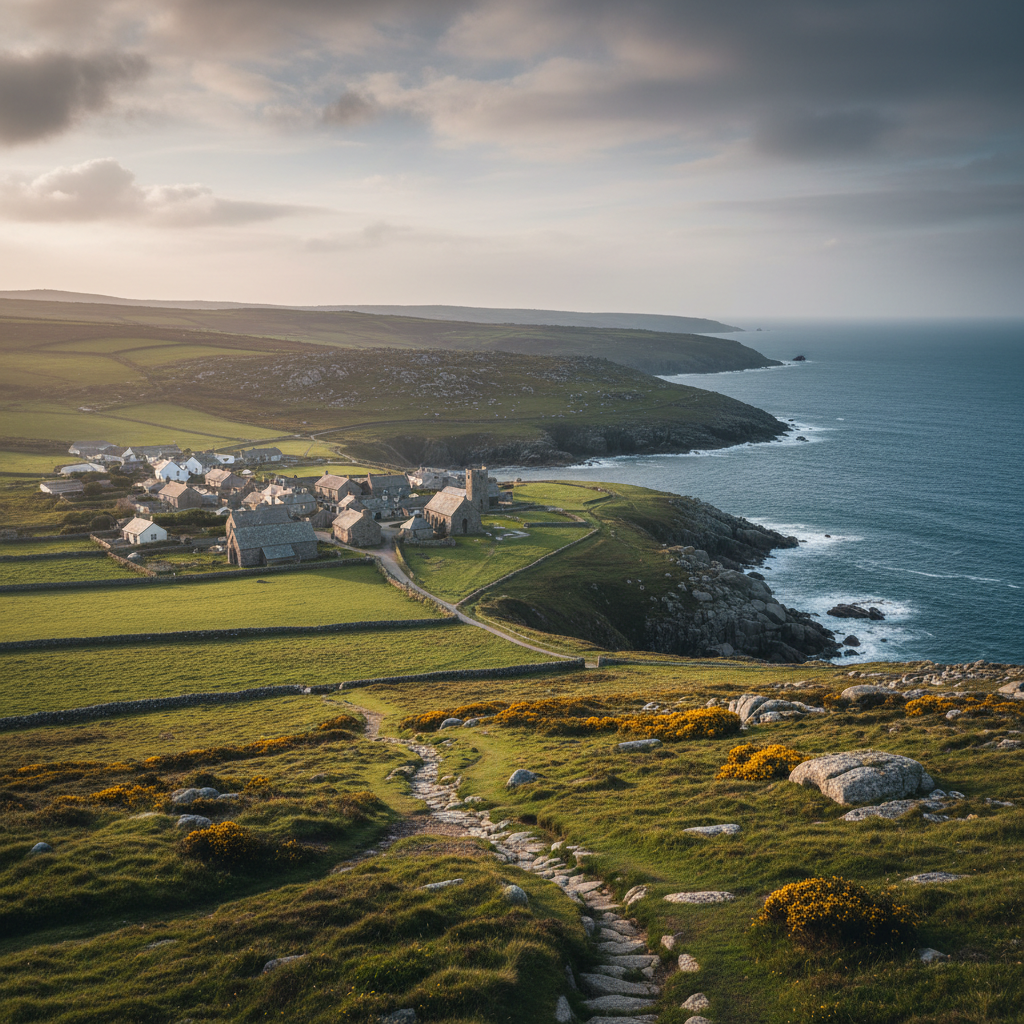
Zennor sits on the far western edge of Cornwall, tucked into a shallow combe between granite moorland and the Atlantic. It is not a place you pass through by accident. The road narrows as you approach, the hedges close in, and by the time the church tower comes into view you have the distinct sense of having arrived somewhere that exists on its own terms. The village is small — a cluster of stone buildings, a pub, a church, and not much else — and that smallness is part of what draws people here.
Most visitors come for one of three things: the coast path, the folklore, or simply the atmosphere. The coastal stretch between Zennor and St Ives to the east is among the most demanding and rewarding in Cornwall, a relentless sequence of headlands, coves, and ancient cliff workings. To the west, the path pushes on toward Pendeen and the old mining country around Geevor. In either direction, the walking is serious and the scenery is exceptional.
The folklore is anchored to the church of St Senara, where a carved bench end depicting a mermaid has given rise to a local legend about a sea creature who lured a chorister named Mathey Trewella to his watery fate. It is the kind of story that fits the place perfectly — half-beautiful, half-threatening, rooted in the idea that this coast does not belong entirely to human beings.
Zennor also serves as a loose gateway to the moorland interior of the Penwith peninsula, a landscape of ancient field systems, logan stones, and standing stones that stretches eastward toward the spine of West Cornwall. Walking inland from the village takes you into a countryside that feels genuinely old in ways that are difficult to explain but easy to feel.
Character
The feel of Zennor
There is a quality of endurance about Zennor that sets it apart from many Cornish villages. The granite here is not decorative — it is structural, foundational, the material from which everything is made and against which everything weathers. The walls are thick, the window openings small, and the whole settlement has the look of something that has been holding its ground against the elements for a very long time. Wind is a constant presence, even on calm days
you hear it in the grass around the churchyard and feel it shift the air as you walk the lanes.
The atmosphere is contemplative rather than festive. There are no amusement arcades, no cream tea emporia jostling for trade, no signs urging you to visit something. The Tinners Arms is a proper pub with the feel of a room that has been in use for centuries, and it functions as the social centre of the village without making any great effort to attract outsiders. You are welcome, but the place is not performing for you. That distinction matters more than it might sound.
Literary association adds a further layer. D. H. Lawrence lived near Zennor during the First World War, drawn — as others have been since — by the sense of being at the edge of something, geographically and imaginatively. The peninsula has always attracted people who want to think more clearly or feel more intensely, and whatever it is about the light and the silence and the weight of the sea that encourages that, it has not diminished.
First-hand visit
Keith's Take
Zennor rewards visitors who arrive with patience rather than a checklist — this is a place that gives itself up slowly, in the quality of its light and the weight of its silence.
I arrived mid-morning on a day in late October when the sea was the colour of pewter and the gorse on the cliff top was just beginning to thin after its autumn flush. The car park was empty except for a mud-spattered van that looked like it had been there since the previous evening. Walking up toward the church, the only sound was wind in the churchyard elms and, beneath it, the faint and continuous breath of the Atlantic.
The mermaid carving is smaller than you expect. It sits in its pew end with the quiet authority of something that has been looked at for five hundred years and is not particularly interested in being admired. The church itself feels used rather than preserved — hymn books stacked in a pew, a notice about the heating fund, a vase of slightly tired flowers on the altar. It is a working parish church that happens to contain a medieval treasure, and the ordinariness of the context makes the carving more affecting, not less.
On the coast path above the village, looking west toward Gurnard's Head with the sea a long way below and nothing between me and America, I had the distinct sensation — familiar from certain other places on the Penwith coast — of being at the edge of the world as it was understood for most of human history. Zennor does not manufacture that feeling. It simply has not done anything to get in its way.
Keith's Take — a first-hand account from the 3moors team
Map & Getting Here
Getting to Zennor
What to expect
A natural way to spend time here
The village itself takes perhaps ten minutes to walk around in its entirety, and first-time visitors sometimes feel a flicker of surprise at how little there is — in the built sense. A car park at the edge of the village absorbs most arrivals. The church is almost always unlocked and rewards a quiet few minutes inside. The pub is generally open for food and drink at standard hours, though it is worth checking ahead in winter. Beyond that, Zennor offers landscape rather than amenities, and visitors who come expecting the former leave satisfied
those who come expecting the latter may be puzzled.
The soundscape is worth paying attention to. On most days you can hear the sea from the higher ground above the village, a low continuous presence beneath the wind and the occasional distant crow. Walking any of the paths out of the village quickly takes you into a world of granite and gorse and open sky where the human sounds fall away almost entirely. The light in West Cornwall has a particular quality — flatter and more diffuse than the south coast, frequently silver rather than gold — and it gives the landscape a slightly monochrome beauty that photographs less easily than it impresses in person.
What makes it stand out
What makes Zennor special
What separates Zennor from other small Cornish coastal villages is the way the moorland and the sea press in from both sides simultaneously. You are not simply in a coastal village with a hinterland
you are in a place where two kinds of wild landscape meet and overlap, and neither one softens for the other. The cliff-top heath runs almost unbroken from the village edge to the sea, and the moorland to the north and east carries ancient field boundaries that predate Roman occupation. This layering of geological and human time is palpable in a way that is unusual even by Cornish standards.
The mermaid carving in St Senara's church is genuinely worth seeing — not because it is spectacular, but because it is modest and specific and unexpectedly moving. It dates to around the fifteenth or sixteenth century and sits in a pew end in the south aisle. The legend attached to it is better known than the carving itself, but standing in the quiet of the church with the stone walls thick around you, the story feels less like tourist mythology and more like an honest attempt to make sense of a coast that has taken people without warning or explanation.
The access road into Zennor is also, in a minor but real way, part of the experience. The B3306 between St Ives and St Just is one of the finest moorland coastal roads in the south-west, running along the high ground with sea views opening and closing as the road dips and rises. Arriving by this road, rather than by the more direct routes, gives you a proper sense of where Zennor sits in the landscape before you ever reach the village.
Don't miss
Things to see and do
Visit St Senara's Church to see the carved mermaid bench end in the south aisle — the centrepiece of the village's most enduring legend.
Walk the coast path east toward Zennor Head and beyond toward Gurnard's Head for some of the finest headland scenery in West Cornwall.
Walk west along the coast path toward Pendeen and the Geevor Tin Mine area for a harder, wilder stretch with abandoned mine workings above the cliffs.
Explore the moorland field systems northeast of the village — ancient enclosures with stone walls that predate most recorded history.
Stop at the Wayside Museum, a small but surprisingly absorbing collection of local artefacts covering the working life of the parish over centuries.
Drink at the Tinners Arms, one of the more genuinely characterful village pubs in Cornwall, with limited pretension and real atmosphere.
Look for the Zennor Quoit — a Neolithic chambered tomb on the moorland above the village, reachable on foot in around twenty to thirty minutes.
Walks from here
Getting out from Zennor
The most obvious walk from Zennor is the coast path east to Zennor Head, continuing if energy allows to Gurnard's Head — a distinctive promontory that juts into the Atlantic and offers 270-degree sea views. This stretch involves some serious ascent and descent over rough terrain and takes most walkers two to three hours return. A longer variation continues to the Gurnard's Head Hotel, which makes a reasonable turnaround point with the prospect of food or drink before the return leg.
Walking west along the coast path toward Pendeen is a harder proposition — the path is less maintained in places and the terrain is more demanding — but it passes through remarkable country above old cliff-face mine workings and offers a very different character to the eastern route. This section is better suited to experienced walkers in good conditions and is best planned as a point-to-point rather than a circuit.
The inland alternative is worth considering even if the coast is the main draw. A moorland loop taking in the Zennor Quoit and the higher ground to the northeast can be completed in under two hours and gives a completely different perspective on the peninsula — quieter, more ancient-feeling, with wide views back toward the sea and eastward across the Penwith moors. Navigation is straightforward on clear days but paths can be faint
a map is advisable.
Good to know
Before you go
Parking is available in the village car park, which is small and can fill quickly in summer, particularly at weekends. Arriving early — before ten in the morning — almost always secures a space and gives you the village in its quieter state. The access road from St Ives via the B3306 is narrow in places and single-track sections require careful driving
larger vehicles should approach with caution. There is no petrol station in Zennor and mobile signal can be unreliable on the coast path and moorland above the village.
Coast path walking here requires proper footwear — trainers are technically possible in dry conditions but the terrain is rough and the consequences of a turned ankle are more serious when you are a mile or more from the nearest road. Cliff edges in this area are unfenced and the ground can be unstable near the tops
keeping a sensible distance from the edge is advisable, particularly in wind. The Tinners Arms is the only food and drink option in the village itself, so if it is closed or full, the nearest alternatives are back along the B3306 toward St Ives.
Across the seasons: Summer brings real crowds to the coast path between St Ives and Zennor — day walkers, families, and wild swimmers drawn to the coves accessible from the cliff path. The village car park fills before midday on busy weekends, and the pub can be stretched at lunchtime. Despite this, the headlands absorb visitors surprisingly well and it is rarely difficult to find solitude a mile or so from the village. The sea in July and August can be calm enough for swimming in the coves, though access involves steep descents and the water remains cold by most standards. Spring and autumn are arguably the finest seasons here. The gorse is in bloom from late winter into May, turning the cliff tops and moorland a vivid yellow; later, heather adds purple to the palette. Migrating birds use the headlands as a landfall point in autumn, making this period of interest to birdwatchers. Light at both ends of the day is exceptional in these months, particularly in October when the low sun throws long shadows across the granite. Winter Zennor is almost deserted and is worth experiencing if you are prepared for it. The pub tends to operate reduced hours, and the coast path can be wet, exposed, and demanding in strong south-westerly weather. But the atmosphere on a clear January morning, with the sea a deep iron blue and the moorland frost-silvered, is unlike anything the village offers in summer. Come in winter knowing what you are getting into, and it will likely be memorable for the right reasons.
Practical info
Practical info
There is a small car park in Zennor village, but it fills quickly in summer and space is genuinely limited — arriving early or out of season is strongly advisable. The lanes leading into the village are narrow and passing places are scarce, so reversing distances can be considerable. Roadside parking is very restricted and should not be relied upon. If the main car park is full, it is better to turn back than risk blocking a working farm track.
Zennor has the Tinner's Arms pub, which serves food and is one of the few reliable sources of refreshment in the village. The church of St Senara is generally accessible during daylight hours. There are no public toilets that can be counted on, and no shop or café as such — come prepared. Facilities are sparse by design; this is a working village, not a visitor hub.
The village itself sits on reasonably level ground, but the coast path accessed from here involves steep, rocky descents and climbs with uneven footing throughout. Coastal exposure means wind and low cloud can arrive quickly even in summer, and the path west towards Gurnard's Head in particular demands careful footing on wet granite. Navigation on the open headlands requires some attention, especially in poor visibility. Stout footwear is essential rather than optional.
varies
Join the 3moors Community for path conditions & local tips.
JoinWhy this place matters
Zennor — in its own right
Zennor does not try to be anything other than what it is, and that quality is increasingly rare. The mermaid in the church, the granite in the walls, the wind off the Atlantic — these things have been here longer than the tourism industry and will outlast it. Visiting Zennor is a reminder that some places hold their character not despite their remoteness but because of it. What it leaves you with, more than any specific sight or walk, is a sense of proportion — of how small human arrangements are against the scale of the cliff, the sea, and the moor. That is not a comfortable feeling exactly, but it is a useful one, and Zennor delivers it with a frankness that more accessible places rarely manage.
Explore more
Discover other places, walks, and hidden corners across Bodmin Moor.