The encounter
The adder is Britain’s only venomous snake and an important but often misunderstood part of moorland ecology. It favours sun-warmed banks, rough grass, bracken edges, heath and mosaics of cover and open ground, where it can bask safely and slip away quickly if disturbed.
Quick ID — at a glance
ReptileSize
Britain's only venomous snake. Adults typically 50–65 cm long, occasionally reaching 80 cm. Females tend to be slightly larger and browner; males smaller and more strongly patterned.
Look for
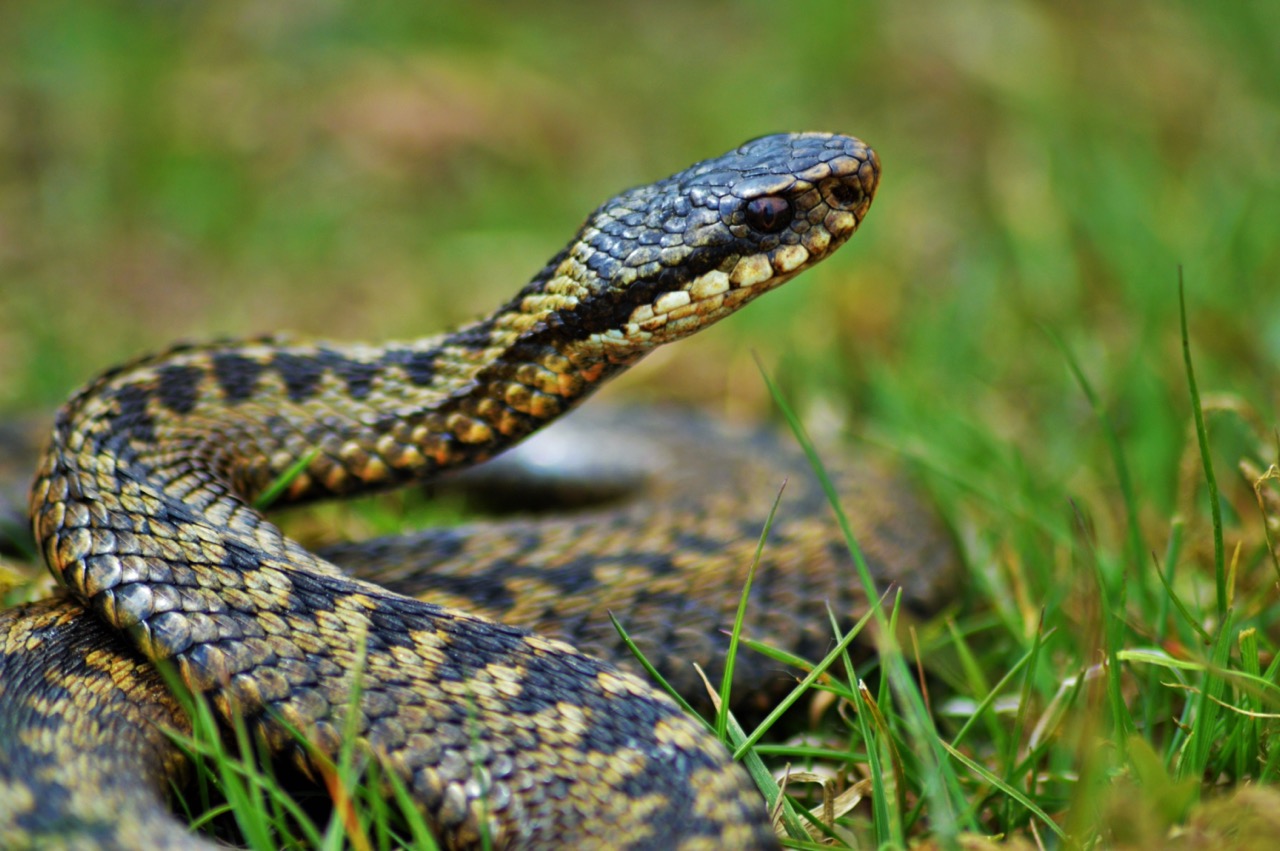
A compact, heavy-bodied snake with a distinctive dark zigzag stripe running the full length of the back. A V- or X-shaped marking on the head. The eye has a vertical, cat-like pupil. Moves slowly when cool; deceptively fast when warm.
Colour & shape
Males are grey or silver with a bold black zigzag. Females are brown or reddish-brown with a dark brown zigzag. Melanistic (all-black) individuals occur occasionally and can cause confusion. The belly is pale grey or yellowish.
Sound / call
Silent. Will hiss quietly if cornered or threatened.
Best time of day
Morning
Best months
Spring is often the best time because adders bask more openly after winter, while very hot midsummer weather can make them harder to find.
Your spotting mission
Visit south-facing slopes and moorland edges on a calm, sunny morning between March and May — adders bask to warm up early in the day and are easiest to spot before temperatures rise. Walk slowly along the edges of paths, bracken beds and heathery banks, scanning low to the ground. Stay on the path: adders rarely bite unless handled or stood on. Keep dogs on a lead in known adder habitat during spring.
Identification guide
How to identify a Adder
Male vs female
Males are often pale grey or silvery with a strong black zigzag marking along the back. Females are usually warmer brown or copper-toned, with a darker brown zigzag, and are often slightly larger.
Juveniles
Young adders look like smaller versions of adults, already showing the characteristic zigzag pattern. They are fully venomous from birth, so should be treated with the same respect as adults.
Colour variation
Adder colour varies more than many people expect. Some are grey, brown, reddish or very dark. Occasionally, almost black individuals occur, which can make the zigzag pattern harder to see.
Where to see them on the moors
Adder across Dartmoor, Exmoor and Bodmin Moor
Dartmoor is one of the adder's strongholds in the south-west. They are found across much of the moor but favour the bracken and heather slopes of the lower moorland margins rather than the exposed high plateau. Haytor Down, Holne Chase, Shaugh Moor and the Plym valley are all well-known localities. Most reliably seen on warm mornings in March and April.
Adders are present across Exmoor, particularly on heathery slopes and woodland edges. The coastal heathland and valley sides hold good populations. Spring mornings on the Brendon Hills or above Porlock are productive. The species is common but easily overlooked when temperatures rise and cover is dense.
Adders occur on Bodmin Moor, especially on the rougher heathland and bracken slopes. They are present but less frequently encountered than on Dartmoor. The edges of the moor where heathland meets farmland offer the best basking habitat.
Find walks where you might spot one
Browse moorland walks that pass through habitat favoured by this species.
Browse walksHabitat & Landscape
Where adders thrive
On Dartmoor, Exmoor and Bodmin Moor, adders favour rough grassland, heather, bracken edges, sunny banks, stone edges and mosaics of open ground mixed with cover.
They are especially associated with south-facing slopes and sheltered edges where sunlight reaches the ground early in the day. Old quarry edges, abandoned railway embankments, moorland fringes and quiet heathland can all provide suitable habitat.
Good adder habitat usually combines places to bask safely, nearby cover to escape into, and undisturbed ground with prey such as small mammals and lizards.
Best time to see them
When to look for Adder
Mar, Apr, May, Jun, Sep
Best time of day: Morning
Best conditions: Sunny but not excessively hot weather, with sheltered banks and light wind
Morning is often best, when snakes use sheltered sunny spots to warm up before moving off.
Through the seasons
Spring
Peak season
Mar · Apr · May
Summer
Active Jun
Jun · Jul · Aug
Autumn
Active Sep
Sep · Oct · Nov
Winter
Not typically present
Dec · Jan · Feb
Behaviour & life through the year
How the Adder lives
Adders emerge from hibernation in early spring, often becoming visible on sunny mornings as they bask to warm their bodies after the colder months. Spring is usually the easiest time to spot them because vegetation is still low and snakes spend longer exposed to sunlight.
During warmer summer periods they become more secretive, often retreating into bracken, heather edges, rough grass or shaded banks during the hottest part of the day. Activity often increases again in early autumn before winter hibernation begins.
Adders are not aggressive animals. Most encounters happen because a snake has been surprised while basking or moving quietly through vegetation.
Safety & Respect
What to do if you see one
The adder is Britain’s only venomous snake, but bites are rare and usually happen only when a snake is handled, cornered or accidentally stepped on.
If you see an adder, keep a respectful distance, never try to touch or move it, keep dogs under close control, and stay on visible paths where possible. Most adders will quietly slip away once aware of people nearby.
If a bite does occur, remain calm, keep movement limited and seek medical advice immediately. Do not attempt old “snake bite” treatments such as cutting or sucking the wound.
Photography
Photographing adders
Early spring mornings offer the best opportunities for respectful adder photography, particularly when snakes are basking quietly after cooler nights.
Use a longer lens and avoid approaching closely. Adders should never be disturbed, repositioned or handled for photographs.
Good images often come from low morning light, heather-edge habitat, natural basking positions, and wider environmental compositions showing the surrounding moorland.
Photography ethics
Folklore & Cultural History
In local legend
The Adder in moorland tradition
Snakes have long appeared in British folklore as symbols of fear, mystery and healing. On the moors, adders were once surrounded by superstition, with stories linking them to bad luck, curses and lonely places avoided by local people.
In some rural traditions, carrying an adder stone or using old snake-related charms was believed to offer protection from illness or misfortune.
Today, the adder remains one of the most misunderstood animals on the moors — feared far more often than it is encountered.
Conservation
Conservation status
Adders are protected under UK wildlife legislation, and populations in some parts of Britain are believed to be declining.
Habitat loss, disturbance, road mortality and persecution all affect local populations. Because adders rely on connected patches of suitable habitat, fragmentation can make survival more difficult.
Healthy moorland, rough grassland and quiet heath edges remain important for their long-term survival.
Population trend
Community sightings
Have you spotted one?
Seen one of these on Dartmoor, Exmoor or Bodmin Moor?
Tell the 3moors community where and when you saw it.
Recent sightings
Buckfast Abbey
Seen on a walk to Yes tor
Printable field notes
A reference sheet for this species — identification, best months, habitat and spotting tips.
Often seen alongside · Similar species
Further reading
Authoritative resources
External links open in a new tab. 3moors is not responsible for third-party content.
Join the 3moors Community for path conditions & local tips.
Join