
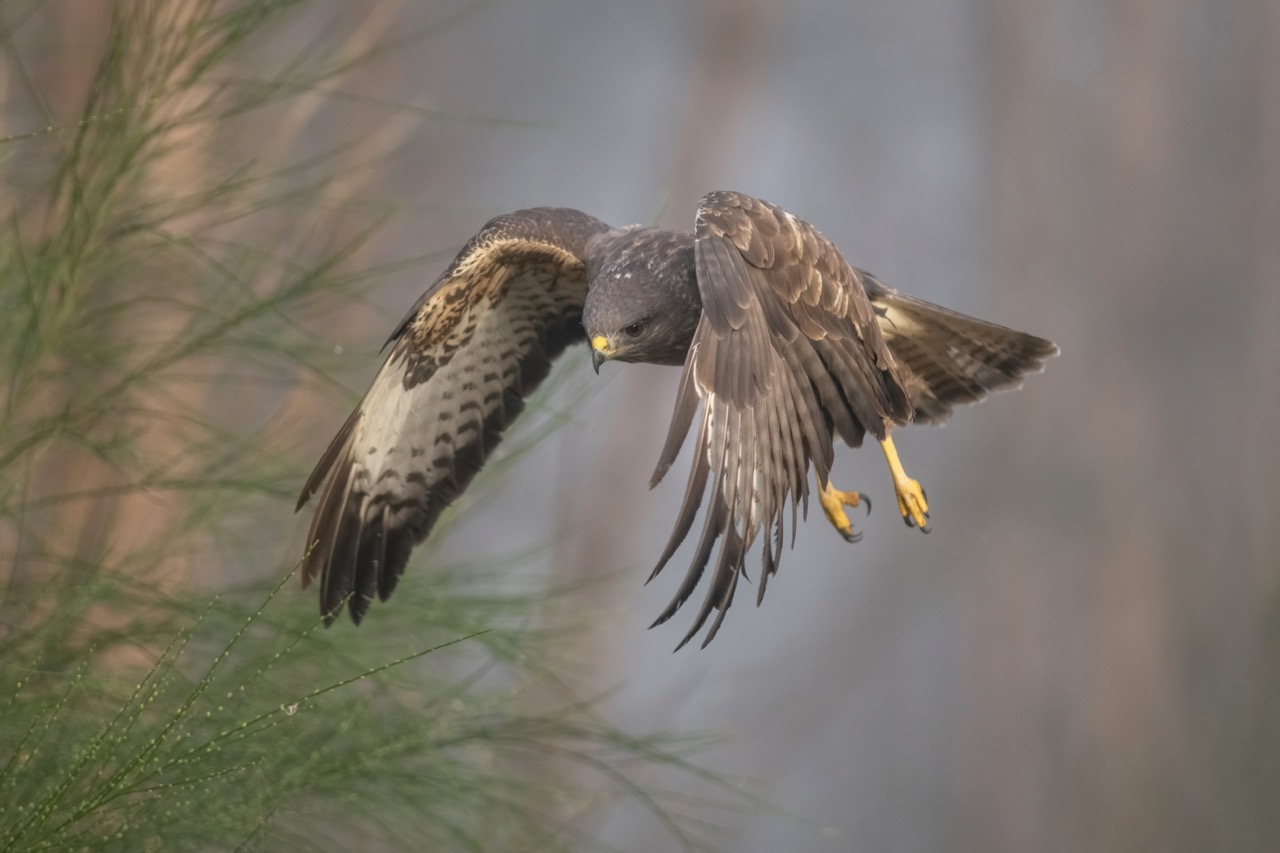
The encounter
The buzzard is now one of the most familiar birds of prey across the moors. You’ll often see one circling slowly overhead or perched on a fence post or lone tree, watching the ground below. Once rare, they are now a constant presence, and for many walkers, spotting a buzzard has become part of the rhythm of being out on the moor.
Quick ID — at a glance
BirdSize
Larger than a crow, smaller than an eagle. Roughly 50–57 cm body length with a wingspan of 110–130 cm.
Look for
Broad, rounded wings with upswept tips when soaring. A short, fanned tail and a pale belly with a darker chest band. Often holds wings in a shallow 'V' (dihedral) when gliding.
Colour & shape
Variable — typically brown above with a pale cream underside crossed by a dark carpal bar. Some individuals are very dark all over; others almost white below. The cere and feet are yellow.
Sound / call
A loud, carrying 'pee-uu' mewing call — almost like a cat — often given repeatedly in flight. Frequently heard before the bird is seen.
Where to look
Buzzards are widespread across Dartmoor, Exmoor and Bodmin Moor. Look above open moorland, farmland edges and valleys, especially where woodland meets open ground. They are often seen circling on thermals or perched on posts, trees and rocky outcrops.
Likelihood
Easy — one of the most commonly seen birds of prey on the moors.
Best time of day
Late morning to afternoon
Best months
Buzzards can be seen throughout the year, though spring often brings more aerial activity and calling.
Your spotting mission
Head to open moorland on a calm, bright morning and scan the sky above valley sides and woodland edges. Buzzards are most active in the first two hours after dawn. Look for a broad-winged silhouette riding a thermal — they often circle slowly without flapping for minutes at a time. Listen too: the mewing call carries far across the moor and will usually locate one before you see it.
Identification guide
How to identify a Common Buzzard
A medium-to-large bird of prey with broad wings and a relatively short tail. Colour varies widely from pale to very dark, but most have a mottled brown appearance. In flight, look for the wide, rounded wings held in a shallow ‘V’ and a slow, soaring style rather than rapid flapping.
Confused with
Red kites (which have longer, forked tails and more graceful, buoyant flight) and sometimes large crows at a distance. Buzzards are bulkier, with broader wings and slower, heavier movement.
Where to see them on the moors
Common Buzzard across Dartmoor, Exmoor and Bodmin Moor
The buzzard is Dartmoor's most commonly seen large raptor. It is present year-round across all areas of the moor, with the highest densities along the eastern valleys — particularly around Haytor, Hound Tor and the Bovey valley woodland. Look up from almost any moorland car park on a fine morning and you will likely see one within minutes.
Common and widespread across Exmoor, particularly in the wooded combes and farmland fringes. The valley systems around Dulverton, Horner and Winsford Hill are productive spots. Numbers are strong year-round, and breeding pairs are regularly recorded in the National Park.
Well established on Bodmin Moor, often seen soaring above the granite tors and moorland edges. Brown Willy and Rough Tor are reliable viewpoints. Less concentrated than Dartmoor but a consistent presence, especially in the more sheltered western valleys.
Find walks where you might spot one
Browse moorland walks that pass through habitat favoured by this species.
Browse walksBest time to see them
When to look for Common Buzzard
All year round
Best time of day: Late morning to afternoon
Best conditions: Bright days with some warmth and light wind. Buzzards make use of thermals, so still, sunny conditions are ideal for seeing them circling high overhead.
Late morning to afternoon is often best, when rising warm air (thermals) helps them soar effortlessly.
Through the seasons
Spring
Peak season
Mar · Apr · May
Summer
Peak season
Jun · Jul · Aug
Autumn
Peak season
Sep · Oct · Nov
Winter
Peak season
Dec · Jan · Feb
Spring is a good time to see display behaviour, with birds circling and calling more frequently. In winter, they are often seen perched, conserving energy.
Behaviour & life through the year
How the Common Buzzard lives
Buzzards spend much of their time soaring on thermals, circling high above the ground. They will also perch for long periods, scanning for prey. Pairs may be seen together, especially in spring, often calling as they circle.
Sound & call
A distinctive, drawn-out ‘mewing’ call, often compared to a cat. It’s frequently heard drifting across valleys, even when the bird itself is hard to see.
Through the seasons
Spring is a good time to see display behaviour, with birds circling and calling more frequently. In winter, they are often seen perched, conserving energy.
Safety & Respect
What to do if you see one
Observe from a distance and avoid disturbing perched birds, especially near nesting sites in woodland edges.
Conservation
Conservation status
Community sightings
Have you spotted one?
Seen one of these on Dartmoor, Exmoor or Bodmin Moor?
Tell the 3moors community where and when you saw it.
Recent sightings
No sightings recorded yet — be the first!
Printable field notes
A reference sheet for this species — identification, best months, habitat and spotting tips.
Often seen alongside · Similar species
Further reading
Authoritative resources
External links open in a new tab. 3moors is not responsible for third-party content.
Join the 3moors Community for path conditions & local tips.
Join