
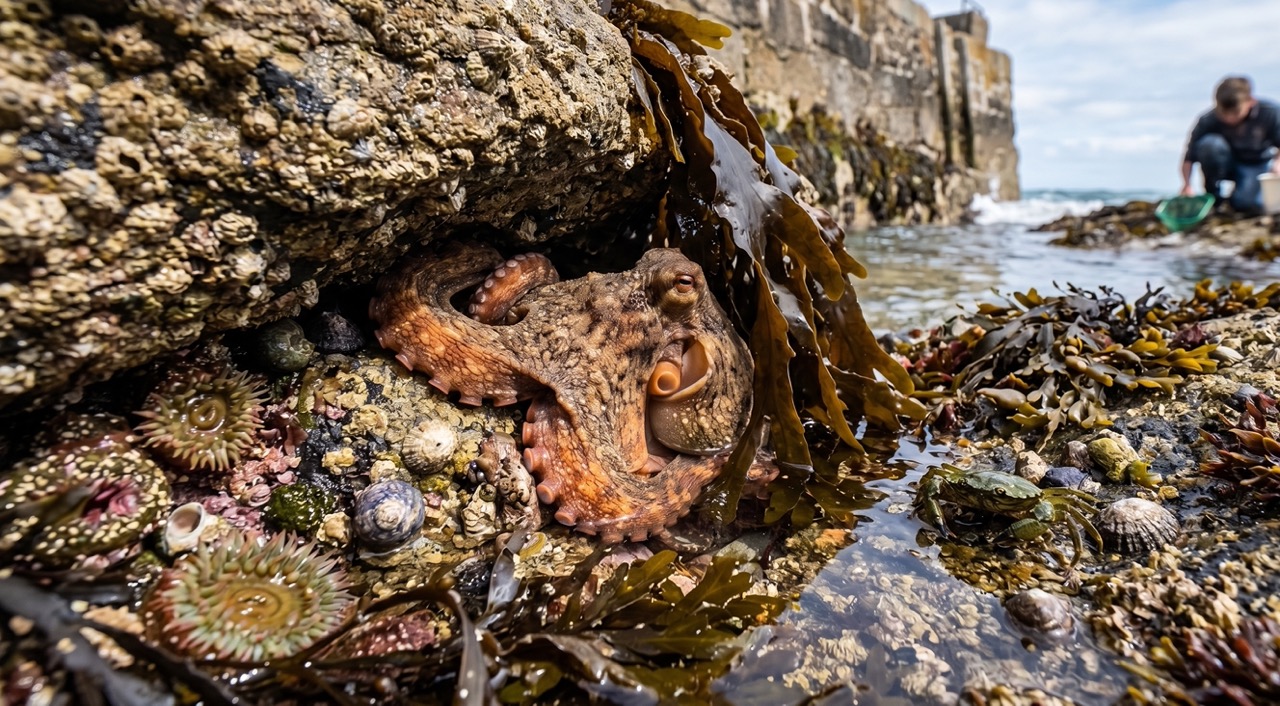
The encounter
The common octopus is one of the most fascinating animals found around rocky South West coasts. It is rarely seen casually, but divers, snorkellers and patient rockpool watchers may occasionally spot one tucked among rocks, kelp or harbour walls. With soft arms, shifting colours and remarkable intelligence, it brings a real sense of mystery to the coastal wildlife world.
Quick ID — at a glance
Marine lifeLook for
Look for a soft-bodied animal with eight arms, large eyes and a rounded head
Where to look
Rocky shore pools, reefs, kelp beds, harbour walls and sheltered coastal areas around Devon and Cornwall.
Likelihood
Difficult — present in South West waters but shy, well-camouflaged and often hidden.
Best time of day
Low tide for rockpool searching; daytime dives can reveal them tucked into rocky crevices, though they are often more active at dusk and night.
Best months
Late spring to early autumn — best chance in warmer, calmer coastal waters.
Your spotting mission
Look for movement that does not quite fit the rock around it — octopuses are masters of camouflage.
Identification guide
How to identify a Common Octopus
Look for a soft-bodied animal with eight arms, large eyes and a rounded head. Colour can vary from reddish brown to grey, sandy or mottled depending on its surroundings. It may appear as a strange patch of moving rock before its shape becomes clear.
Best time to see them
When to look for Common Octopus
May, Jun, Jul, Aug, Sep, Oct
Best time of day: Low tide for rockpool searching; daytime dives can reveal them tucked into rocky crevices, though they are often more active at dusk and night.
Best conditions: Calm, clear water with good visibility. Rocky shores, reefs, kelp edges and sheltered coves give the best chance.
Most likely to be seen by divers, snorkellers or careful rockpool watchers in suitable coastal areas.
Through the seasons
Spring
Active May
Mar · Apr · May
Summer
Peak season
Jun · Jul · Aug
Autumn
Active Sep, Oct
Sep · Oct · Nov
Winter
Not typically present
Dec · Jan · Feb
Safety & Respect
What to do if you see one
Do not poke, handle or remove octopuses from pools or crevices. Watch quietly and leave the habitat exactly as you found it.
Community sightings
Have you spotted one?
Seen one of these on Dartmoor, Exmoor or Bodmin Moor?
Tell the 3moors community where and when you saw it.
Recent sightings
No sightings recorded yet — be the first!
Printable field notes
A reference sheet for this species — identification, best months, habitat and spotting tips.
Further reading
Authoritative resources
External links open in a new tab. 3moors is not responsible for third-party content.
Join the 3moors Community for path conditions & local tips.
Join