The encounter
The Dartmoor pony is one of the most recognisable and quietly iconic sights on the moor. Small, hardy and perfectly adapted to the landscape, they graze freely across open ground, often appearing in loose groups against the backdrop of tors and wide skies. Seeing them isn’t rare — but it always feels like part of the character of Dartmoor itself.
Quick ID — at a glance
MammalSize
A compact, sturdy native pony standing 11.1 to 12.2 hands high (roughly 1.1–1.25 m at the shoulder). Noticeably shorter and stockier than most riding breeds.
Look for
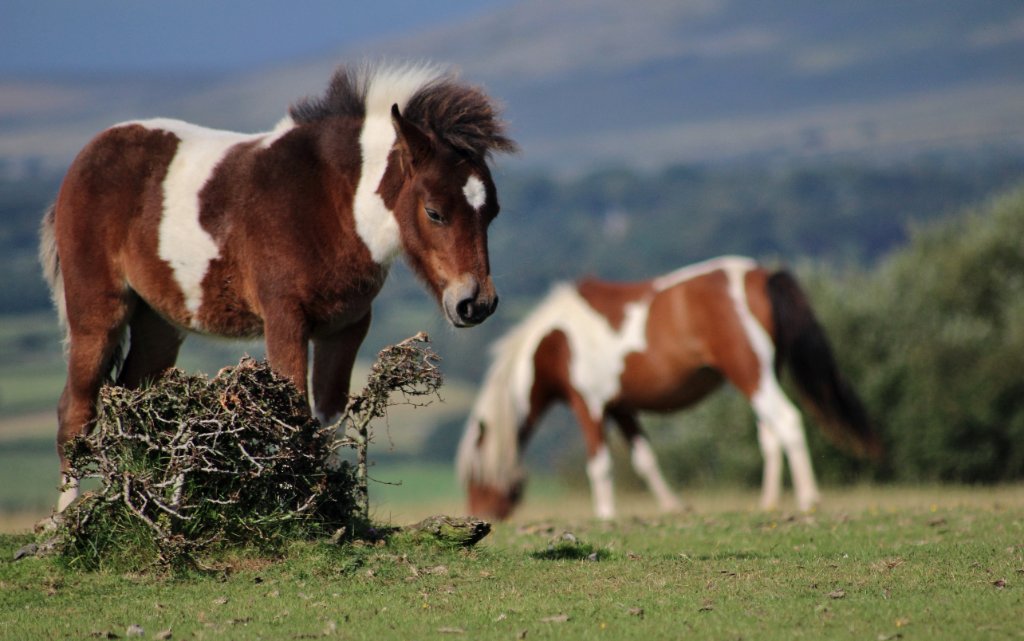
A small, rounded body with a thick, shaggy coat, a full mane and tail, and a broad forehead. The eyes are large and gentle. Most are bay, brown or black. Hard, well-formed hooves adapted to rough terrain.
Colour & shape
Most commonly bay (brown body with black mane and tail), dark brown or black. Occasionally grey or dun. Foals are often a lighter shade that darkens with age. White markings on the face or legs are uncommon in purebred animals.
Sound / call
Soft whinnies and snorts. Foals call to mares with a higher, more insistent whinny. Grazing herds are mostly quiet.
Where to look
Across Dartmoor, especially on open moorland, around tors, near roads and in grazing areas managed by local farmers. They are often seen in small groups, moving slowly across open ground or standing quietly in sheltered spots.
Likelihood
Easy — one of the most commonly seen animals on Dartmoor.
Best time of day
Any time during daylight
Best months
Visible year-round, though foals in spring and early summer add a different experience.
Your spotting mission
Dartmoor ponies roam freely across the open moor and are not difficult to find — but give them space and never feed them. Drive or walk the high moorland between Haytor, Widecombe and Two Bridges in the morning or evening and scan the rough grass and heather slopes. In late spring look for mares with foals. Ponies are accustomed to people but remain wild animals; watch quietly from a short distance and let them graze undisturbed.
Identification guide
How to identify a Dartmoor Pony
A small, sturdy pony with a thick mane and tail, built to withstand harsh moorland weather. Coat colours vary — most are brown, bay or black, with some lighter or mottled individuals. They have a compact body, strong legs and a calm, watchful presence.
Confused with
Domestic horses in enclosed fields. Dartmoor ponies are typically smaller, roam freely, and are seen in open moorland rather than fenced areas.
Where to see them on the moors
Dartmoor Pony across Dartmoor, Exmoor and Bodmin Moor
The Dartmoor Pony is the defining native breed of this moor — it has grazed here for thousands of years and is critical to the conservation of the moorland habitat. Numbers have declined sharply and only around 200 registered mares remain on the moor today. The Dartmoor Hill Pony Association works to preserve the breed. Best seen across the central and southern moor — Widecombe-in-the-Moor, Holne Moor, Dartmeet and the Haytor area are all reliable locations.
Dartmoor Ponies are not native to Exmoor. The native breed here is the Exmoor Pony, a separate and equally ancient breed. Some Dartmoor Ponies may occasionally be seen on conservation grazing projects, but the true wild native on Exmoor is the Exmoor Pony.
Dartmoor Ponies are not native to Bodmin Moor. However, free-roaming ponies — including some similar native breeds — are used in conservation grazing schemes on parts of the moor. Check locally for current grazing projects.
Find walks where you might spot one
Browse moorland walks that pass through habitat favoured by this species.
Browse walksBest time to see them
When to look for Dartmoor Pony
All year round
Best time of day: Any time during daylight
Best conditions: Clear conditions help with photography and viewing, but ponies can be seen in all weather — from bright sun to mist and rain.
Any time of day — they are not particularly shy and are often seen throughout daylight hours.
Through the seasons
Spring
Peak season
Mar · Apr · May
Summer
Peak season
Jun · Jul · Aug
Autumn
Peak season
Sep · Oct · Nov
Winter
Peak season
Dec · Jan · Feb
Spring and early summer bring foals, which are often seen close to their mothers. Winter shows their resilience, as they endure harsh conditions on the open moor.
Behaviour & life through the year
How the Dartmoor Pony lives
Dartmoor ponies spend most of their time grazing, moving slowly across the moor in small groups. They are well adapted to harsh weather and can often be seen standing quietly in exposed conditions. Social behaviour within groups is subtle but constant.
Sound & call
Generally quiet, though occasional soft whinnies or calls can be heard within groups.
Through the seasons
Spring and early summer bring foals, which are often seen close to their mothers. Winter shows their resilience, as they endure harsh conditions on the open moor.
Safety & Respect
What to do if you see one
These are semi-wild ponies and should not be fed or approached. Keep a safe distance, especially around foals, and take care when driving as they often stand or move slowly on roads.
Conservation
Conservation status
Community sightings
Have you spotted one?
Seen one of these on Dartmoor, Exmoor or Bodmin Moor?
Tell the 3moors community where and when you saw it.
Recent sightings
No sightings recorded yet — be the first!
Printable field notes
A reference sheet for this species — identification, best months, habitat and spotting tips.
Often seen alongside · Similar species
Further reading
Authoritative resources
External links open in a new tab. 3moors is not responsible for third-party content.
Join the 3moors Community for path conditions & local tips.
Join