
The encounter
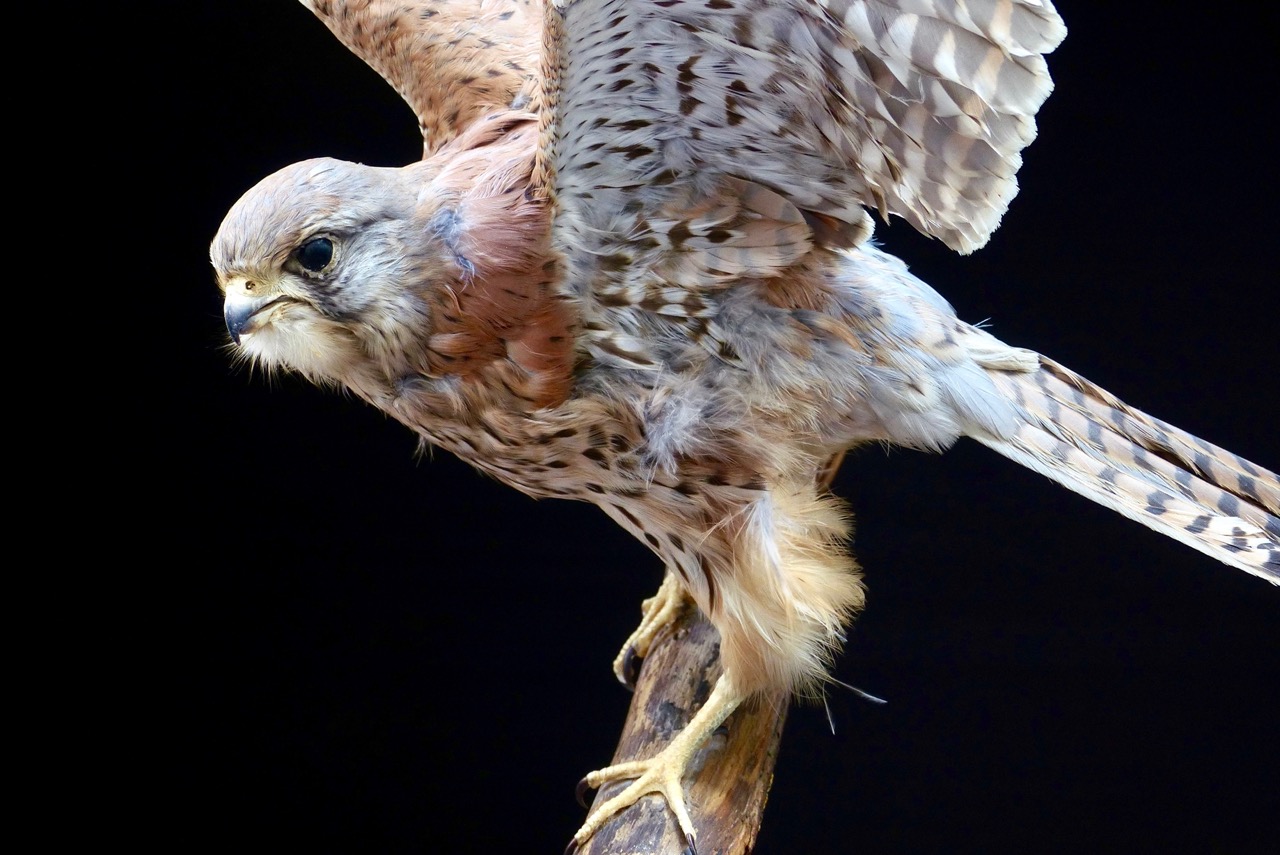
Kestrel on the moor The Kestrel is one of the most familiar birds of prey on Dartmoor, Exmoor and Bodmin Moor, famous for its ability to hover almost motionless into the wind while scanning the ground below. You’ll often spot one suspended above rough grassland, heath or roadside verges, its wings beating rapidly as it searches for voles, mice and large insects.
Slim and agile, kestrels are smaller than buzzards and falcons such as the peregrine. Males are particularly handsome, with a blue-grey head and tail and chestnut-brown back marked with black spots. Females are browner overall and more heavily barred.
On the moors, they tend to favour open country where prey is easier to detect. They can often be seen perched on fence posts, telegraph poles or lone branches, watching patiently before dropping suddenly onto prey with surprising speed and accuracy.
Unlike larger raptors that soar on thermals, the kestrel’s signature “wind-hover” is often the giveaway for visitors. On breezy days, you may see them facing into the wind for several seconds at a time, adjusting their tail like a rudder and making tiny wing corrections to stay perfectly still.
Listen for a sharp, repeated “kee-kee-kee” call, especially in spring and summer when pairs are defending nesting territory.
Quick ID — at a glance
BirdSize
Slightly smaller than a collared dove, larger than a thrush. Body length 32–35 cm, wingspan 71–80 cm. Noticeably slimmer and longer-tailed than the buzzard.
Look for
The hovering flight is the definitive feature — no other British raptor hovers so consistently over open ground. At rest, look for a long tail and pointed wings. Males have a distinctive blue-grey head and tail; females are all warm brown with dark barring.
Colour & shape
Males: chestnut-red back with black spots, blue-grey head and a blue-grey tail with a broad black terminal band. Females and juveniles: warm reddish-brown above with heavy dark barring throughout. Both sexes have a pale, streaked underside and yellow cere and feet.
Sound / call
A sharp, repeated 'kee-kee-kee' — quite shrill and high-pitched. Given in alarm near the nest or during territorial encounters. Often silent when hunting.
Best time of day
Morning to late afternoon
Best months
Kestrels are resident and can be seen throughout the year, though clear spring and summer days often give the best views.
Your spotting mission
Drive or walk any open moorland road and watch the verges and rough grassland. The kestrel's hovering flight — facing into the wind, tail fanned, head perfectly still while the body trembles — is unmistakable and visible from a considerable distance. Roadside verges, moorland edges and rough grassland beside tracks are prime hunting spots. Early morning and late afternoon are the most productive times, when small mammals are most active in the grass below.
Where to see them on the moors
Kestrel across Dartmoor, Exmoor and Bodmin Moor
A familiar and frequently seen raptor across all areas of Dartmoor. Easiest to spot along the moorland roads and the open grassland fringes — the B3212 between Princetown and Postbridge, and the road above Haytor, consistently produce sightings. Numbers are healthy on Dartmoor relative to many parts of lowland England where populations have declined.
Common and widespread across Exmoor's open moorland and farmland margins. Particularly visible along the higher moorland roads and on the coastal heathland. The Brendon Hills and Porlock Common are reliable spots. Resident year-round.
Present across Bodmin Moor, particularly on the moorland edges and rough pasture of the western moor. The area around Jamaica Inn and the A30 corridor is good for roadside sightings. Also found on the coastal farmland fringe. Numbers appear stable.
Find walks where you might spot one
Browse moorland walks that pass through habitat favoured by this species.
Browse walksBest time to see them
When to look for Kestrel
All year round
Best time of day: Morning to late afternoon
Best conditions: Bright weather with a light to moderate breeze
Daylight hours are best, especially when there is enough breeze for a bird to hover steadily over grassland.
Through the seasons
Spring
Peak season
Mar · Apr · May
Summer
Peak season
Jun · Jul · Aug
Autumn
Peak season
Sep · Oct · Nov
Winter
Peak season
Dec · Jan · Feb
Community sightings
Have you spotted one?
Seen one of these on Dartmoor, Exmoor or Bodmin Moor?
Tell the 3moors community where and when you saw it.
Recent sightings
No sightings recorded yet — be the first!
Printable field notes
A reference sheet for this species — identification, best months, habitat and spotting tips.
Often seen alongside · Similar species
Further reading
Authoritative resources
External links open in a new tab. 3moors is not responsible for third-party content.
Join the 3moors Community for path conditions & local tips.
Join