
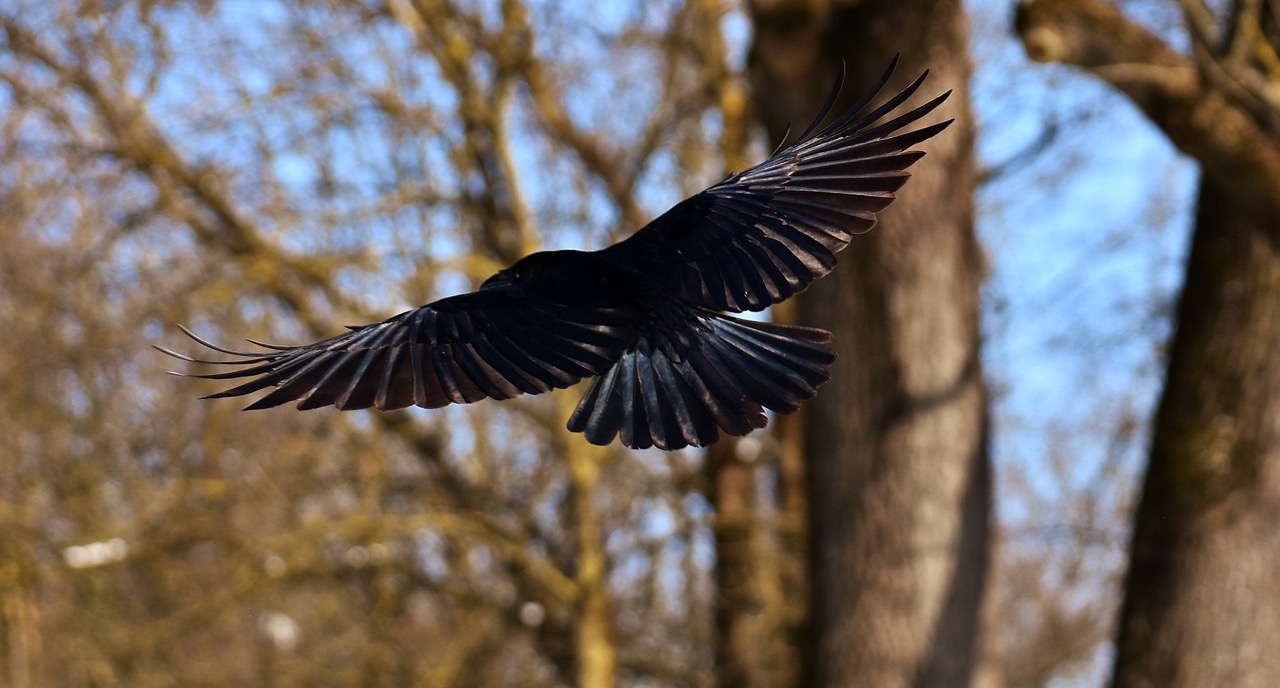
The encounter
The raven is one of the great presences of the moors: large, glossy black, deeply intelligent and often heard before it is properly seen. Its croaking call and playful aerial tumbling are part of the mood of wild upland country.
Quick ID — at a glance
BirdSize
The largest crow in the world, and easily the largest all-black bird on the moors. Body length around 60–68 cm, with a wingspan of 120–150 cm. Significantly larger than a carrion crow.
Look for
Entirely glossy black with a large, heavy, curved bill. In flight, the distinctive wedge-shaped tail is diagnostic — no other moorland crow has this. Also note the large 'beard' of throat feathers visible at closer range. Wings are long and broad, with somewhat fingered tips.
Colour & shape
All black with a strong blue-purple or greenish iridescent gloss in good light. The bill is heavy and black. Young birds are duller and browner, lacking the full gloss.
Sound / call
A deep, resonant 'cronk' or 'prruk-prruk' that carries far across open ground. Nothing else on the moors sounds quite like it — far deeper and more hollow than a crow's caw. Also produces guttural gurgling notes and a wide range of calls.
Best time of day
Early morning to mid-afternoon
Best months
Ravens are present throughout the year, but early spring can be especially lively as pairs display and call over territories.
Your spotting mission
Scan the sky above any open moorland or rocky hillside — ravens are most often detected by their deep, resonant calls before they are seen. Look for a very large, all-black bird soaring with stiff, flat wings or performing spectacular aerial rolls. Tors and crags are favourite perching sites. On Dartmoor, any prominent granite tor is worth checking. Ravens are resident year-round and often travel in pairs, which makes identification easier.
Where to see them on the moors
Raven across Dartmoor, Exmoor and Bodmin Moor
Ravens are a resident breeding species on Dartmoor and one of the most reliable large birds to spot on the high moor. Pairs nest on sheltered rock faces and in woodland near tor outcrops. Hound Tor, Haytor, Great Mis Tor and Fur Tor are all productive areas. Often seen alongside buzzards on thermals in spring.
Present across Exmoor, particularly on the coastal cliffs and rocky inland valleys. The North Devon and Somerset coast provides excellent nesting habitat. Inland, the higher moorland areas and wooded combes hold resident pairs. Numbers have increased following the end of widespread persecution.
Ravens are present on Bodmin Moor year-round, with strongholds around the granite tors and the rougher central upland. Brown Willy and the Rough Tor area regularly hold birds. Also found on the rocky coastal sections in north Cornwall.
Find walks where you might spot one
Browse moorland walks that pass through habitat favoured by this species.
Browse walksBest time to see them
When to look for Raven
All year round
Best time of day: Early morning to mid-afternoon
Best conditions: Clear or showery weather with broad views over open country
Any daylight hours can be good, with early morning often giving the strongest sense of raven activity on quiet moorland.
Through the seasons
Spring
Peak season
Mar · Apr · May
Summer
Peak season
Jun · Jul · Aug
Autumn
Peak season
Sep · Oct · Nov
Winter
Peak season
Dec · Jan · Feb
Community sightings
Have you spotted one?
Seen one of these on Dartmoor, Exmoor or Bodmin Moor?
Tell the 3moors community where and when you saw it.
Recent sightings
No sightings recorded yet — be the first!
Printable field notes
A reference sheet for this species — identification, best months, habitat and spotting tips.
Often seen alongside · Similar species
Further reading
Authoritative resources
External links open in a new tab. 3moors is not responsible for third-party content.
Join the 3moors Community for path conditions & local tips.
Join