
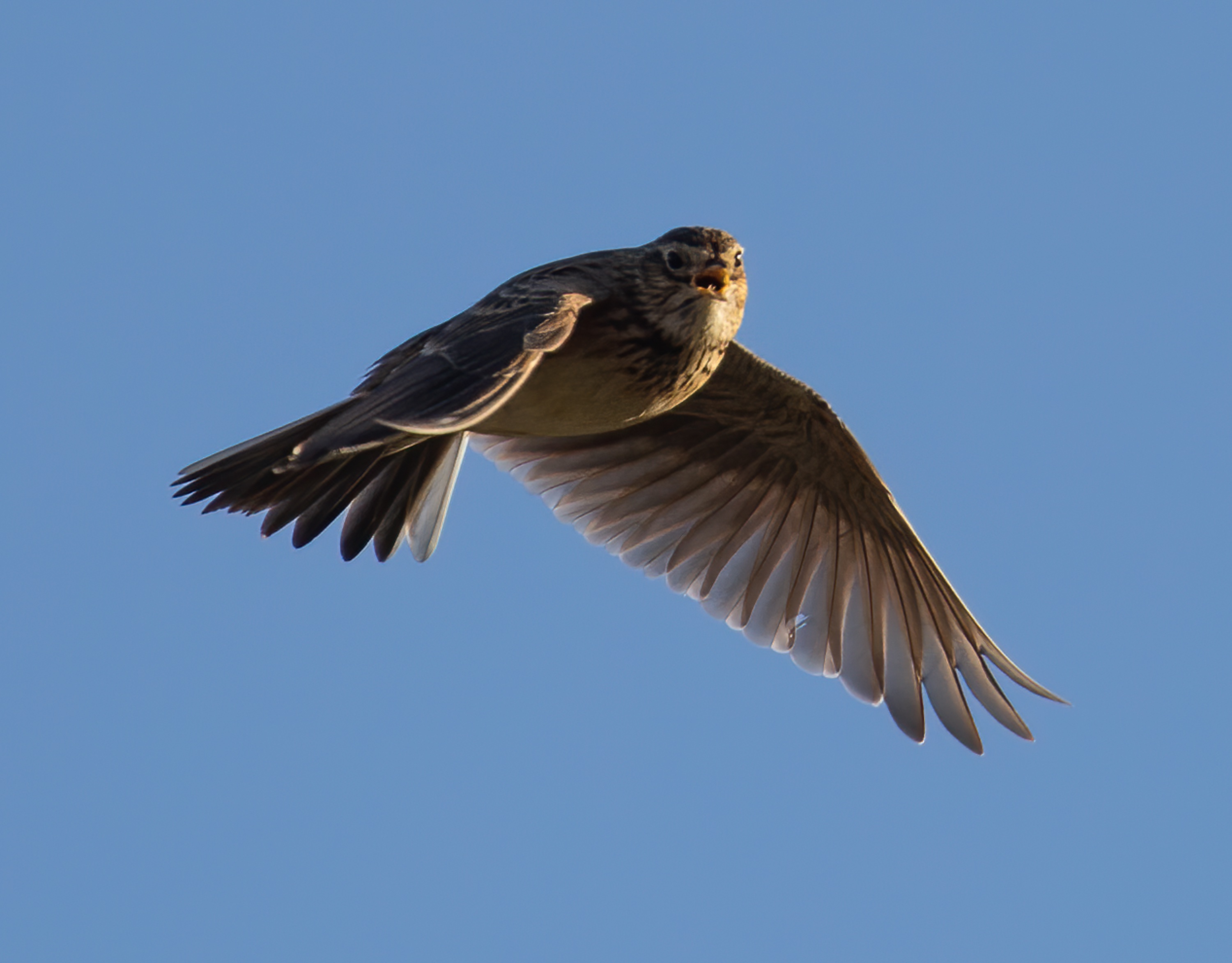
The encounter
The skylark is one of the defining sounds of the open moor. You’ll often hear it long before you see it — a constant, shimmering song pouring down from high above the ground. On a still spring or summer morning, that sound becomes part of the landscape itself, turning an ordinary walk into something much more memorable.
Quick ID — at a glance
BirdSize
Roughly the size of a sparrow, but slimmer and more elongated in flight. Body length around 18–19 cm. In the air it appears small and pale against the sky.
Look for
A small brown-streaked bird with a short crest that can be raised or flattened. In flight, look for white outer tail feathers and a faint white trailing edge to the wings. On the ground it walks, rather than hops, and is easy to miss in short vegetation.
Colour & shape
Sandy brown above with heavy dark streaking. Pale whitish-buff underparts with a streaked breast. The small crest is the most distinctive feature when seen at close range.
Sound / call
One of the most distinctive sounds in British wildlife — a rich, continuous, cascading song delivered in high, sustained flight. Each phrase is fluid and warbling, unlike any other moorland bird. The alarm call is a dry 'chrrup'.
Where to look
Skylarks are widespread across open moorland on Dartmoor, Exmoor and Bodmin Moor. You're most likely to encounter them on broad, open ground with short grass or heath, away from woodland and enclosed farmland. High, exposed areas and wide plateaus are particularly good.
Likelihood
Easy to hear, harder to see — the song gives them away, but the bird itself can be difficult to pick out against the sky.
Best time of day
Morning, especially on calm, bright days
Best months
Spring and early summer are the peak months, when skylarks are most active and their song is constant across open ground.
Your spotting mission
Go to open moorland on a still, bright morning between April and July — the skylark's song is most sustained when the air is calm. Listen before you look: the bird rises almost vertically from the ground, singing continuously, and can hover or drift for minutes before descending. Fix the sound, then trace the vertical line upward with your eyes. On descent, the bird drops steeply and vanishes into the grass — mark where it lands to see it on the ground.
Identification guide
How to identify a Skylark
A small, brown, streaky bird with a slightly raised crest. On the ground it can be easy to overlook, blending into grass and heather. In flight, it rises almost vertically, hovering high above while singing continuously — often appearing as a tiny speck against the sky.
Confused with
Meadow pipits and other small brown birds. Skylarks are larger, with a more sustained hovering song flight and a slightly more robust shape.
Where to see them on the moors
Skylark across Dartmoor, Exmoor and Bodmin Moor
Dartmoor supports one of the most significant skylark populations in the south-west, particularly on the high open plateau areas. The moorland between Okehampton, Princetown and Postbridge is particularly good. Listen for song from March through to August on fine mornings across any area of open grassland and heather.
Skylarks are common on Exmoor's open heather moorland and upland grasslands, particularly on Dunkery Hill, Brendon Common and the Chains. Numbers are strong during the breeding season. The bird is also present in winter, sometimes in flocks on lower farmland.
A regular breeding species on Bodmin Moor's open heath and rough grassland, though in lower densities than Dartmoor. The area around Brown Willy and Rough Tor is good in summer. Listen carefully on calm mornings when song carries furthest.
Find walks where you might spot one
Browse moorland walks that pass through habitat favoured by this species.
Browse walksBest time to see them
When to look for Skylark
Mar, Apr, May, Jun, Jul
Best time of day: Morning, especially on calm, bright days
Best conditions: Still or lightly breezy weather with good visibility. Skylarks are far less active in strong wind or heavy rain.
Early morning offers the strongest and most continuous song, though skylarks can be heard throughout the day in good conditions.
Through the seasons
Spring
Peak season
Mar · Apr · May
Summer
Active Jun, Jul
Jun · Jul · Aug
Autumn
Not typically present
Sep · Oct · Nov
Winter
Not typically present
Dec · Jan · Feb
Spring and early summer are the highlight, when males sing almost constantly. Outside of this period, skylarks are quieter and more easily overlooked, spending most of their time on the ground.
Behaviour & life through the year
How the Skylark lives
Skylarks are best known for their vertical song flight. A male will rise steadily into the sky, hover while singing continuously, then drift back down to the ground. Outside of this display, they spend much of their time on the ground, feeding and moving quietly through grassland.
Sound & call
A continuous, rippling stream of notes delivered while hovering high above the ground. It can last several minutes and carries surprisingly far, often filling the entire landscape on calm days.
Through the seasons
Spring and early summer are the highlight, when males sing almost constantly. Outside of this period, skylarks are quieter and more easily overlooked, spending most of their time on the ground.
Safety & Respect
What to do if you see one
Avoid disturbing ground-nesting birds, especially in spring and early summer. Keep to paths where possible and take care with dogs in nesting areas.
Conservation
Conservation status
Community sightings
Have you spotted one?
Seen one of these on Dartmoor, Exmoor or Bodmin Moor?
Tell the 3moors community where and when you saw it.
Recent sightings
No sightings recorded yet — be the first!
Printable field notes
A reference sheet for this species — identification, best months, habitat and spotting tips.
Often seen alongside · Similar species
Further reading
Authoritative resources
External links open in a new tab. 3moors is not responsible for third-party content.
Join the 3moors Community for path conditions & local tips.
Join