
Bodmin Moor · South Cornwall coast
Mevagissey
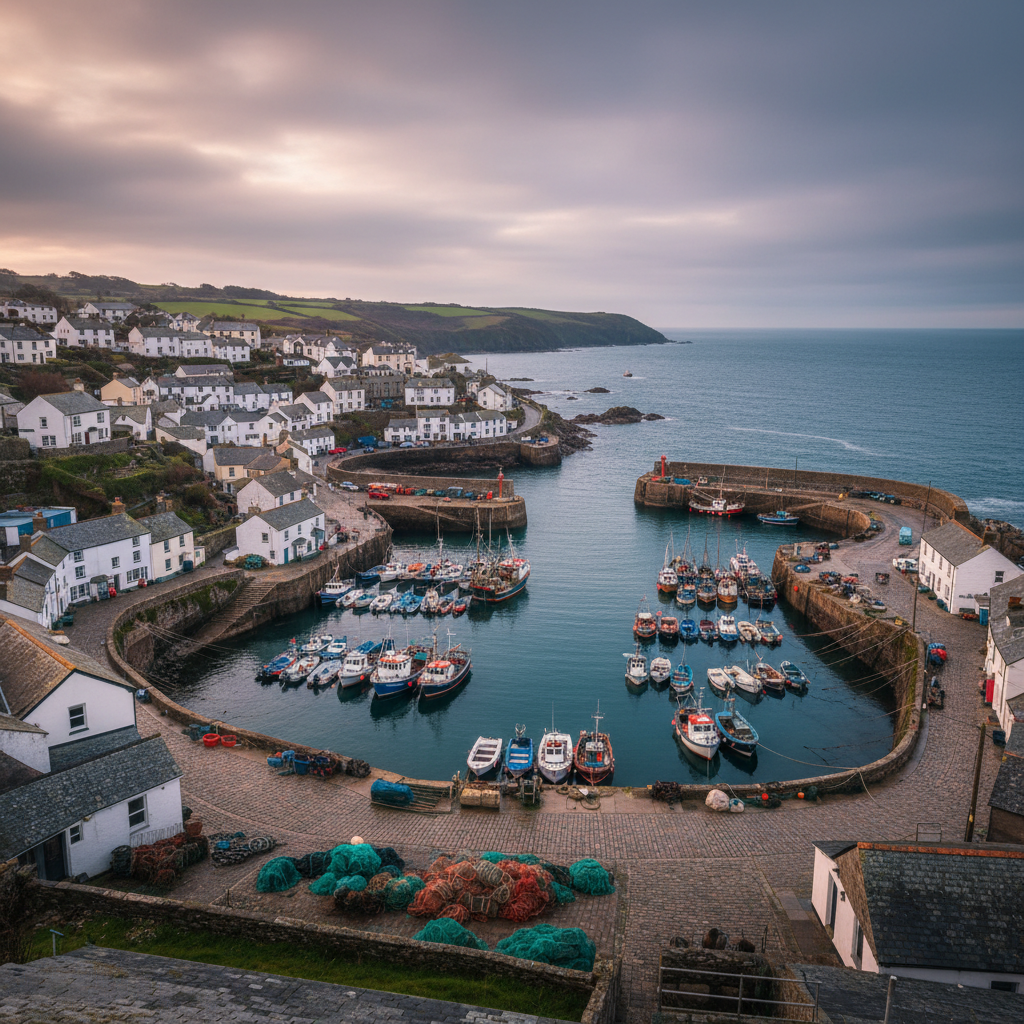
A busy working harbour packed with narrow lanes and maritime character.
About
Mevagissey
Mevagissey sits on the south Cornish coast between Pentewan and Gorran Haven, tucked into a fold of the land where two valleys meet the sea. The village grew around its double harbour, and that harbour still defines it: the inner basin where fishing boats rest on the mud at low tide, the outer wall that takes the weather, the smell of salt and engine oil that lingers on still mornings. This is not a place that has reinvented itself for tourism. It has absorbed visitors while continuing to function as something older and more particular.
The lanes that run back from the waterfront are narrow enough that two people passing must turn sideways. Cottages lean against one another at odd angles, their walls painted in faded creams and terracottas that have long since stopped being fashionable and are simply the colours of the place. The streets have a vertical quality: steps appear where you expect a path, paths drop away where you expect a road. The geography forces a certain attentiveness.
What is most striking, especially if you arrive outside the main summer period, is how quiet the place actually is. Not abandoned, not desolate, but genuinely still in a way that coastal villages often fail to be. The sound of the harbour carries everywhere: ropes against cleats, the occasional engine turning over, the persistent low conversation of gulls above the fish market. These are not intrusive sounds. They belong here, and they give the silence its texture.
People come to Mevagissey for the harbour, for seafood, and for the particular satisfaction of a place that does not feel assembled for their arrival. The photography is obvious to anyone who has seen it once: early morning light on wet cobbles, the masts of boats against a grey sky, the layered rooftops running up the hillside behind. But the appeal is less about individual images than about sustained atmosphere, the sense of a place that has been doing more or less the same thing for a very long time.
Character
The feel of Mevagissey
The built fabric of Mevagissey is dense and purposeful. Buildings were constructed close together because space was at a premium and because the community that lived here worked collectively: fish were landed, processed, and sold through networks of labour that connected almost every household. The old net lofts and store rooms have largely become something else now, but their proportions remain, and they give the village a functional solidity that purely residential settlements rarely have. The harbour area in particular has a working quality to it that persists even when the day's catch is modest and the boats are tied up.
What sustains Mevagissey as more than a pretty postcard is the sense that the community here still has a life beyond the visitor economy. The local shops, the lifeboat station, the small boatyard at the edge of the inner harbour: these are not preserved features but active parts of a place that continues to identify itself through its relationship with the sea. Fishing has declined considerably from its nineteenth-century peak, when Mevagissey was one of the most productive pilchard ports in Cornwall, but the identity it created has not been entirely replaced. The village still knows what it is.
This rootedness shows in small ways. A handwritten notice on a door. A boat being repainted by someone who is neither a professional restorer nor a hobbyist but simply a person who owns a boat. A conversation in the harbour car park that clearly has nothing to do with tourism. These things are not unusual in coastal Cornwall, but in Mevagissey they accumulate into something coherent, a community that has made a particular accommodation with being looked at without being entirely reshaped by it.
Map & Getting Here
Getting to Mevagissey
What to expect
A natural way to spend time here
The approach from the main car park above the village gives you a moment to read the layout before you descend. The roofscape is compressed and varied, and the harbour is visible below in sections, framed by the lanes as you work your way down. The gradient is noticeable but not severe, and the route through the upper lanes is the more interesting one, passing the older residential parts of the village before the streets widen slightly toward the waterfront.
Down at the harbour wall itself, the smell is specific and consistent: brine, a faint trace of diesel, and something organic and not entirely pleasant that belongs to working water rather than ornamental water. It is not an offensive smell. It is accurate. The surface underfoot on the quayside is uneven, the stone worn smooth in the most-trafficked lines and rougher at the edges, and in wet weather the cobbles close to the water's edge carry a genuine risk of a slip.
The place rewards those who are willing to stop completely. A bench on the outer harbour wall, a coffee from one of the handful of small cafes, a half-hour of watching the boats rather than photographing them: this is how Mevagissey discloses itself most fully. The instinct to move on quickly, to see it and record it and leave, is understandable but counterproductive. The character of the place operates on a longer timescale than a thirty-minute circuit allows.
What makes it stand out
What makes Mevagissey special
The double harbour is the most immediately distinctive feature, and it is worth understanding why it exists. Mevagissey's outer harbour was constructed to provide shelter for the fleet in poor weather, and the result is an unusually sheltered anchorage for this stretch of coast. The geometry of the two basins means that the inner harbour can be genuinely calm when the outer wall is taking a significant swell. Watching the water change character between the two is one of the more specific pleasures of spending time here properly rather than passing through.
What also sets Mevagissey apart from comparable Cornish harbour villages is the degree to which the hillside behind it is still visibly inhabited rather than second-homed into seasonal emptiness. The terraces that rise steeply from the waterfront have a lived-in density that places like Polperro or Port Isaac now only partially retain. Whether this reflects property prices, local housing policy, or simple chance is difficult to say from the outside. But the effect is that the village has a social mass that gives it more heft than its size might suggest.
Don't miss
Things to see and do
Walk the outer harbour wall to its end and stand with your back to the village, looking south toward the open water and the curve of the bay.
Find the inner harbour at low tide when the boats are grounded and the mud is exposed, and notice how entirely different it looks from the same spot at high water.
Eat whatever is being served as the catch of the day at the small restaurants near the harbour, and ask where it was landed if you want to know.
Look up at the net lofts and upper-storey openings on the old buildings behind the inner harbour and consider what the building densities along this waterfront were actually built to do.
Visit the small aquarium on the harbour front, which is modest in scale but specific to this coastline and genuinely informative about what lives in these particular waters.
Follow the lane that rises steeply behind the village to the south and turn to look back at the rooftops and the harbour mouth: this is the view that makes sense of the geography.
Wait for a weekday morning in the off-season and walk the harbour when the working boats are active and the visitor population is thin.
Walks from here
Getting out from Mevagissey
The South West Coast Path passes above Mevagissey and provides the most immediate walking access to the surrounding coastline. Heading north along the coastal path toward Pentewan and Black Head gives a cliff-top perspective on the village from above, with the double harbour visible below before the path moves on toward the dunes and the estuary at Pentewan. This section is well-maintained and relatively level, with good views back along the bay.
To the south, the path climbs toward Chapel Point and then continues toward Gorran Haven, a walk of roughly four miles on terrain that becomes more exposed and rugged as it moves away from the village. The headlands in this direction are less visited than those to the north, and the path between Mevagissey and Gorran Haven can feel genuinely remote in poor weather. The coastal scenery is more dramatic than the northern section, though the walking is correspondingly more demanding.
For those who prefer circular routes, a number of inland paths connect back from Gorran Haven or Pentewan through the gentle farmland above the valley, returning to Mevagissey from the higher ground to the west. These routes are less well-signed than the coastal path itself and benefit from a detailed map, but they offer a completely different register of the landscape: quiet agricultural land, hedgerows, and occasional long views south toward the sea.
Good to know
Before you go
Parking above the village fills quickly in summer and the walk down is unavoidable, so arriving before ten in the morning is strongly advisable between June and September. The narrow lanes in the village centre are not well-suited to mobility aids in places, and some of the routes between the upper terraces and the harbour involve steps with no alternative route. It is worth checking your intended route in advance if this is a consideration.
The fish market and working harbour activity, where it exists, tends to be concentrated in the early morning. If you want to see the village in its working mode rather than its visitor mode, this is the window. Seafood restaurants near the harbour are popular and tend to fill quickly on summer evenings
booking ahead is sensible rather than optional during peak weeks.
Across the seasons: Winter is when Mevagissey most clearly resembles itself. The harbour is quieter, the lanes largely clear, and the light on the water has a quality that summer never quite produces: lower, sharper, and with longer shadows across the quayside in the afternoons. A calm day in December or January, when the inner harbour is flat and the village is going about its business without an audience, is as good a time to be here as any. Spring brings early visitors and the first influx of day-trippers from the Easter period onward. The village handles this reasonably well, but the narrowest lanes can feel pressured by mid-April on warm weekends. Late spring, particularly May before the schools break up, offers a reasonable balance between accessible weather and manageable numbers. Summer is busy in the way that all south Cornish harbour villages are busy, and Mevagissey is no exception. The atmosphere shifts considerably, the lanes become slow to navigate, and the working character of the place retreats behind the visitor economy. It remains worthwhile, but the early morning and early evening hours are when the village recovers something of its quieter self. Autumn from late September onward sees a rapid thinning of numbers, and by October the village has largely returned to its own rhythms.
Practical info
Practical info
Mevagissey has no parking within the village itself. The main car park sits above the village on the approach road and requires a short downhill walk into the centre. It fills quickly in summer, particularly from mid-morning onwards, and space is not guaranteed at any point during the season. Arriving early or out of season gives the best chance of a straightforward visit.
Public toilets are available near the harbour. The village has a good range of cafés, fish and chip shops, and a small number of pubs, most of which are concentrated around the inner harbour. There are no large supermarkets and no visitor centre as such. Mobile signal can be unreliable in the narrower lanes.
The village sits on a steep hillside and the lanes connecting the upper streets to the harbour involve noticeable gradients. Cobbled and uneven surfaces are common throughout, and these become slippery when wet. Flat, practical footwear is advisable even for a short visit. Wheelchair and pushchair access is limited in the older parts of the village.
varies
Explore nearby
Places nearby
Boscastle
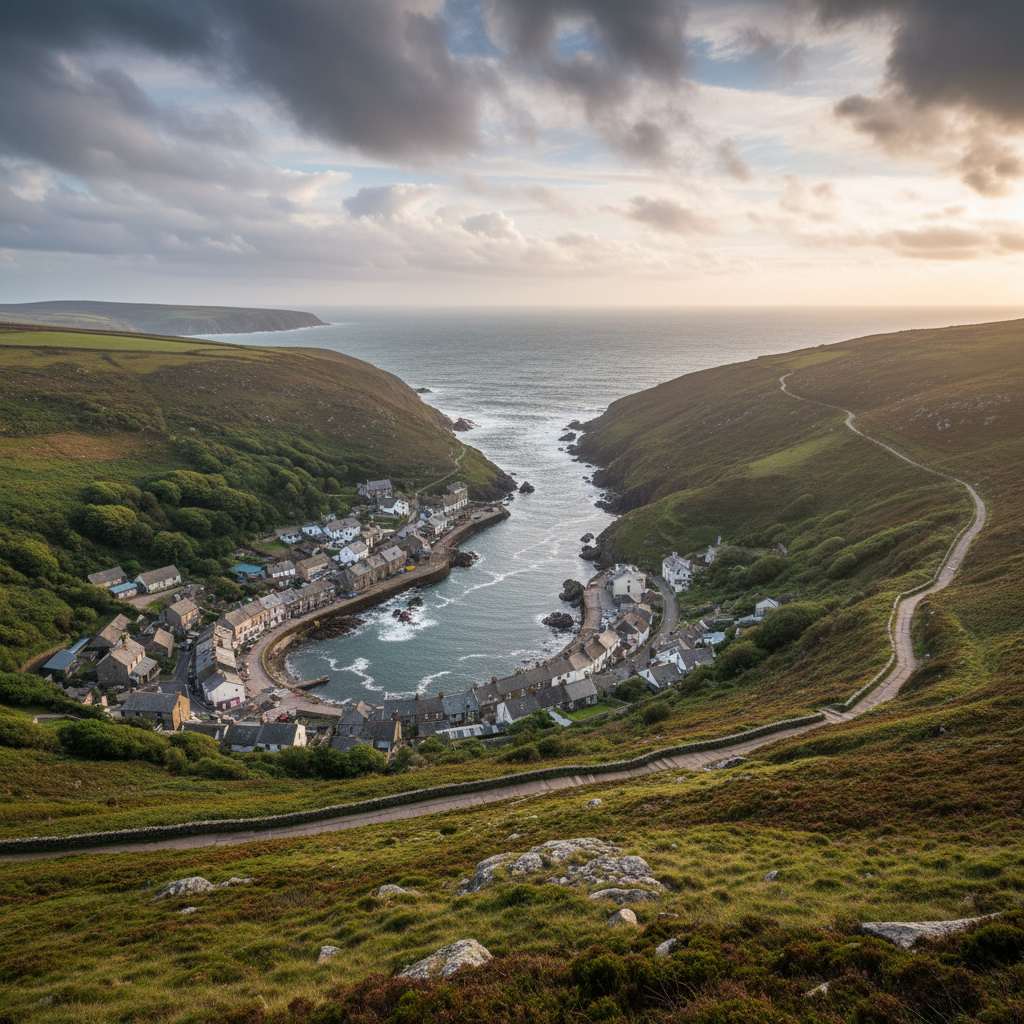
Boscastle adds harbour, folklore, geology and coast path potential to the 3moors place network.
Bossiney Cove
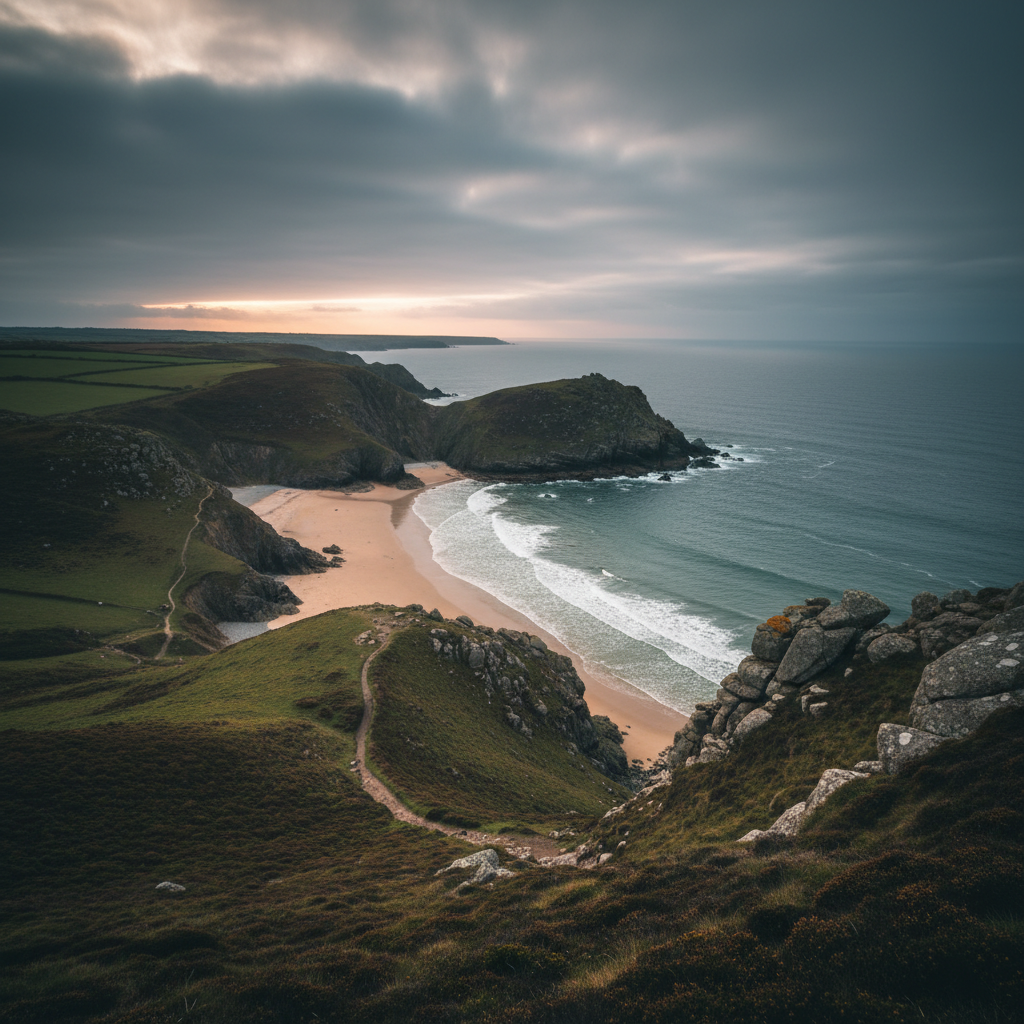
Bossiney Cove brings a wilder, less polished coastal note to the Bodmin-side 3moors map.
Crackington Haven
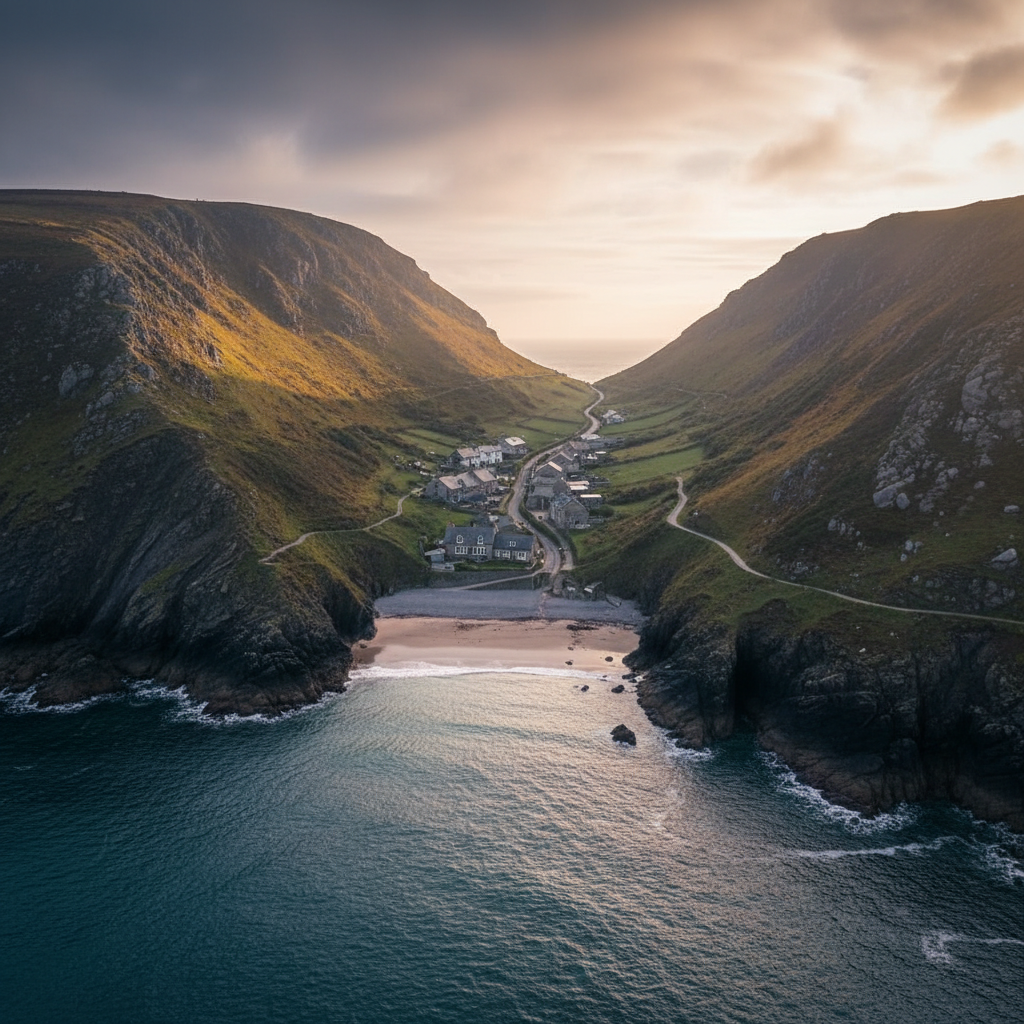
Crackington Haven works well as a quieter North Cornwall coastal place with strong walking and geology appeal.

Golitha Falls
Golitha Falls offers a different side of Bodmin Moor — river, woodland and easier walking in a calm but atmospheric setting.
Join the 3moors Community for path conditions & local tips.
JoinWhy this place matters
Mevagissey — in its own right
What Mevagissey ultimately offers is a particular kind of geographical honesty. It sits where it sits because of the harbour, and the harbour exists because of the sea, and the sea here is not decorative but operational, something that people have been working with and against for centuries. The hills that press in on three sides, the valley that channels the village downward toward the water, the way the landscape both shelters and constrains: these are not incidental features but the reason the place exists at all. To stand at the end of the outer wall and look back at the village is to understand this clearly. The settlement reads as a response to a specific set of geographical conditions, compact and purposeful, shaped by what the land and the sea required rather than by what might have been convenient or picturesque. That it is also, at certain hours and in certain lights, deeply picturesque is almost beside the point.
Explore more
Discover other places, walks, and hidden corners across Bodmin Moor.