Dartmoor · East Devon coast
Branscombe
A deeply rural coastal village with thatched cottages and a quieter Jurassic Coast feel.
About
Branscombe
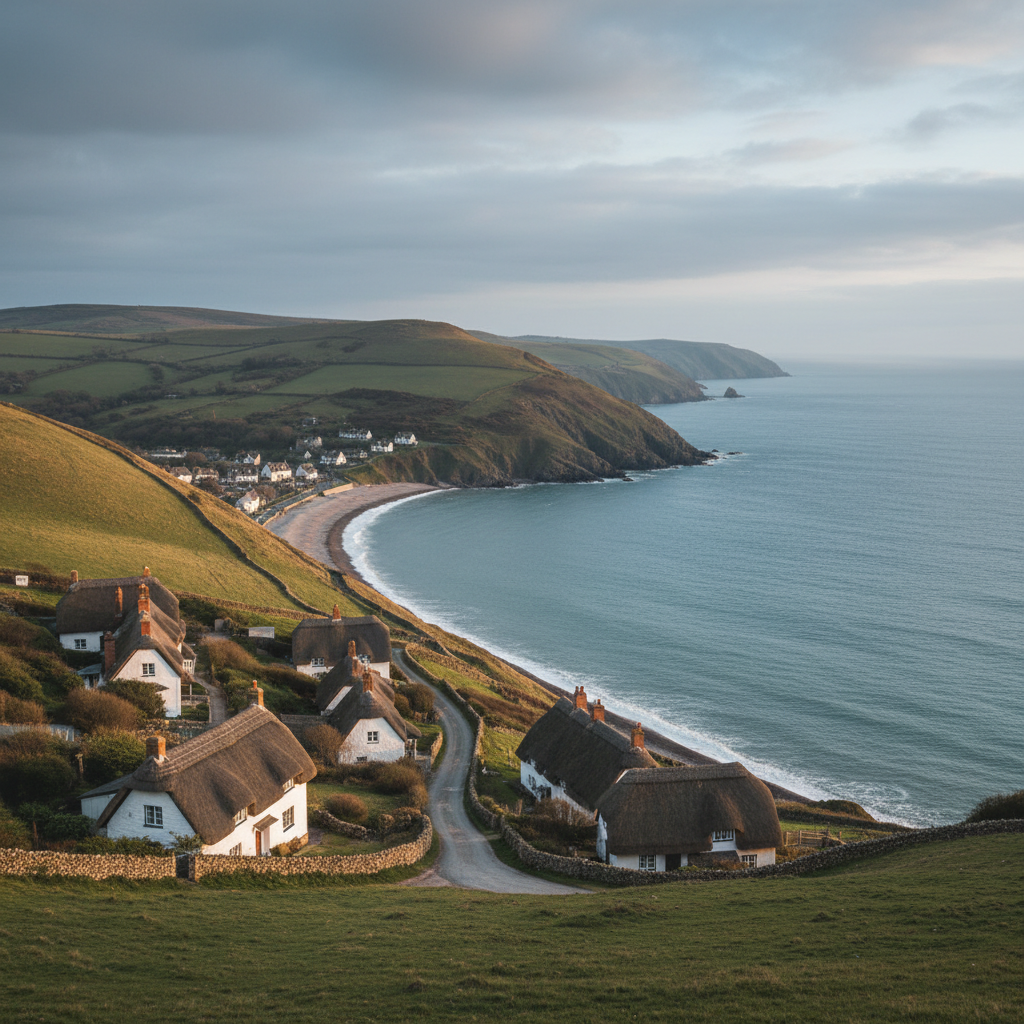
Branscombe sits in a deep, wooded valley on the East Devon coast, tucked between high chalk and greensand cliffs that drop steeply to a shingle beach. The village is strung out along a single lane, its thatched cottages separated by small orchards and stream-fed meadows, the whole settlement feeling less like a destination and more like a place that has simply persisted. It lies within the Jurassic Coast World Heritage Site, though it wears that designation quietly, without the visitor infrastructure that has gathered around nearby Beer or Sidmouth.
The coastline here changes noticeably with the seasons, and that quality is part of what defines Branscombe as a place worth returning to. In late spring the cliff-top paths are dense with cow parsley and red campion, the light still sharp and low. By August the bracken has grown waist-high in places, the paths narrower, the valley heavier and more enclosed. Come October, that bracken turns a burnt copper, and the cliffs take on a rawer, more exposed quality as the summer visitors thin out and the sea reasserts itself.
The beach at Branscombe Mouth is reached by a short drive or a longer walk from the village, and it has the particular character of a Devon shingle beach: loud underfoot, steepening quickly into deeper water, backed not by car parks and beach huts but by a single thatched building and the cliffs themselves. The sea here runs a clear grey-green in good weather, deeper blue-grey when cloud builds offshore.
People come to Branscombe for the walking primarily, whether along the coast path towards Seaton to the east or Beer Head to the west, or inland through the National Trust-managed farmland and ancient orchards that fill the valley floor. Some come specifically for the church of St Winifred, one of the longest in Devon, its tower thought to date from the Norman period. Many simply come because the village remains, for now, genuinely unhurried.
Character
The feel of Branscombe
The built character of Branscombe is defined by its dispersal. Unlike villages gathered around a green or a square, this one trails along its valley in loose clusters, each group of cottages separated by enough land that you are rarely aware of the settlement as a whole. The forge, the bakery, the church and the pub are all distinct landmarks rather than a unified core, and walking between them takes you through working countryside rather than a village centre. That physical spread has protected Branscombe from the kind of concentrated commercialisation that can hollow out a pretty village.
What you feel here, more than almost anywhere on this stretch of coast, is solitude as a structural condition rather than a temporary escape. The roads do not encourage passing traffic. There is no through route, no reason to come unless Branscombe is specifically where you are going. That quality filters the people who arrive: walkers with maps, families who have stayed before, a few careful day-trippers willing to follow a single-track lane for three miles without a guarantee of easy parking. The result is a place that does not perform its own attractiveness. It simply exists, indifferent to whether you find it.
There is a particular social texture to villages shaped by topography rather than planning, and Branscombe has it. The valley walls close things in just enough to create a sense of shelter without enclosure. The sound of the stream is audible in the lower parts of the village. Small fields of unimproved grassland survive on the steeper slopes, and the hedgebanks are tall and ancient-looking, threaded through with hart's tongue fern and pennywort.
First-hand visit
Keith's Take
Something about the sound of the shingle drawing back in the wave wash made everything else recede. A beach that earns its quietness.
The shingle at Branscombe Mouth moves in a low, sustained clatter as the wave retreats, a sound somewhere between a hiss and a rattle that you feel as much as hear. It is one of those sounds that has no equivalent inland, and standing a few feet from the waterline, I found it almost impossible to think about anything else. Not in a meditative, deliberate way. Simply because the sound took up the available space.
I had come down from the village in the early afternoon, when the light was at its least interesting and the sea running grey-green under flat cloud. I was not expecting much. The cliff face behind the beach was wet from the morning rain, the chalk bands showing up bright against the darker greensand, and a pair of fulmars were working the updraft at the western end without any particular urgency. The beach itself was almost empty.
What I remember most is not the view or the cliffs or even the walk down, but that sound at the waterline, recurring every twelve seconds or so with the patience of something that has been doing this without interruption for longer than the village has existed. It gave the whole afternoon a structure it would not otherwise have had.
Keith's Take — a first-hand account from the 3moors team
Map & Getting Here
Getting to Branscombe
What to expect
A natural way to spend time here
The walk from the village centre down to Branscombe Mouth follows a quiet lane that becomes a farm track, passing through orchards and past stone-built barns before the valley opens at the coast. The final approach is gradual: the cliff line appears ahead of you before the sea does, and then the beach arrives all at once as the track ends at the shingle bank. The path is well-used but not over-managed, with a few muddy pinch points after rain.
The tidal rhythm here is audible before it is visible. The shingle at Branscombe Mouth has a particular acoustics: as a wave draws back, the stones clatter and hiss in a low, sustained note that carries some distance inland. It is not violent. It is patient, regular, indifferent, and after a few minutes of listening it tends to organise your attention in a useful way, pulling you into the present rather than the journey you have just made.
The beach rewards a patient approach. Walk the waterline rather than settling at the top of the shingle, and take the time to look at the cliff exposures on the eastern end where the chalk meets the darker greensand layers. The rock pools below the cliffs hold anemones, small crabs and occasional blennies
they are more rewarding at low tide, and better visited on a weekday morning when the beach has not yet been disturbed.
What makes it stand out
What makes Branscombe special
What distinguishes Branscombe from the other attractive villages on the East Devon coast is the completeness of its working history. The National Trust property here includes a still-functional watermill, a traditional forge and a bakery that has been in almost continuous operation since the fourteenth century. These are not museums or reconstructions. They are, or were until very recently, genuinely working buildings in a working landscape. That fact gives the village a depth of material character that purely picturesque places tend to lack.
The beach itself is also genuinely different. Branscombe Mouth is one of the few places on the South West Coast Path where the shoreline feels entirely unprocessed. The car park is small and often full by mid-morning in summer, which limits the numbers. The shingle shelves steeply and the sea can be rough even on calm-looking days, which keeps the atmosphere honest. There are no amusements, no beach hire, no food vans beyond the most basic seasonal provision. What you get is the cliff face behind you, the Channel in front, and the sound of shingle moving in the backwash.
Don't miss
Things to see and do
Walk the coast path east towards Seaton Hole, where the chalk cliffs turn almost white and the path stays close to the cliff edge with long views back towards Beer Head.
Look at the cliff section at the eastern end of the beach where the geological boundary between chalk and greensand is clearly visible, one of the more accessible exposures on this stretch of the Jurassic Coast.
Visit the National Trust forge at the lower end of the village, a small, dark building that has been in use since at least the eighteenth century and still has its original bellows and anvil.
Follow the valley lane from the church towards the mill, taking the lower path along the stream where the hedgebanks are particularly dense and the light filters green in early summer.
Cross to the west side of Branscombe Mouth and take the steep path up to the cliff top, where the view back along the bay towards Sidmouth opens up on clear days.
Sit at the top of the shingle bank at dusk when the light flattens across the water and the cliffs go grey-pink before the colour leaves them entirely.
Search the rock pools below the eastern cliffs on a low spring tide, working slowly along the base of the chalk rather than at the open water edge.
Walks from here
Getting out from Branscombe
The South West Coast Path passes directly through Branscombe Mouth, and both directions offer strong walking. Heading east towards Seaton takes you along a section of cliff-top path that is largely unfenced and vertiginous in places, with clear views across to the Portland Bill on good days. The descent into Seaton takes roughly an hour and a half from the beach. Heading west towards Beer Head is shorter and steeper, with the path climbing sharply from the shingle before levelling on the cliff top. Beer village is a further twenty minutes beyond the headland.
From the village centre, a circular route of around five miles can be made using the inland footpaths that run through the National Trust farmland above the valley, connecting the upper farms before dropping back down via the lane past the church. This route avoids the coast path entirely and gives a very different picture of the landscape: enclosed, agricultural, with long views across the valley rather than out to sea. The terrain is uneven in places and can be wet in the lower meadows after prolonged rain. Ordnance Survey Explorer map OL9 covers the area.
Good to know
Before you go
The lane into Branscombe Mouth has a small National Trust car park that fills quickly on summer weekends, often by nine in the morning. Arriving before half past eight or after four in the afternoon gives a noticeably different experience of the beach. The village itself has limited parking at the pub and near the church
both are signed. A torch is useful if you plan to visit the forge, which can be dark inside on overcast days.
The beach shelves steeply and the sea can produce a strong backwash even when the surface looks calm. It is not a beach for young children paddling unsupervised. The shingle is coarse and tiring to walk on at length
shoes with ankle support are more useful than sandals. The rock pools at low tide are the more rewarding option for families with children who want close engagement with the shoreline.
Across the seasons: Winter on this stretch of coast can be genuinely raw. The valley funnels the south-westerly wind and the beach is fully exposed. Between November and February Branscombe Mouth is often deserted on weekdays, and the walk from the village down to the sea has a stripped, clarified quality that is very different from the summer version. The cliff colours are at their most saturated in low winter light, the greensand layers running dark orange against the chalk. The best walking conditions tend to fall in May and early June, before the vegetation on the cliff paths reaches its full height and while the coastal flora is at its most varied. Late October is worth the visit specifically for the bracken on the inland slopes, which turns a deep amber by mid-month, and the sea in autumn is often at its clearest. High summer brings more visitors than the village comfortably absorbs, and the single-lane access roads can produce genuine queuing on August bank holidays. Those who know Branscombe tend to avoid July and August entirely, or time their visits for early morning and late afternoon.
Practical info
Practical info
Parking in Branscombe is limited and requires some forward planning. The National Trust car park at Branscombe Mouth is the most reliable option, though it fills quickly on summer weekends and bank holidays. There is no large village car park, and the lanes through the village are narrow, with passing places rather than kerb-side spaces. Arriving early in the morning is strongly advisable, particularly between June and September.
Branscombe Mouth has a seasonal beach café run by the National Trust, which is open during warmer months but should not be relied upon outside of summer. Public toilets are available near the beach car park, though they may be closed outside the main season. There are no facilities in the upper village itself. Visitors should carry water and supplies if walking further along the coast path.
The lane down to Branscombe Mouth is steep, and the return on foot from the beach to the upper village will challenge those with limited mobility. Cliff path sections along this stretch of coast involve uneven ground, exposed chalk and greensand edges, and gradients that steepen quickly in both directions. In wet weather the chalk paths can become slippery underfoot, and sturdy footwear with a firm grip is recommended. Sea conditions can make the beach shingle difficult to walk on, particularly after storms.
varies
Join the 3moors Community for path conditions & local tips.
JoinWhy this place matters
Branscombe — in its own right
Branscombe is a place that asks very little of you and offers something in return that is harder to name than the sum of its parts. The tidal rhythm of that shingle beach has a quality that most coastal landscapes do not quite manage: it is not dramatic, not particularly scenic in the conventional sense, but it sets a pace. After an hour on that beach, listening to the stone moving in the water, you tend to feel that you have been somewhere rather than simply passed through it. That quality of arrival, of genuine presence in a place, is increasingly rare on the South Devon and East Devon coast. Branscombe has kept it, partly through geography, partly through the character of the people who manage it, and partly through the good fortune of a road that goes nowhere else. Whether that lasts is an open question. For now, the shingle still moves with the same indifferent patience it always has.
Explore more
Discover other places, walks, and hidden corners across Dartmoor.