Exmoor · North Devon coast
Clovelly
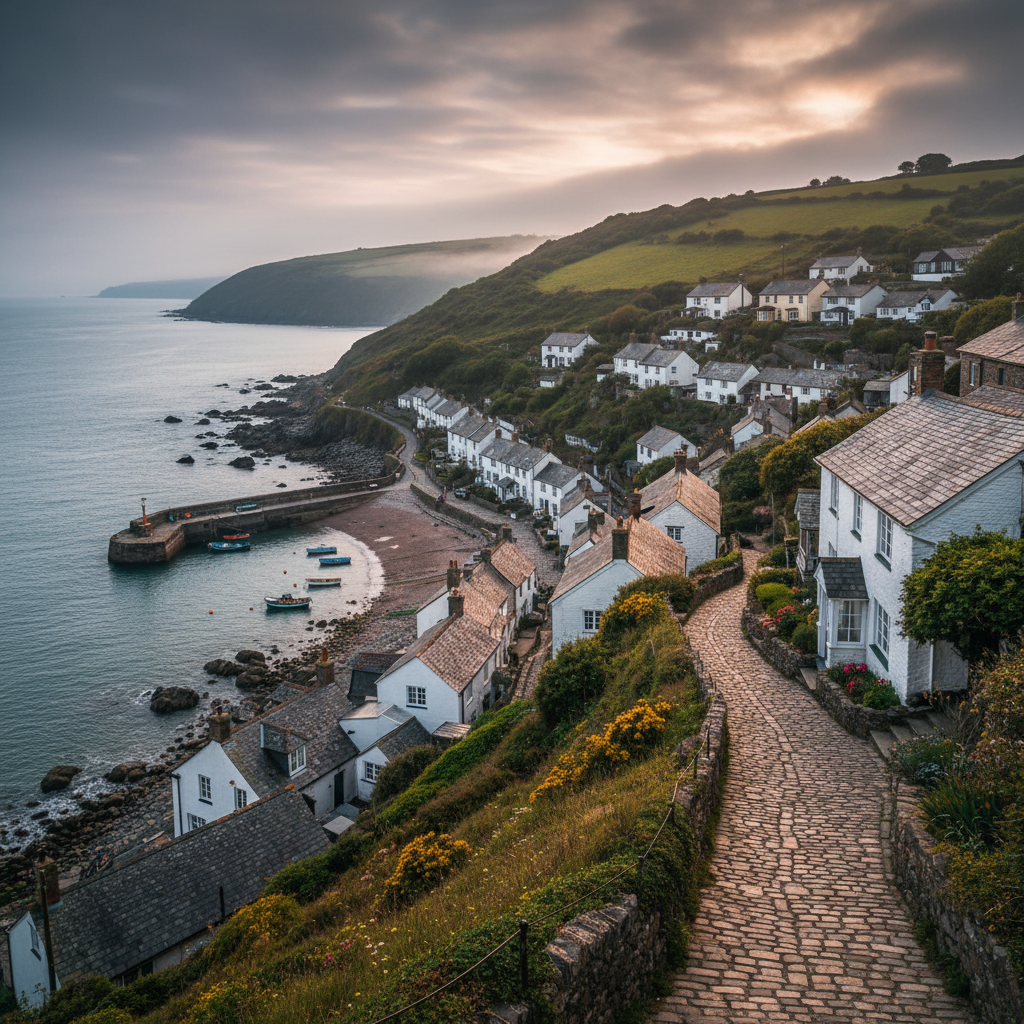
A steep cobbled fishing village where white cottages tumble towards the sea.
About
Clovelly
Clovelly sits on the North Devon coast at the western edge of Exmoor's influence, a village of such singular geography that it feels less like somewhere you choose to visit and more like somewhere you fall into. The settlement clings to a near-vertical cleft in the cliffs, its single cobbled street dropping steeply from the wooded ridge above to a small working harbour below. There are no cars here. No pavements in any conventional sense. Just the long, patient descent of rounded cobblestones worn smooth by centuries of use.
The views from this descent are what fix Clovelly in the memory. As you move down through the village, the Bristol Channel opens and shifts in the gaps between whitewashed cottages, framed differently at each turn. The water sits out to the north, wide and frequently restless, and on clear days the Welsh coast resolves into a low dark line on the far horizon. This is not a panoramic viewpoint in the conventional sense. The view here is something you move through, something that reveals itself in fragments, cottage wall to cottage wall, as the street bends and drops.
The harbour at the foot of the village is small and utilitarian, a working structure built to withstand Atlantic swells rather than to attract admiration. Fishing boats sit against the old stone pier, and above them the village stacks up the hillside in layers of white render and dark slate, a composition that has been photographed more times than it is possible to count and that still retains something genuinely unexpected about it when you see it in person.
Clovelly's long history as a fishing settlement is visible in the bones of the place. The estate village character, preserved carefully through the twentieth century under private ownership, has kept the architecture coherent in a way that many comparable coastal settlements have not. This consistency, which might in other contexts feel contrived, here reads as continuity. The village looks as it does because it was built for a particular purpose in a particular place, and neither the purpose nor the place has fundamentally changed.
Character
The feel of Clovelly
The physical experience of Clovelly is dominated by the weather in a way that few English villages can match. Its north-facing aspect and coastal exposure mean that conditions here change rapidly and are often more extreme than anything inland. A morning of flat grey cloud and drizzle can give way to glittering light by midday, or to driving squall by afternoon, and the village responds to each shift differently. In dull weather the whitewashed walls take on a chalky pallor and the harbour water turns the colour of pewter. In low winter sun everything sharpens, the cobbles glisten, and the shadows in the narrow lanes cut hard and deep.
The weight of weather here is not incidental. It is what has shaped the character of the place over centuries. The deep-set windows, the heavy render, the way buildings sit close together on the hillside: these are architectural responses to Atlantic exposure, not aesthetic choices. In a real storm, standing on the quayside with the spray coming over the pier wall, the village stops being picturesque and becomes something more serious. It reminds you that the people who built this place were not here for the view.
There is a particular kind of damp cold that settles into the lower lanes in winter, drawn down off the wooded cliffs and held close by the narrow walls. It lifts when the wind comes off the sea, replaced by something colder but cleaner. Locals who have lived here through many winters speak of the village in weather terms, not distance terms: how long it takes to get up the hill in an east wind, which cottages hold the warmth, where the frost settles first. Weather is the primary language of this place, and understanding that changes how you experience it.
First-hand visit
Keith's Take
Something about the cobbles changes underfoot as you drop towards the water, and by the time the harbour comes into view you realise you've been paying close attention for the last half hour without noticing it.
The sound you hear before you see much of anything is the creak of boat fenders against the quay wall, a low rhythmic sound that carries up the lane even when the village is otherwise quiet. It takes a few visits to register it properly, and then it becomes one of the things you listen for. Clovelly has a habit of giving up its details gradually, over return visits, in the way that places with strong daily rhythms tend to do.
What regular visitors eventually understand is that the village runs on a tide of its own, not a sea tide but a tourist one. There is a window in early morning, before the car park fills, when the residents are doing what they have always done, moving deliveries on the wooden sledges, tending the small gardens, opening shutters onto the channel light, and the village is operating as itself rather than as an attraction. That version of Clovelly is not hidden or hard to reach; it simply requires being there at the right hour. Come back on a weekday in March and it is available for the whole day.
The other thing that takes time to notice is how differently the channel reads from different points on the descent. At the top it is a distant bright strip between trees. Mid-way it is framed by rooflines and chimney pots, the water visible over the heads of the buildings below. At the harbour wall it is immediate, right there, occasionally flecked with white. The village has been built into a view rather than beside one, and understanding that distinction changes what you look at on the way down.
Keith's Take — a first-hand account from the 3moors team
Map & Getting Here
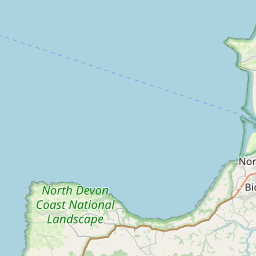
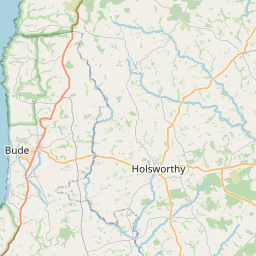
Getting to Clovelly


What to expect
A natural way to spend time here
The approach to the village from the top car park leads through the estate grounds and then, without much ceremony, onto the cobbled main street. The surface underfoot changes immediately and noticeably. These are not flat paving stones but rounded, uneven cobbles, many of them worn to a polish over centuries, and they require attention. Sensible footwear is not a recommendation here
it is a practical necessity, particularly in wet weather when the stones become properly slippery.
Half way down, where the street bends and a small terrace of cottages opens a gap towards the sea, there is a moment when the scale of the village becomes fully apparent. You are suspended between woodland and harbour, the buildings stacking above and below you, the channel visible ahead. At this point the gradient also steepens. What felt like a gentle descent at the top becomes more emphatic, and the return journey, which is always uphill, begins to feel like a commitment worth thinking about.
The village rewards patience more than pace. Those who move through it quickly, covering the descent and ascent in under an hour, miss the way it changes with attention. Sit on the harbour wall for a while. Watch how the boats move on their moorings. Let the other visitors thin out. Clovelly at rest, when the main movement of the day has passed, feels quite different from Clovelly in the middle of it.
What makes it stand out
What makes Clovelly special
What distinguishes Clovelly from other preserved coastal villages in the South West is not its prettiness, though it is undeniably striking, but its structural logic. The village exists in this form because the topography demanded it. The single street, the sledge-transport of goods, the arrangement of buildings in tight tiers: none of this was designed for effect. It evolved from the practical problem of building a working settlement on a cliff face. That origin is legible in every detail, and it gives the place an integrity that coastal villages arranged for tourism rarely possess.
The woodland above the village is also particular to Clovelly and often overlooked. The cliffs are clothed in ancient mixed woodland that provides shelter and creates the micro-climate that makes the village's hanging gardens possible. Walking through this woodland before descending into the village proper gives a useful sense of the geology: the deep combes, the sudden drops, the way water moves through the hillside. It is a landscape that explains the village rather than simply decorating it. Most visitors bypass it in their hurry to reach the cobbles below, which means the woods remain genuinely peaceful even on busy days.
Don't miss
Things to see and do
Walk the full descent to the harbour before doubling back, letting the view reveal itself gradually rather than seeking it out at a single point.
Sit on the harbour wall for at least twenty minutes and watch the light move on the channel water.
Look up at the village from the quayside to understand its vertical scale properly: it is the view most photographers seek and the one that makes the most sense of the layout.
Follow the signed path into the woodland above the village before or after your descent, where the trees are old and the ground falls away sharply to either side.
Notice the sledge tracks worn into the steeper cobbles near the bottom: goods have been moved this way for centuries and the stone remembers it.
Find the small terraced gardens attached to mid-slope cottages, where tender plants survive in the shelter of the hillside in a way they would not fifty metres higher.
Linger near the fishing boats rather than rushing past them. The harbour is still working in a limited way, and the equipment and the craft on display are not ornamental.
Walks from here
Getting out from Clovelly
The South West Coast Path passes through Clovelly and provides the most direct connection to the broader landscape. Heading east from the harbour and climbing back through the village, the path continues along the clifftop towards Bucks Mills, a smaller and much quieter settlement about three miles along a well-marked but undulating route. The terrain here involves repeated dips into wooded combes and climbs back to the clifftop, with good open views north across the channel between sections of woodland cover.
Westward from Clovelly, the coast path moves towards Hartland Point, one of the most exposed and dramatic sections of the entire South West coastline. This is a more serious undertaking, involving significant height gain and loss over rough ground, but the reward is a coastline that feels entirely unmediated. Hartland Point itself, with its lighthouse and the serrated rocks below the cliffs, is about five miles from Clovelly and can form the basis of a long day walk with return by the same route or via inland lanes.
For shorter walks, the estate woodland above the village has its own network of paths, some signed and some informal, that wind through the trees and provide elevated views back along the coast. These are particularly valuable in high summer when the main village is busy, offering a measure of solitude within easy walking distance of the car park.
Good to know
Before you go
Clovelly operates under a private estate and charges an entry fee to access the village, which has been the case for many decades. The fee includes use of the land train that runs from the top car park to the village entrance, though most visitors descend on foot. There is a Land Rover service that carries luggage and less mobile visitors back up to the top, which is worth noting if the return climb is a concern. The cobbled street is uneven throughout and the gradient significant
anyone with mobility difficulties should consider this carefully before committing to the full descent.
Arriving early in the day makes a genuine difference here. The village attracts substantial visitor numbers in summer and the narrow main street cannot absorb large crowds comfortably. By mid-morning in July or August the cobbles can feel congested. Early arrivals, typically before ten o'clock, will find the village quiet enough that the place takes on a different character entirely. Similarly, visiting outside the main summer season, particularly in late autumn or early spring, offers a more considered experience and the chance to see the harbour in the kind of weather it was actually built for.
Across the seasons: Clovelly in October and November, when the woodland above is in colour and the light comes low and lateral across the channel, is a different proposition from Clovelly in August. The crowds are absent, the air has weight to it, and the whitewashed walls catch the afternoon light in a way that is more revealing than the flat brightness of high summer. This is also the period when Atlantic weather is most likely to arrive without warning, which, far from being a deterrent, is part of what makes the visit worthwhile. A grey morning with mist in the combes can lift in an hour into something extraordinary. Winter visits, particularly in January and February, require preparation but offer the village in its least curated form. The harbour is quieter, the fishing activity more evident, and the quality of light on clear winter days is sharp and clear in a way that summer rarely matches. The cobbles may be icy after overnight frost, which makes the descent genuinely hazardous, so timing matters. Spring brings the estate gardens into sequence from late March onwards, and the woodland above is at its most legible before full leaf cover arrives, the structure of the old trees visible in a way that summer obscures.
Local weather
Weather near Clovelly
Cloudy
Today
Met Office forecast · updated every 30 min
Practical info
Practical info
Clovelly village itself is car-free, and visitors must park at the top of the hill in the privately operated Clovelly Visitor Centre car park. This is a pay-and-display facility with reasonable capacity, though it fills quickly during summer weekends and bank holidays. There is no alternative roadside parking nearby that reliably serves the village. Arriving before 10am in peak season will give you the best chance of a straightforward start.
The Visitor Centre at the top of the hill has toilets, a café, and a small gift shop. Within the village itself there are a couple of pubs and a café, though these operate seasonally and hours vary. Public toilets within the village are limited. There is no National Trust infrastructure here in the conventional sense, as Clovelly is privately owned and maintained by the Hamlyn family estate.
The main cobbled street descends very steeply from the top of the village to the harbour, dropping around 120 metres over a short distance. The cobbles are uneven and can be extremely slippery when wet, making footwear with a firm grip essential at any time of year. There is no vehicular access down the main street for visitors; goods are transported by sledge. The return climb on foot is demanding, and a Land Rover taxi service operates for those who find the ascent difficult.
varies
Explore nearby
Places nearby
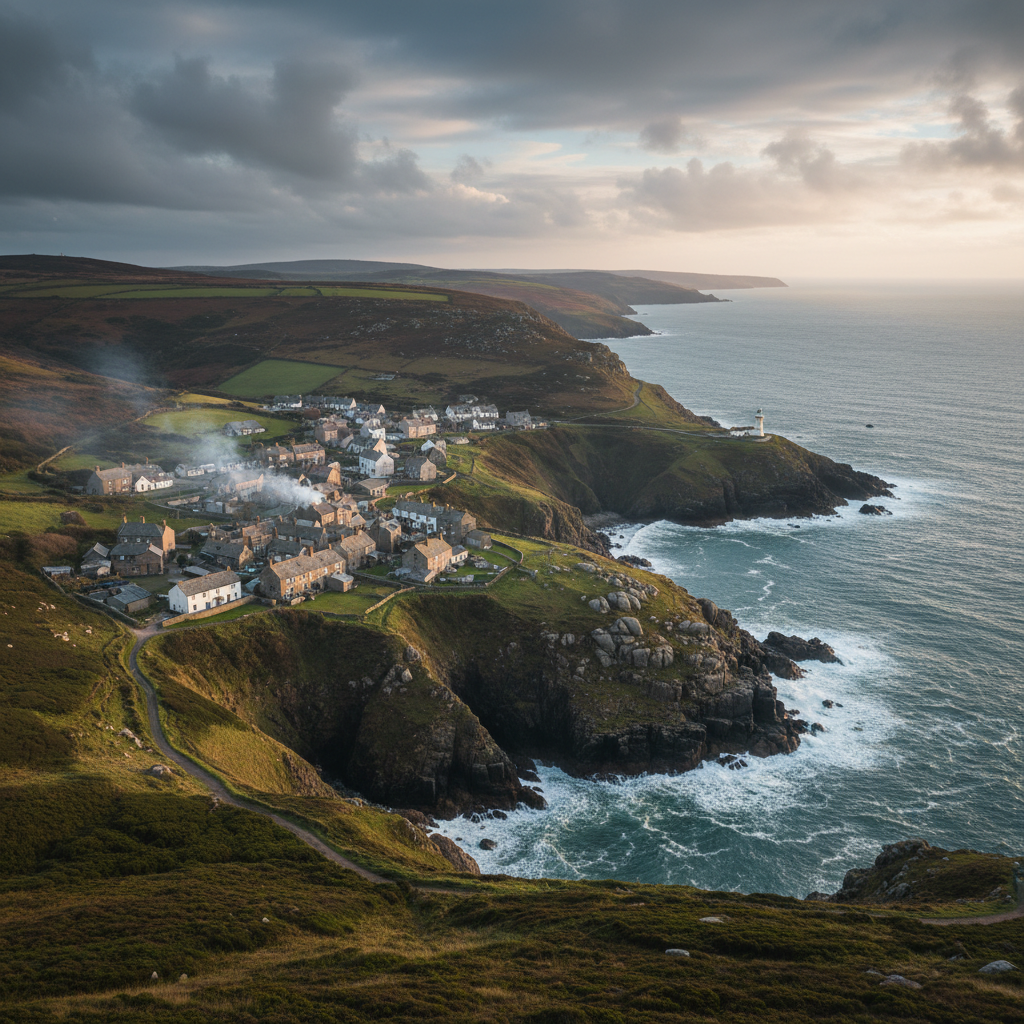
Hartland
Hartland offers dramatic cliff scenery, isolation and strong Atlantic atmosphere.
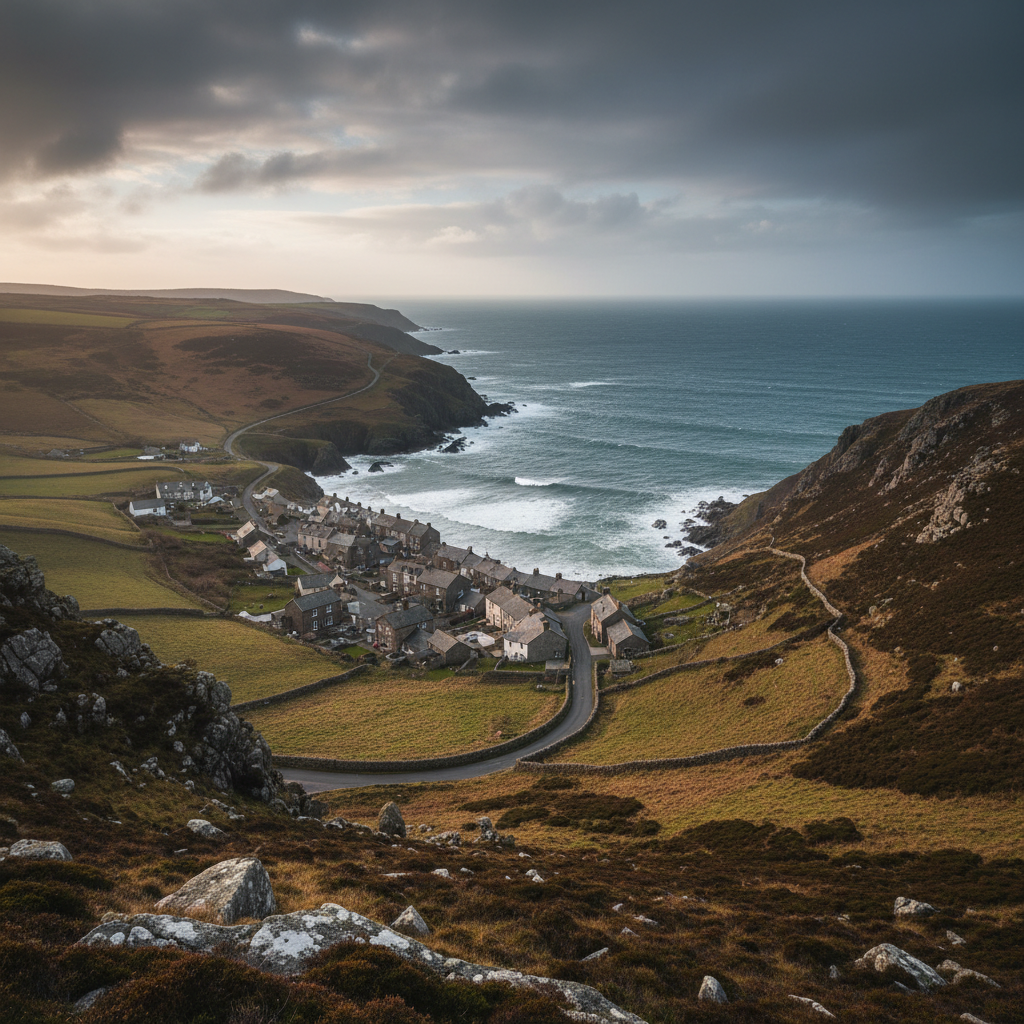
Hartland
Hartland offers dramatic cliff scenery, isolation and strong Atlantic atmosphere.
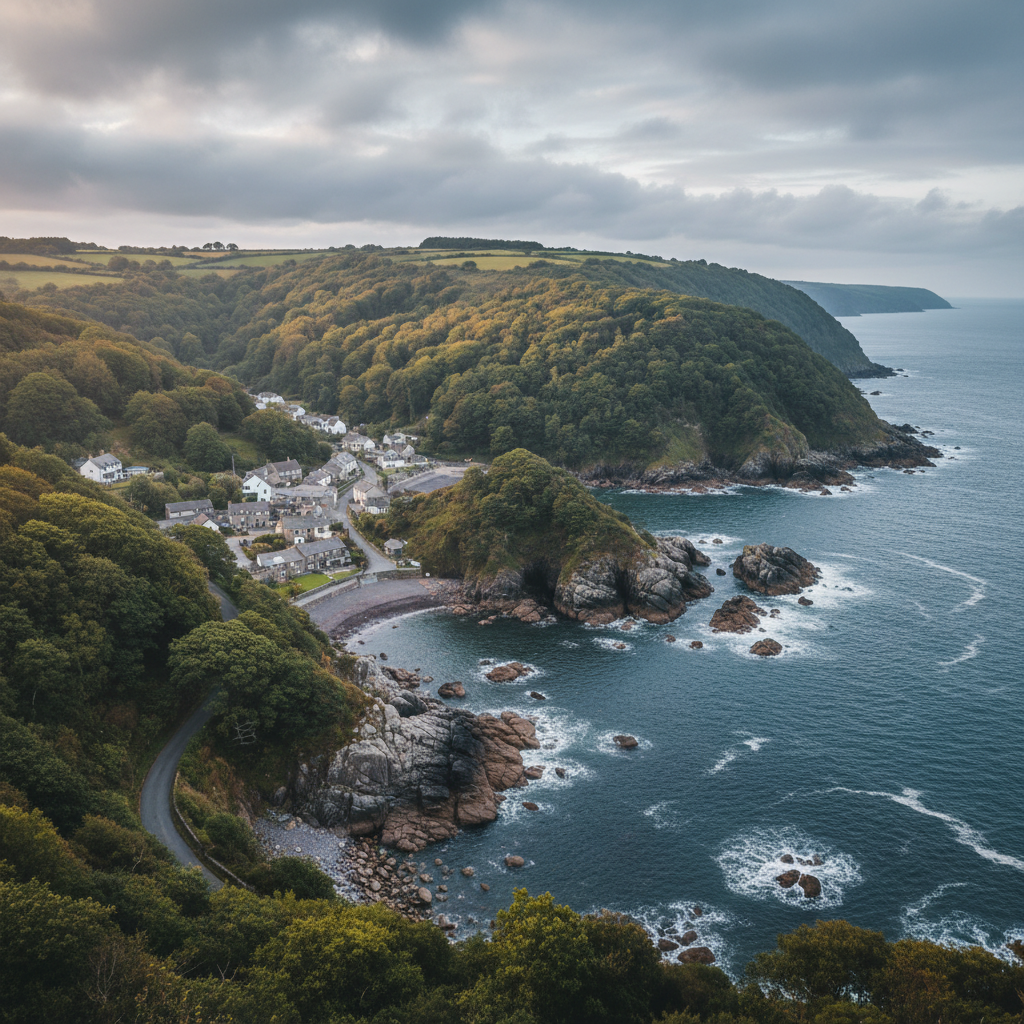
Lee Bay
Lee Bay feels sheltered, hidden and quieter than many North Devon coastal spots.
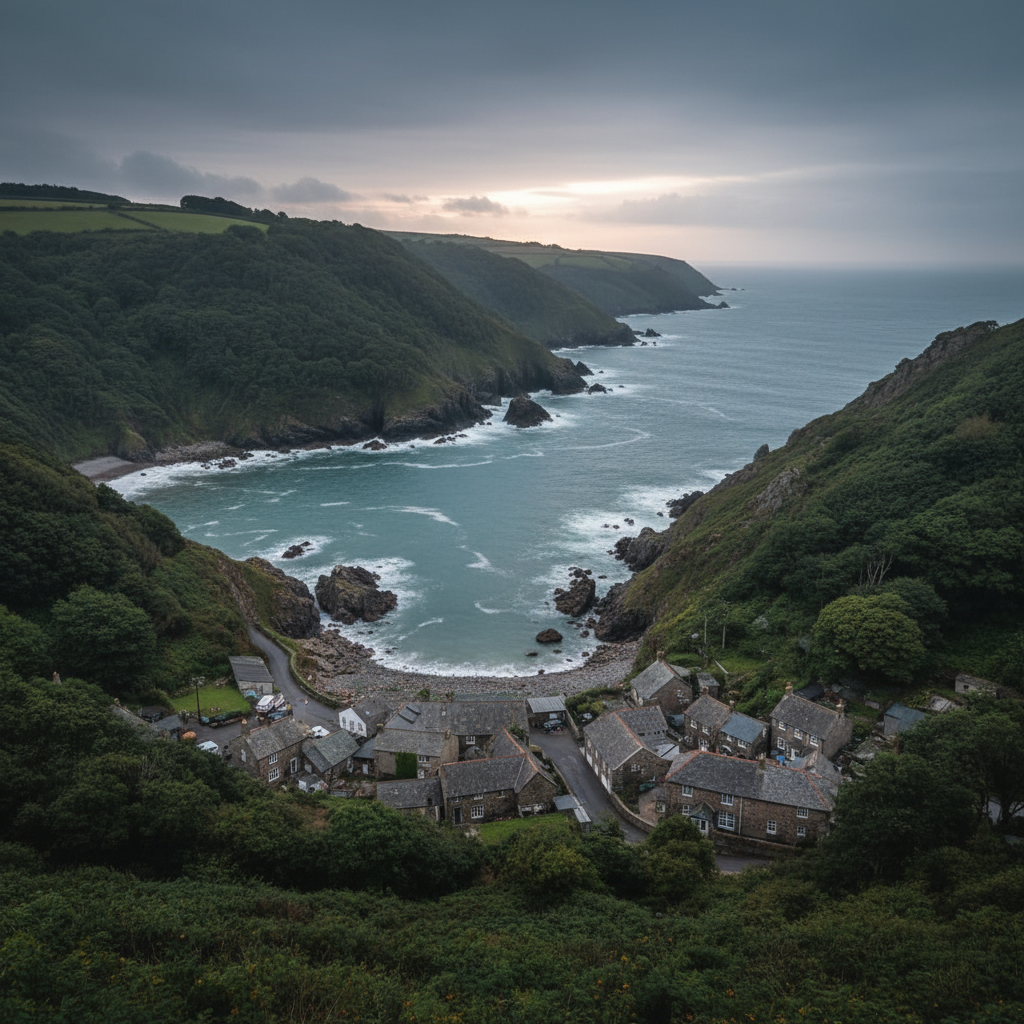
Lee Bay
Lee Bay feels sheltered, hidden and quieter than many North Devon coastal spots.
Join the 3moors Community for path conditions & local tips.
JoinWhy this place matters
Clovelly — in its own right
What stays with you after Clovelly is a sense of proportion that is easier to feel than to describe. The village is small, genuinely small, a single street and a harbour and a handful of lanes off it. Yet the experience of moving through it feels more substantial than that scale should allow. This is partly a function of the gradient, which makes even a short distance feel earned, and partly something to do with compression. Everything in Clovelly is present in close proximity: the working life of the harbour, the domestic life of the cottages, the natural world of the cliffs and woodland, all arranged within a few hundred vertical metres. That compression is the thing first-time visitors most often underestimate. They expect a village and find instead a kind of argument about how to inhabit an impossible piece of geography. The people who built here were not making a picturesque gesture. They were solving a problem. The fact that the solution turned out to be beautiful is, in some ways, beside the point.