Bodmin Moor · Far West Cornwall
Porthcurno
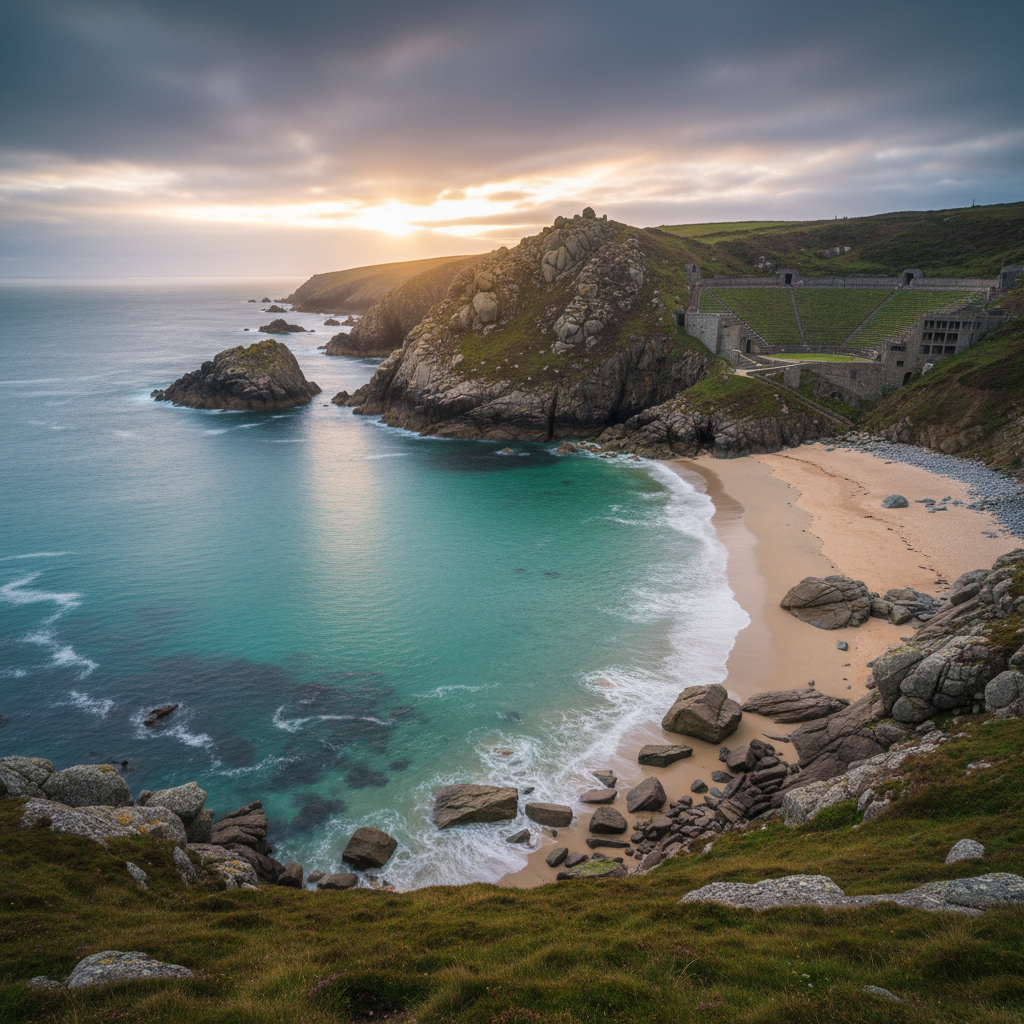
A turquoise cove beneath steep cliffs and the famous Minack coastline.
About
Porthcurno
Porthcurno sits at the far southwestern tip of Cornwall, tucked into a steep-sided valley where the land gives out and the Atlantic begins. It is a small cove by any measure, enclosed by granite headlands that press in close on either side, with a beach of near-white sand that seems improbable given its latitude. The approach from the car park is downhill, narrow, and hedged with wind-shaped vegetation, and the sea is hidden until the final few metres of the descent, when the valley opens and the water appears below.
The beach itself is governed by the tide in ways that become apparent the longer you spend here. At low water, Porthcurno is broad and generous, with firm sand running out to a surf line and rock platforms exposed at either edge. As the tide turns and the water climbs, the beach reduces steadily, the sand darkens, and the cove takes on a more compressed, pressurised quality. By high tide in rough weather, the sea can reach the base of the valley path. This tidal rhythm shapes every visit: whether you find a wide, walkable shore or a strip of wet shingle at the cliff foot depends entirely on when you arrive.
Most people come because of the visual drama: the combination of turquoise water, pale sand, and dark headland cliffs is rare on this coast, and rare in Britain more broadly. The Minack Theatre sits on the western headland above, its stone terraces carved into the cliff face, and its presence adds a layer of human interest that few coastal coves of this size can match. But Porthcurno is not simply a backdrop or a viewpoint. It is a working place in the sense that the sea makes it work constantly, rearranging its edges, altering its mood, and demanding attention from anyone who visits.
The valley behind the beach once carried telegraph cables that linked Britain to the wider world: the Eastern Telegraph Company routed its undersea cables through Porthcurno from the 1870s onwards, and a museum now sits in the cable station building partway up the valley. This history sits quietly beneath the scenic reputation, easy to overlook, but it gives the place a depth that goes beyond its appearance.
Character
The feel of Porthcurno
The quality of light at Porthcurno is the thing that sets it apart from the broader Cornish coast. The water here achieves a green-to-turquoise shift that is more Mediterranean in register than Atlantic, caused by the pale sand beneath a relatively shallow approach. In clear conditions and with the sun overhead, the sea holds its colour with an almost luminous intensity. In the hour before or after midday on a bright day, the light bounces back off the surface in a way that makes the whole cove seem to emit rather than simply reflect. The cliffs above stay dark against all of this, which sharpens the contrast and makes the water seem brighter still.
By overcast conditions, the effect reverses entirely. The water becomes pewter-grey and opaque, the sand loses its pale warmth, and the enclosing cliffs seem to press closer. This is not a less interesting version of the place
it is simply a different one. The shape of the valley, the height of the headlands, and the narrow mouth of the cove become more legible on grey days, when nothing is competing with them for attention. Visitors who return often tend to find the low-light version as compelling as the bright one, if not more so.
The sound at Porthcurno carries its own character. The beach is steep enough that waves arrive with some force, and the particular combination of coarse sand and fine shell debris at the tide line produces a distinctive rushing-and-dragging sound that differs from the flatter, wider beaches further north. In a swell, the noise fills the valley. On calm days it retreats to a measured background rhythm, punctuated by the calls of herring gulls working the cliff face above.
First-hand visit
Keith's Take
The water was doing something I hadn't seen at other coves along this coast, holding a green so bright it seemed almost internal, as though the colour came from beneath the sand rather than from the sky above it.
A cormorant was drying its wings on the eastern rocks when the tide began to turn. It stood absolutely still with both wings held wide, facing into the breeze, and stayed there long enough that most people passing on the beach either didn't notice it or had stopped noticing it. That kind of patience is easier to appreciate here than at beaches where the scene is constantly refreshed by arrivals and departures. Porthcurno on a mid-week morning in late spring has a quality of stillness between the crowds and the full quiet of winter: enough people to give the place life, few enough that you can still hear the specific sound the water makes as it pulls back across the shell-flecked sand.
What regular visitors here seem to understand is that the cove has distinct moods that correspond not just to season but to time of day and state of tide. The beach that appears at low water on a bright morning is not the same place as the narrowing strip of wet sand you find three hours later. The light shifts its angle, the water darkens as it deepens, and the cliff shadows begin to cut across the lower beach. Those who arrive, spend an hour, and leave will always see one version of this. Those who stay through a tidal cycle begin to understand the structure beneath it, the way the cove operates as a system rather than a static view.
There is also the matter of the valley itself, which most people pass through without slowing. The cable station sits partway up the path in a building that is easy to mistake for a minor administrative structure. The cables that once ran from here to India, to Gibraltar, to the Americas, entered the sea just below where children now paddle. It is not obvious that this happened here, and there is nothing in the landscape that marks it. That is perhaps why it repays the visit to the museum: the gap between the ordinary appearance of the cove and the scale of what was once routed through it is, on reflection, one of the more quietly astonishing things about this stretch of the Cornish coast.
Keith's Take — a first-hand account from the 3moors team
Map & Getting Here
Getting to Porthcurno




What to expect
A natural way to spend time here
The path from the car park leads downhill through a narrow, partly surfaced track flanked by low hedgebanks and wind-pressed gorse. The descent takes less than ten minutes at a measured pace, but it is steep enough in places to require some care, particularly on the return. Where the valley widens near the bottom, a small cluster of facilities sits above the beach: a seasonal café, a toilet block, and a stretch of grass used by those arriving early or leaving late. The beach itself reveals itself in stages as the path bends left and the final hedge gives way to open air.
At the tide line, the smell changes: the dry, gorse-and-salt scent of the upper path gives way to the colder, mineral smell of wet sand and exposed rock. The waves at Porthcurno arrive at an angle from the southwest, and where they meet the eastern headland they produce a cross-chop that occasionally sends spray further up the shore than expected. On rougher days, this is worth watching from the dry upper beach rather than the water's edge.
The cove rewards a patient visit rather than a brisk one. Those who walk the length of the beach at low tide, find a position on the exposed rock platforms at either end, and wait will see the character of the place shift. The light changes, the tide moves, the crowd redistributes. A couple of hours here will give a more complete picture of what Porthcurno actually is than a half-hour at the water's edge.
What makes it stand out
What makes Porthcurno special
What distinguishes Porthcurno from the other coves along this stretch of the Penwith coast is its combination of genuine inaccessibility and genuine fame. The beach is not remote in any serious sense: the car park is within a few minutes' walk, and the Minack Theatre draws visitors who might not otherwise venture this far west. But the valley setting, the enclosing headlands, and the tidal variability mean that even on busy days the cove retains a self-contained quality. The geography does not permit sprawl: there is the beach, the cliffs, and the sea, and nothing else.
The Minack Theatre on the western headland is a genuinely unusual presence. Built largely by hand by Rowena Cade from the 1930s onwards, it is a full outdoor amphitheatre cut into the cliff face, with the Atlantic as its permanent backdrop. It operates as a working theatre through the summer months, and its stone terraces are open to visitors outside of performance times. Seen from the beach below, the Minack reads as a faint geological irregularity on the cliff top: only from the path above does its scale become clear. The relationship between the theatre and the cove beneath is one of the more unusual adjacencies on the British coast.
Don't miss
Things to see and do
Walk the beach at low tide from headland to headland to understand the full width of the cove before the sea reclaims it.
Climb the path to the western headland and find the terraces of the Minack Theatre looking down at the water below.
Sit on the upper beach in the middle of the day when the sun is directly overhead and the water colour is at its most vivid.
Look at the rock platforms on the eastern side of the cove at low tide, where the granite is layered and fractured in long horizontal slabs.
Follow the valley path uphill past the cable station to the Porthcurno Telegraph Museum, which tells the story of the undersea cables that once ran through this cove.
Watch the western headland cliffs at dusk in summer, when the light catches the pink in the granite and the gorse holds its yellow against the darkening sky.
At high tide, take the coastal path east towards Treen and find a position on the open cliff to watch the surf arrive in sets from the open Atlantic.
Walks from here
Getting out from Porthcurno
The South West Coast Path runs through Porthcurno in both directions and offers some of the finest cliff walking in Cornwall within a short distance. Heading east from the beach, the path climbs steeply to the cliff top and follows the headland towards Treen, passing above the sea cave known as the Lion's Den before reaching the promontory of Treryn Dinas, which carries the Logan Rock: a large rocking stone that sits above a natural cliff fortress that has been occupied since the Iron Age. This section takes around an hour at a comfortable pace and involves some exposure on narrow cliff paths.
Heading west, the path climbs to the Minack headland and continues towards Land's End, with views back into the cove from progressively higher ground. This direction is more open and windswept, with fewer sheltered sections, but the coastline becomes increasingly dramatic as the path approaches Gwennap Head. The full walk to Land's End from Porthcurno takes roughly three to four hours one way and requires onward transport or retracing the route. A shorter option is to walk as far as Porthgwarra (around an hour each way) and return along the same path, which reads differently on the return given the changed light and altered views.
Good to know
Before you go
The car park at Porthcurno is managed and charges a fee in season. It fills early on fine summer days, and by mid-morning in July and August the approach road can become congested. Those arriving before nine in the morning or after five in the afternoon will find conditions significantly calmer. The beach faces broadly south-southwest and receives direct sun for much of the day in clear weather, but the enclosing cliffs mean the lower beach falls into shade earlier than expected in the afternoon, particularly in spring and autumn.
The coastal path sections above Porthcurno are exposed and sometimes narrow. Good footwear is necessary: the granite can be slippery when wet and the path surface varies considerably between sections. Mobile signal is unreliable in the lower valley. The beach has no lifeguard cover in the off-season, and the surf can be more powerful than its appearance suggests from the upper beach.
Across the seasons: Porthcurno is at its most photogenic in late spring, from mid-May through June, when the light is strong and high, the gorse is in full flower along the valley path, and the crowds have not yet reached their summer peak. The water colour is sharpest in these conditions, the paths are dry, and the Minack is open but not yet operating at full capacity. This is the period when the qualities that make the cove distinctive are most easily visible. Midsummer brings significant visitor numbers, and on fine weekends the beach and paths can be genuinely crowded. The experience of the cove changes under those conditions: it becomes more social, more performative, and harder to read as a landscape. Those who value the quieter character of the place should consider weekday visits, early or late in the day, or accept that the summer version is a different thing altogether. In autumn and winter, Porthcurno becomes markedly different. From October onwards, the coastal light takes on a lower, more directional quality that suits the cliffs and the darker water well. Swells from Atlantic depressions can produce spectacular surf, and the valley path carries the smell of wet earth and decomposing bracken rather than gorse and salt. The beach is rarely busy outside of half-term periods, and the Minack Theatre is closed to performances though the structure remains visible from the path. Winter visits require preparation for exposure: the headlands are unprotected and the wind off the sea can be severe.
Local weather
Weather near Porthcurno
Sunny intervals
Today
Met Office forecast · updated every 30 min
Practical info
Practical info
Porthcurno has a single managed car park above the beach, operated by the National Trust, which fills quickly on summer weekends and bank holidays. Arrive before 10am in peak season or expect to queue or be turned away. There is no roadside overflow or informal parking in the lanes nearby, and the approach road is narrow with limited passing places. An honesty box or pay machine is typically in operation; check current charges before visiting.
The beach area has a seasonal café and public toilets, though these are not always open outside the summer months. There is no large visitor centre at the cove itself, though the nearby Minack Theatre has its own facilities during opening hours. Bring water and food if visiting in the shoulder seasons. Mobile signal is unreliable in the cove and along the cliff path.
The path down to the beach is steep and can be slippery on the worn stone and compacted earth surface after rain. Sturdy footwear is advisable even in summer, particularly if continuing onto the South West Coast Path in either direction. The cliff edges above the cove are unfenced in places, and the exposed headland offers little shelter when the wind comes in off the Atlantic. Wheelchair and pushchair access to the beach itself is limited by the gradient of the descent.
varies
Explore nearby
Places nearby
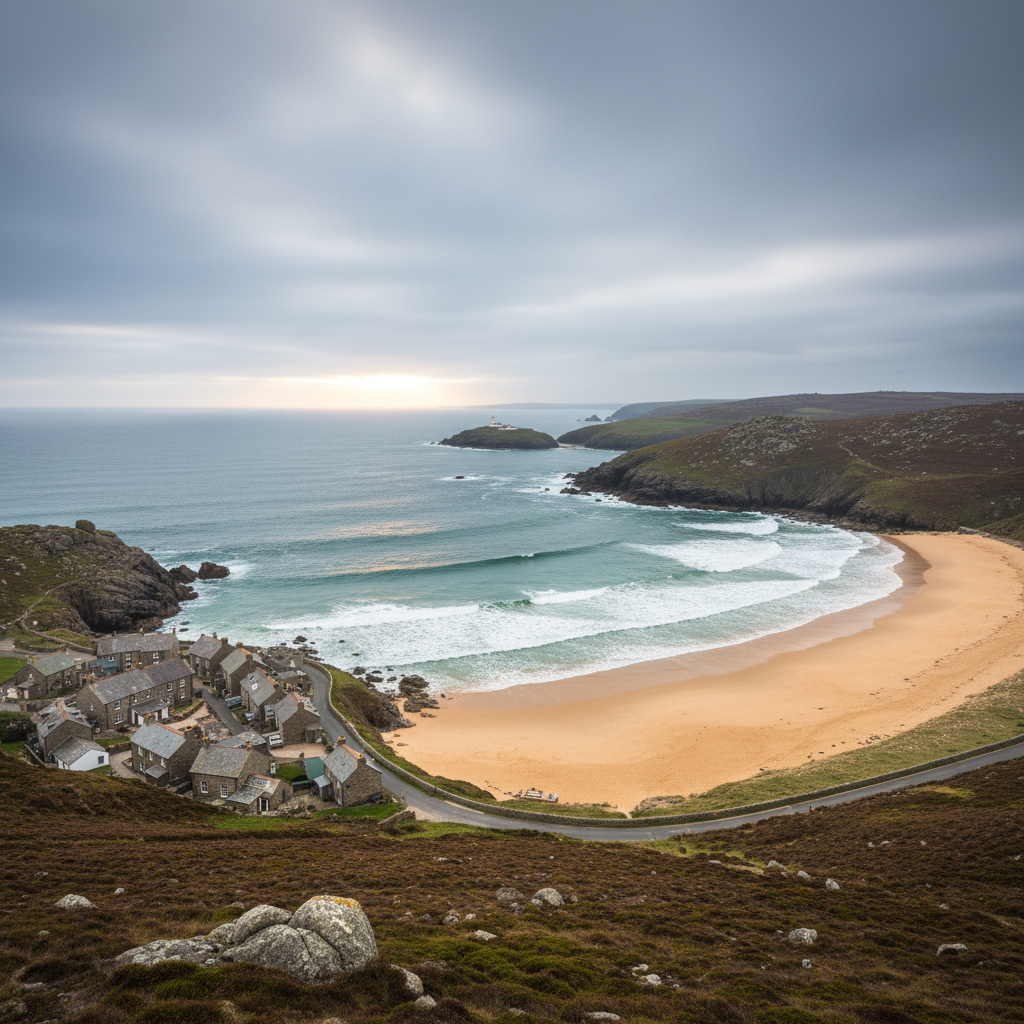
Sennen Cove
Sennen Cove combines beach atmosphere with some of Cornwall’s most exposed coastline.
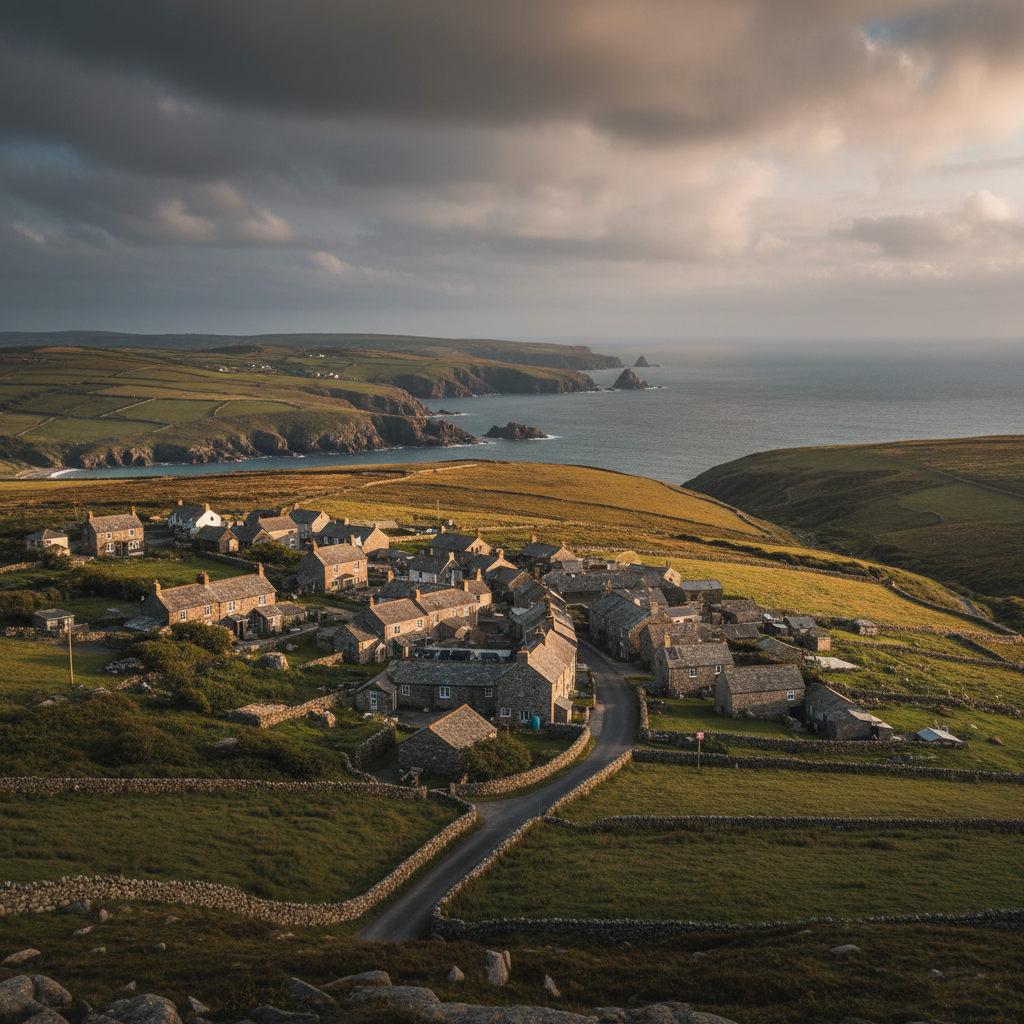
Mullion
Mullion combines village atmosphere with access to some of Cornwall’s wildest coastline.
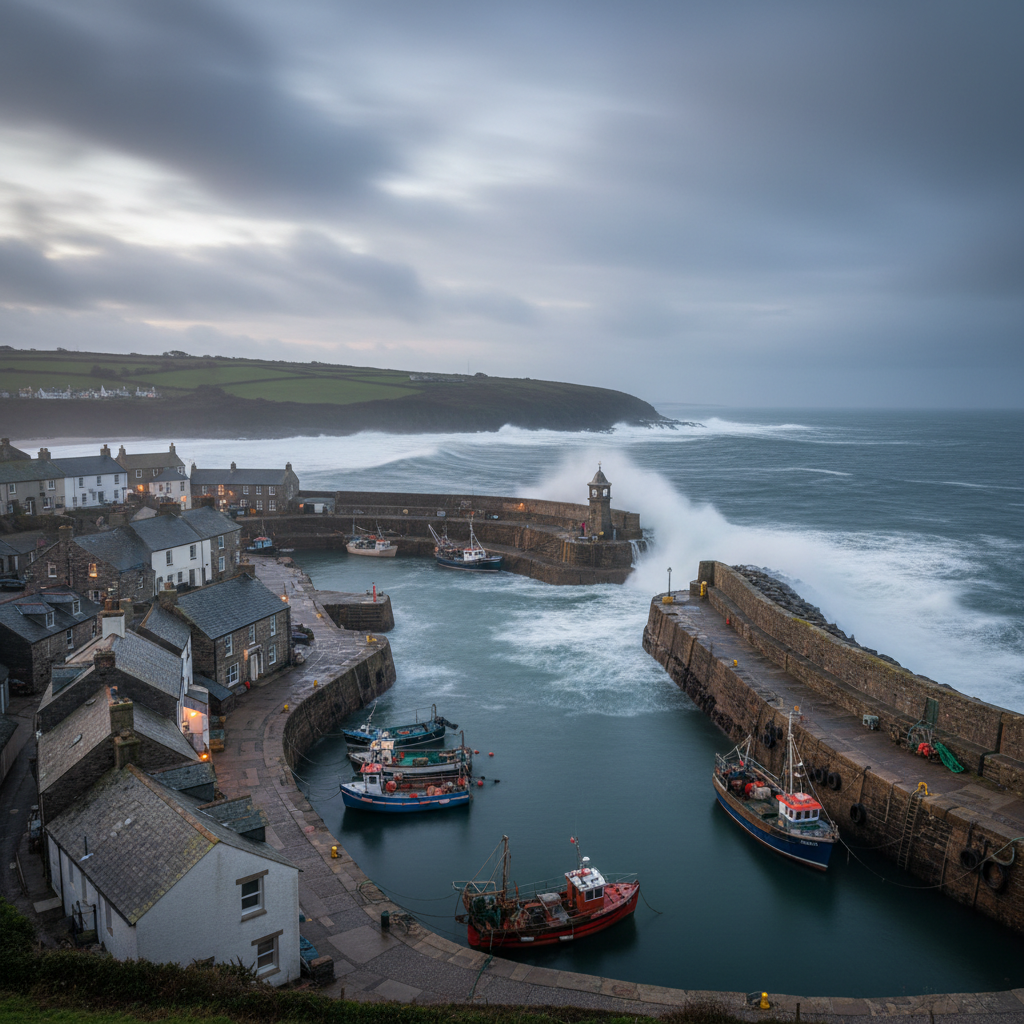
Porthleven
Porthleven offers one of Cornwall’s strongest combinations of harbour atmosphere and Atlantic power.
Join the 3moors Community for path conditions & local tips.
JoinWhy this place matters
Porthcurno — in its own right
There is something useful about a place that refuses to stay the same from one visit to the next. Porthcurno's exposure, its orientation to the southwest, and the narrowness of its valley mean that it responds to the weather more visibly than most beaches. A change in wind direction or cloud cover alters the whole register of the cove: the colour of the water, the quality of the sound, the feeling of the air on the cliff path above. Visitors who arrive with fixed expectations sometimes find this frustrating. Those who come without them tend to find it the most interesting thing about the place. That susceptibility to conditions is, in the end, what the cove is about. It is not sheltered or forgiving. It faces the full weight of the Atlantic with nothing between it and the open ocean, and it makes no accommodation for that fact. The experience of being here in a winter gale and the experience of being here on a calm June morning share a setting but almost nothing else. Both are legitimate. Both are, in their own way, the real Porthcurno.
Explore more
Discover other places, walks, and hidden corners across Bodmin Moor.