Walk Guide
Wistman's Wood, Dartmoor: Walk, History, Ecology and Photography Guide
A flagship 3moors guide to walking to Wistman's Wood on Dartmoor — combining practical route advice, ancient history, upland ecology, responsible visiting guidance and photography tips.
Quick Answer
Wistman's Wood is an ancient upland oak woodland in the West Dart Valley on Dartmoor, reached by a roughly 4km return walk from Two Bridges car park. It is a fragile habitat — enjoy it from the paths and edges, and do not enter the wood or scramble on the moss-covered boulders.
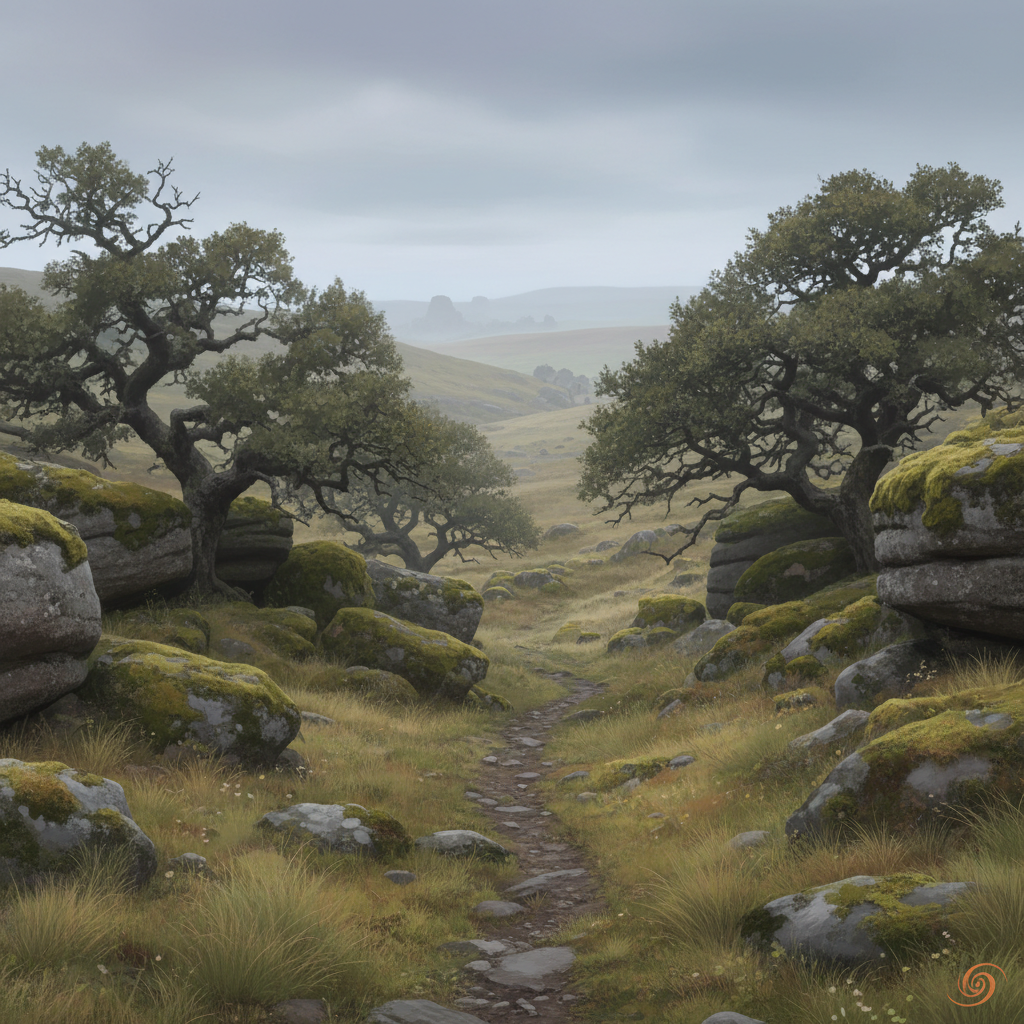
There are few places on Dartmoor — or anywhere in England — that feel quite like Wistman's Wood. Tucked into the West Dart Valley above Two Bridges, this ancient fragment of upland oak woodland seems to belong to another time. Twisted, moss-draped trees rise from a clutter of lichen-covered granite boulders, wrapped in a damp Atlantic haze that barely lifts even in summer. It is genuinely ancient, genuinely fragile, and genuinely worth the walk.
This guide covers everything you need to visit Wistman's Wood thoughtfully: the walk in from Two Bridges, the ecology and history of the wood, photography advice, and clear guidance on how to enjoy this remarkable site without harming it. Because Wistman's Wood is one of those places that can only stay special if the people who love it treat it with care.
Quick Facts
- Start point: Two Bridges car park, Dartmoor (OS grid ref SX 609 750)
- Distance: Approximately 4km return
- Walking time: Around 1 hour walking; allow longer for photography and quiet stops
- Grade: Easy to moderate
- Terrain: Moorland track, rough path, wet and muddy sections especially near the wood
- Best for: Ancient woodland views, photography, ecology, quiet Dartmoor atmosphere
- Access note: Fragile habitat — enjoy from outside and the edge; do not enter the wood or walk through the boulders
The 60-Second Version
Wistman's Wood is one of three surviving fragments of ancient upland oak woodland on Dartmoor. It sits at around 380 metres above sea level in the West Dart Valley, which is unusually high for woodland of this character. The trees are sessile oaks — small, gnarled and slow-growing — draped in extraordinary quantities of mosses and lichens that have built up over centuries of damp Atlantic conditions. The boulders beneath them are equally ancient, part of the clitter that covers much of this valley.
People visit because it looks and feels unlike anywhere else. It has the character of temperate rainforest, the atmosphere of old Dartmoor myth, and a quiet intensity that photographs well but rewards slow, careful attention even more.
It is also fragile. Visitor numbers have increased significantly in recent years, and the mosses, lichens and root systems that make the wood so extraordinary are easily damaged. The guidance throughout this article is to keep to the paths and enjoy the wood from its edges.
Walking to Wistman's Wood
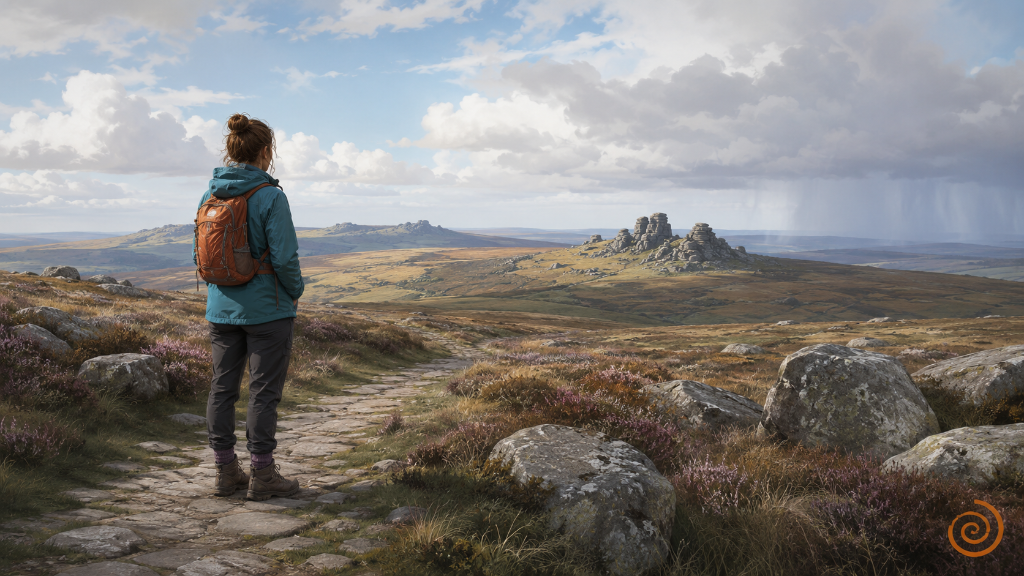
The walk begins at Two Bridges, one of the most recognisable crossing points on central Dartmoor. The Two Bridges Hotel sits here, and a small car park is available nearby. The route follows a clear moorland track heading north along the west bank of the West Dart River.
The first section is easy going — a broad track past Crockern Farm with good views opening across the valley. The West Dart runs to your right, and the moorland rises on both sides with open skies above. On a clear day the walking feels expansive and easy. In mist, the valley closes in and takes on an entirely different character.
As you continue north, the path becomes rougher and the ground wetter underfoot. Waterproof boots are strongly recommended — even in summer, this section can be muddy. The wood itself becomes visible ahead and to the right: a dark, compact mass of twisted trees rising from the pale grey boulders of the valley side.
Approach the wood carefully and quietly. The path runs along the lower edge and you can see clearly into and across the woodland from here without needing to enter. This is the right place to stop, look, and take your time.
Why Wistman's Wood Matters
Wistman's Wood is not ordinary woodland. It is one of the best surviving examples of upland temperate rainforest in England — a habitat type that is genuinely rare on a global scale, found mainly in the wet Atlantic fringe of western Europe and in similar oceanic climates elsewhere in the world.
The conditions here are specific: high rainfall, mild temperatures, relatively clean air and a long period of ecological continuity. These factors allow mosses and lichens to build up in extraordinary diversity and depth. Some of the cushions of moss on the boulders within the wood have been accumulating for centuries. The lichen flora is similarly rich and slow-growing.
The oak trees themselves are small by any standard — many are only a few metres tall despite being hundreds of years old. This is partly the effect of altitude, exposure and the thin soils, and partly because the trees have been growing slowly in a stable, undisturbed environment for a very long time. The result is a woodland canopy that feels compressed and ancient, with a density of character that has nothing to do with size.
This is why the wood is so easily damaged. A single footstep on a moss cushion can compress centuries of growth. Scrambling over boulders to get a better look or a better photograph removes the surface layer that has taken generations to establish. The wood can recover, but only slowly — and only if the pressure is reduced.
A Short History of Wistman's Wood
The name Wistman's Wood is old, though its precise origin is debated. One interpretation connects it to the old Dartmoor dialect word 'wisht' — meaning eerie, uncanny or haunted. The wood has carried an atmosphere of strangeness for as long as records exist.
The landscape around the wood is prehistoric. Hut circles, field systems and ceremonial monuments are visible within a short distance, indicating that the West Dart Valley was occupied during the Bronze Age and possibly earlier. Whether the wood was larger then, or whether it has always been this isolated fragment, is not certain — but it is known that woodland once covered far more of the Dartmoor uplands before clearance by early farmers.
In folklore, Wistman's Wood has been associated with the Devil, with a pack of spectral hounds known as the Wisht Hounds, and with a sense of supernatural presence that Dartmoor writers have returned to repeatedly. The Wisht Hounds were said to hunt the moor at night, gathering at the wood and setting out across the high ground. This mythology connects to the broader theme of the Wild Hunt found across northern European folklore, adapted here to the specific landscape of Dartmoor.
By the 19th and early 20th centuries, naturalists, artists and writers had begun to document the wood with increasing interest. It became one of the defining images of Dartmoor's character — ancient, wild and unlike anything in the farmed lowlands. That reputation has only grown.
Ecology and Wildlife
The ecological richness of Wistman's Wood is concentrated in its non-vascular plants — the mosses, liverworts and lichens that smother the boulders, branches and ground within the wood. Surveys have recorded well over 100 species of lichen and a significant number of moss species, many of which require exactly the combination of humidity, air quality and stability that the West Dart Valley provides.
The trees themselves are sessile oak (Quercus petraea), the characteristic oak of upland Atlantic woodland in Britain. Rowan also occurs within the wood, able to root in crevices between boulders where grazing pressure is limited.
For birds, the wood and surrounding moorland supports species typical of upland Dartmoor: ravens, buzzards, kestrels and ring ouzels in the valley. Within and around the wood, common woodland birds such as robin, wren, treecreeper and various tits are present. The wood is too small and isolated to support a full woodland bird community, but it functions as a refuge in the wider moorland landscape.
Insects, including specialist lichen-feeding species, are present in the wood, though surveys of this group remain incomplete. Reptiles — particularly adders and common lizards — are found on the surrounding moorland.
Conservation pressures on the wood include increased visitor footfall, overgrazing by sheep and cattle at the wood's edges, the slow effects of climate change on moisture and temperature conditions, and the cumulative impact of small individual actions — picking lichens, moving branches, scrambling over boulders — that each seem minor but collectively cause significant damage.
Wistman's Wood is a Site of Special Scientific Interest (SSSI) and is managed by the Dartmoor National Park Authority in partnership with Natural England.
Photography Guide
Wistman's Wood is one of the most-photographed locations on Dartmoor. Getting a distinctive image requires thought, patience and — most importantly — restraint.
Best conditions: Mist is transformative here. Soft morning mist in the valley, particularly in autumn and spring, gives the wood exactly the mysterious, atmospheric quality it deserves. Damp days with diffuse light also work very well — the wet mosses and lichens become more vivid, and the colours deepen. Hard sunshine produces flat contrast and busy shadows. Late afternoon light in autumn can be beautiful on the surrounding moorland and valley sides.
Lens suggestions:
- Wide angle: for the approach walk, the valley context and showing the wood within its moorland setting
- Standard zoom: for compositions from the path edge showing the structure and texture of the wood
- Telephoto: compressed views of the trees from further down the valley, isolating the twisted canopy against sky or hillside
- Macro or close-focus: for detail shots of lichen, bark texture and moss from the path — without entering the wood
Composition ideas:
- The approach: the track from Two Bridges with the wood visible ahead and the valley opening on both sides
- Twisted tree silhouettes against a pale sky or mist layer
- The relationship between moss, boulder, bark and sky
- The wood from across the valley — showing its scale and isolation within the moorland
- Early morning or late evening with low light raking across the moorland foreground
Ethical note: Do not enter the wood or climb onto the boulders for a photograph. The images that matter most can be made from the path. Do not move or disturb branches, moss or stones to improve a composition. Do not trample vegetation for a viewpoint. Leave the wood exactly as you found it.
Responsible Visiting
Wistman's Wood is one of Dartmoor's most visited natural sites, and the cumulative impact of that attention is real. Please take the following guidance seriously:
- Stay on the paths and edges. The path alongside the wood gives excellent views. You do not need to enter the wood to experience it.
- Do not walk on or through the boulders. The moss cushions covering them are centuries old and are easily crushed or removed.
- Do not pick, remove or disturb lichens, mosses, bark or branches. Even small amounts of material represent significant ecological damage when multiplied across thousands of visitors.
- Leave no trace. Take all litter home. Do not light fires or use barbecues anywhere near the wood or on this section of moorland.
- No wild camping in or near the wood. Open moorland camping under Dartmoor's access rules does not apply to sensitive habitats.
- Dogs under close control at all times. Keep dogs on leads near the wood and when livestock is present on the track.
- Avoid blocking access. Do not park on verges or block gateways near Two Bridges.
- Consider timing. Weekend afternoons in summer are the busiest times. An early morning visit in spring or autumn will give you a far better experience and reduce pressure on the site.
When to Visit
Spring: The oaks come into leaf late, given their altitude — usually May. Bird activity increases, and the fresh green growth against the grey boulders is striking. The ground will still be wet from winter rainfall.
Summer: Longer days and the most reliable weather, but this is also the busiest period. The full leaf canopy softens the wood's silhouette character. Early morning visits are strongly recommended to avoid the main visitor wave.
Autumn: Often the finest season. Mist settles in the valley in the mornings, the light is low and golden in the afternoons, and the surrounding moorland takes on its bracken and heather colours. Visitor numbers begin to fall after mid-September.
Winter: Stark and dramatic. The bare trees show their full structure, the boulders are more exposed, and the valley light is low all day. The ground will be at its wettest. Cold clear days with frost on the moorland can produce exceptional photographs. Very few visitors.
Safety and Access
- Parking: Limited car parking near Two Bridges. Can fill quickly on summer weekends and bank holidays. Arrive early or consider alternative transport.
- Weather: Dartmoor weather can change very quickly. Mist can descend rapidly on central Dartmoor even on days that begin clear. Always carry a waterproof and extra layers.
- Footwear: Waterproof boots are strongly recommended. The path from Two Bridges can be muddy throughout the year and is wet near the wood in all seasons.
- Navigation: In clear conditions, route-finding to Wistman's Wood is straightforward. In mist, the moorland can disorient quickly. Carry a map and compass or a downloaded GPS route and know how to use them.
- Mobile signal: Unreliable on central Dartmoor. Do not rely on your phone for navigation or emergency communication in poor conditions.
- The West Dart River: Stays to your right on the walk in. River levels rise quickly after heavy rain. Do not attempt to ford the river.
Explore Further
3moors Community
Recent conditions or questions about this walk?
Join the 3moors Community to ask about path conditions, parking, wildlife sightings and local tips.
Join the 3moors CommunityDiscussion takes place in our Facebook community.
Join the 3moors Community for path conditions & local tips.
JoinGuide information is based on careful research and local knowledge. Content is reviewed regularly and updated as new information becomes available.
Ready to explore?