We use essential cookies to keep the site working. Non-essential cookies help us improve your experience and understand how you use the site. You can accept or reject non-essential cookies at any time. Learn more
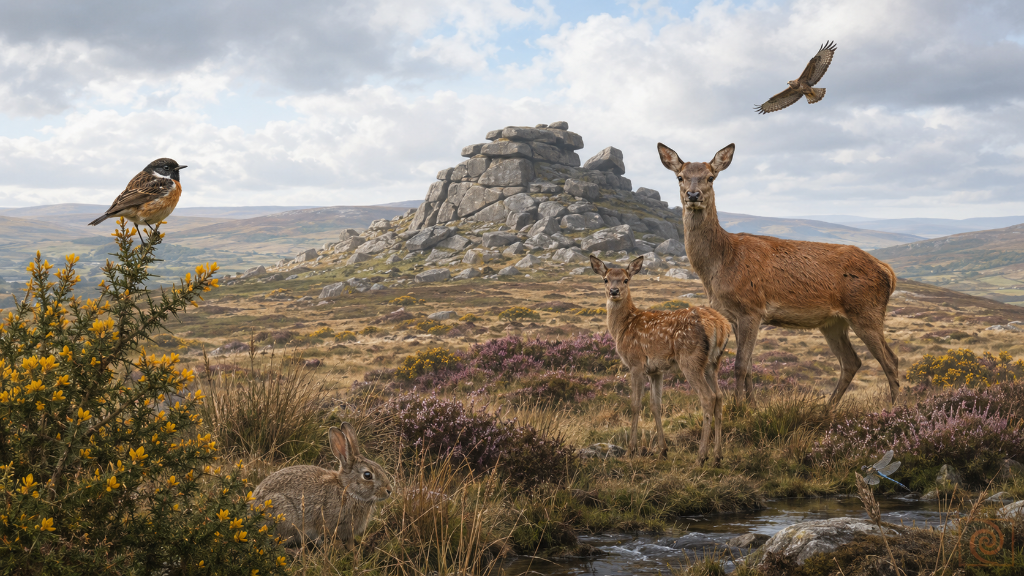
A practical guide to where you're most likely to see wildlife on Dartmoor, from open moorland to quiet valleys and woodland edges.
Q&Adartmoordevon
TypeWildlife Guide
Q&A
Moordartmoor
Countydevon
Quick Answer
<p>The best places to see wildlife on Dartmoor are open moorland for ponies, skylarks, meadow pipits and birds of prey, and quieter valleys, woodland edges and moorland fringes for deer, foxes and more sheltered birdlife.</p>
<p>You do not always need to walk far. Even moving a short distance away from busy car parks, roads and popular viewpoints can improve your chances. Look for variety: open ground, cover, water, edges and places where the landscape changes.</p>
Introduction
<p>Dartmoor wildlife is not evenly spread. Some areas can feel almost empty at first glance, while others quietly hold movement, sound and life.</p>
<p>The key is not simply choosing a famous location. It is learning what kind of habitat to look for. Open moorland, valleys, streams, woodland edges, rocky tors and quieter fringe areas all support different wildlife.</p>
<p>If you know what each landscape is likely to offer, you have a much better chance of seeing something.</p>
<h2>Before you head out</h2>
<p>Wildlife watching on Dartmoor works best when you slow down. Choose a route with time built in for stopping, listening and scanning. A short, quiet walk can sometimes reveal more than a long route rushed from point to point.</p>
<p>Early morning and dusk are often best, especially for deer, foxes and rabbits. Birds of prey can be easier later in the morning once the air warms and they begin circling. In spring and early summer, open moorland comes alive with skylarks and other ground-nesting birds.</p>
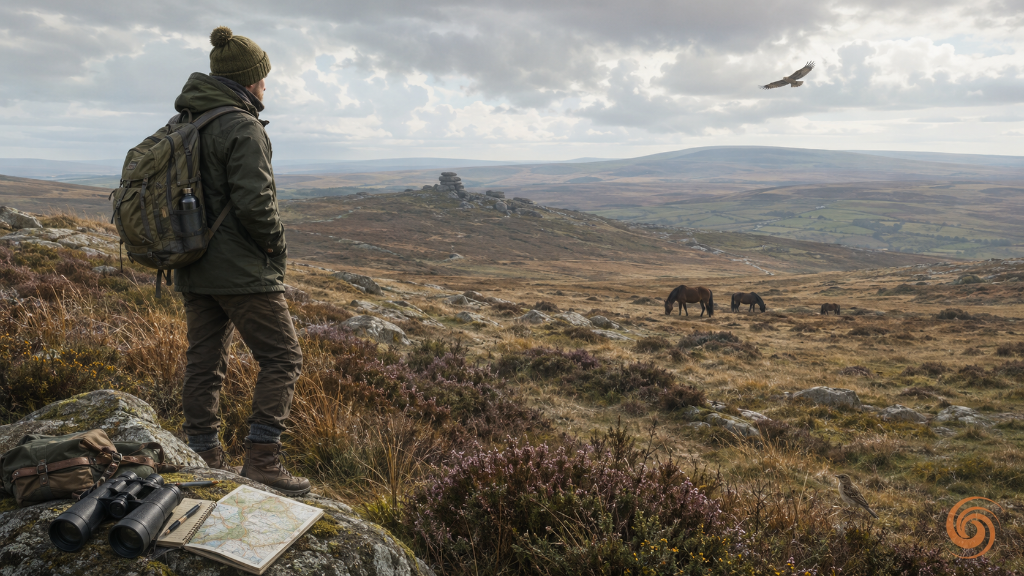
<p>Take binoculars if you have them, wear suitable clothing, and keep dogs under close control.</p>
<h2>Open moorland</h2>
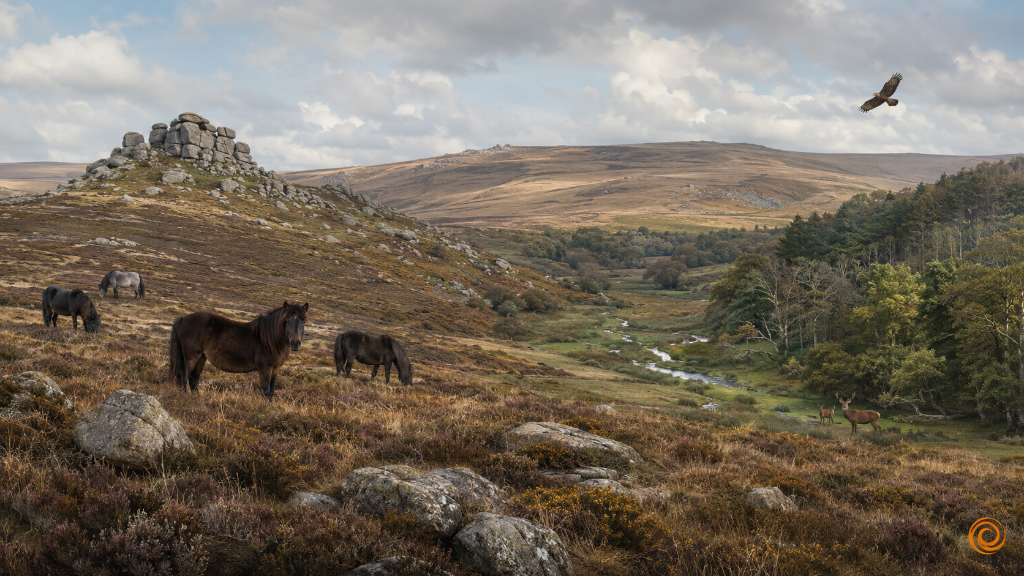
<p>Wide, open moorland is one of the best places to see Dartmoor ponies, skylarks, meadow pipits, ravens and buzzards.</p>
<p>The open landscape gives you long views, which makes it easier to spot movement at distance. Watch the skyline, scan ridges slowly and pause often. Ponies may be obvious, but smaller birds can be easy to miss unless you stop and listen.</p>
<ul><li><strong>Best for:</strong> ponies, skylarks, meadow pipits, buzzards, ravens</li><li><strong>Best time:</strong> spring and early summer for birdsong; most of the year for ponies</li><li><strong>Look for:</strong> movement along ridges, birds rising from grass, ponies grazing in small groups</li></ul>
<h2>Tors and high ground</h2>
<p>Tors are useful places to stop and scan. From higher ground you can watch large areas without moving through them, which gives wildlife a better chance of appearing naturally.</p>
<p>Buzzards, ravens and crows are often seen from high points. You may also spot ponies, sheep, cattle and distant movement across valleys or slopes. The trick is to stand still for a few minutes rather than arriving, taking a photo and moving on.</p>
<ul><li><strong>Best for:</strong> birds of prey, ravens, distant deer, ponies, landscape scanning</li><li><strong>Best time:</strong> late morning onwards for birds of prey</li><li><strong>Look for:</strong> circling birds, moving shapes along slopes, activity near valley edges</li></ul>
<h2>Valleys and combes</h2>
<p>Valleys and combes often hold more wildlife than exposed open ground because they offer shelter, water and cover. These areas are better for deer, foxes, smaller birds and wildlife that avoids the busiest open areas.</p>
<p>Early morning and dusk are especially useful. Move quietly and look along the edges rather than straight down the middle of a path. Wildlife often appears where open ground meets bracken, scrub, woodland or streamside cover.</p>
<ul><li><strong>Best for:</strong> deer, foxes, rabbits, woodland-edge birds, sheltered wildlife</li><li><strong>Best time:</strong> dawn and dusk</li><li><strong>Look for:</strong> movement near cover, shapes crossing slopes, birds working the stream edges</li></ul>
<h2>Woodland edges</h2>
<p>The edge between woodland and open moor is often more productive than deep woodland or bare moor alone. These transition zones provide food, shelter and escape routes.</p>
<p>Deer may use woodland edges, especially in quieter areas. Birds move between trees, scrub and open ground. Foxes and rabbits may also appear along banks, walls and fringe habitats.</p>
<ul><li><strong>Best for:</strong> deer, foxes, small birds, rabbits</li><li><strong>Best time:</strong> early morning, evening and quieter days</li><li><strong>Look for:</strong> movement where trees meet open grass, birds flicking between perches, tracks and paths into cover</li></ul>
<h2>Streams, wet ground and pools</h2>
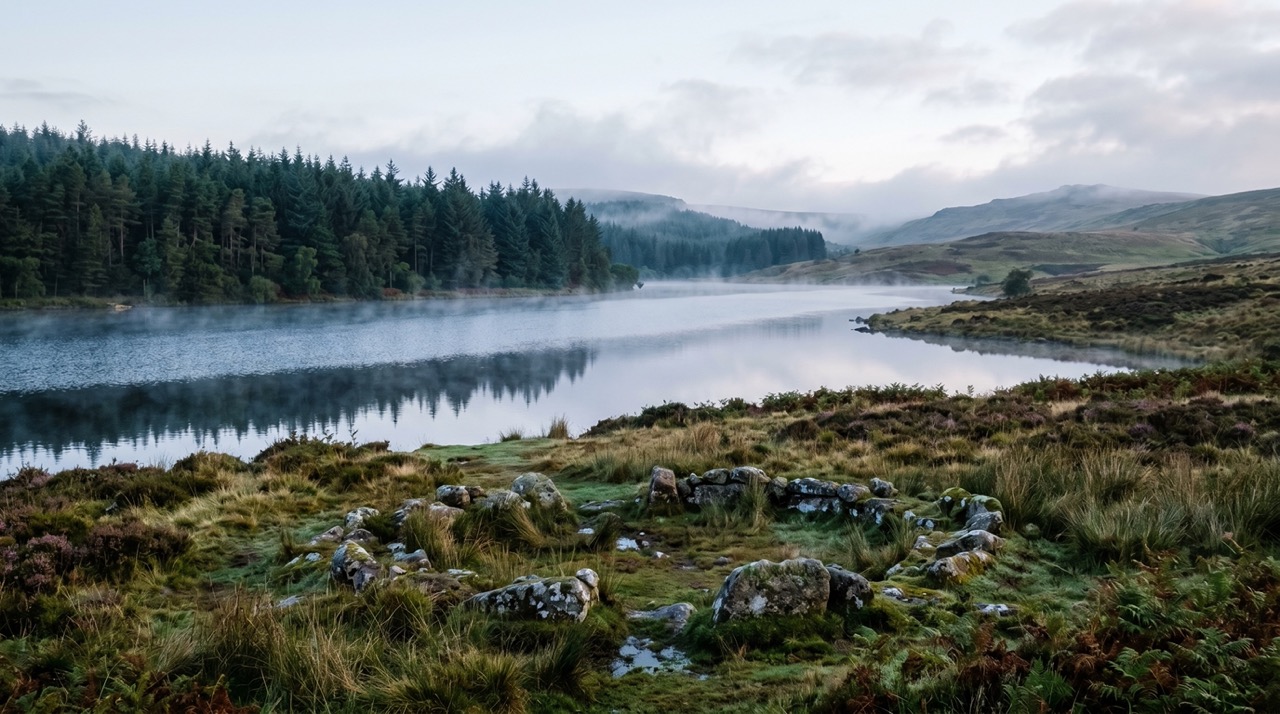
<p>Dartmoor's streams, wet flushes and boggy areas support a quieter world of insects, birds and seasonal life. In warmer months, dragonflies and damselflies can be seen around water, while birds often use stream corridors for feeding and shelter.</p>
<p>Approach wet ground carefully. Some areas are boggy, fragile or difficult to cross. Watch from firm ground and avoid trampling sensitive habitats.</p>
<ul><li><strong>Best for:</strong> dragonflies, damselflies, insects, streamside birds</li><li><strong>Best time:</strong> late spring to early autumn</li><li><strong>Look for:</strong> flashes of movement over water, birds working banks, insects above pools</li></ul>
<h2>Moorland fringes</h2>
<p>The edges of Dartmoor, where moorland meets farmland, lanes, hedges and woodland, can be excellent for wildlife. These areas often contain more varied habitat than the open high moor.</p>
<p>You may see rabbits, foxes, deer, buzzards, small birds, butterflies and other wildlife using the mix of fields, banks, walls and rough ground.</p>
<ul><li><strong>Best for:</strong> foxes, rabbits, deer, buzzards, small birds</li><li><strong>Best time:</strong> early morning and evening</li><li><strong>Look for:</strong> hedge lines, field edges, old walls, quiet lanes and scrubby corners</li></ul>
<h2>Less busy areas</h2>
<p>Wildlife tends to avoid constant disturbance. Popular car parks, roadside viewpoints and busy paths can still produce sightings, but quieter areas usually offer better chances.</p>
<p>You do not always need to go remote. Sometimes walking ten or fifteen minutes away from the busiest spot is enough. Choose quieter tracks, avoid peak times and give yourself permission to stop.</p>
<ul><li><strong>Best for:</strong> better general wildlife chances</li><li><strong>Best time:</strong> weekdays, early mornings, evenings, out of season</li><li><strong>Look for:</strong> places where people thin out and the landscape becomes quieter</li></ul>
<h2>Best habitat by wildlife type</h2>
<h3>Ponies</h3>
<p>Look across open moorland, commons and grazing areas. Ponies are often visible from roads and tracks, but treat them with respect. Do not feed them and keep your distance, especially around foals.</p>
<h3>Buzzards and ravens</h3>
<p>Use high ground, tors and valley edges. Watch the sky as well as the land. Buzzards often circle slowly, while ravens are larger, darker and more powerful in flight.</p>
<h3>Skylarks and meadow pipits</h3>
<p>Open grassland and heath are best, especially in spring and early summer. Listen carefully. Skylarks are often heard before they are seen.</p>
<h3>Deer</h3>
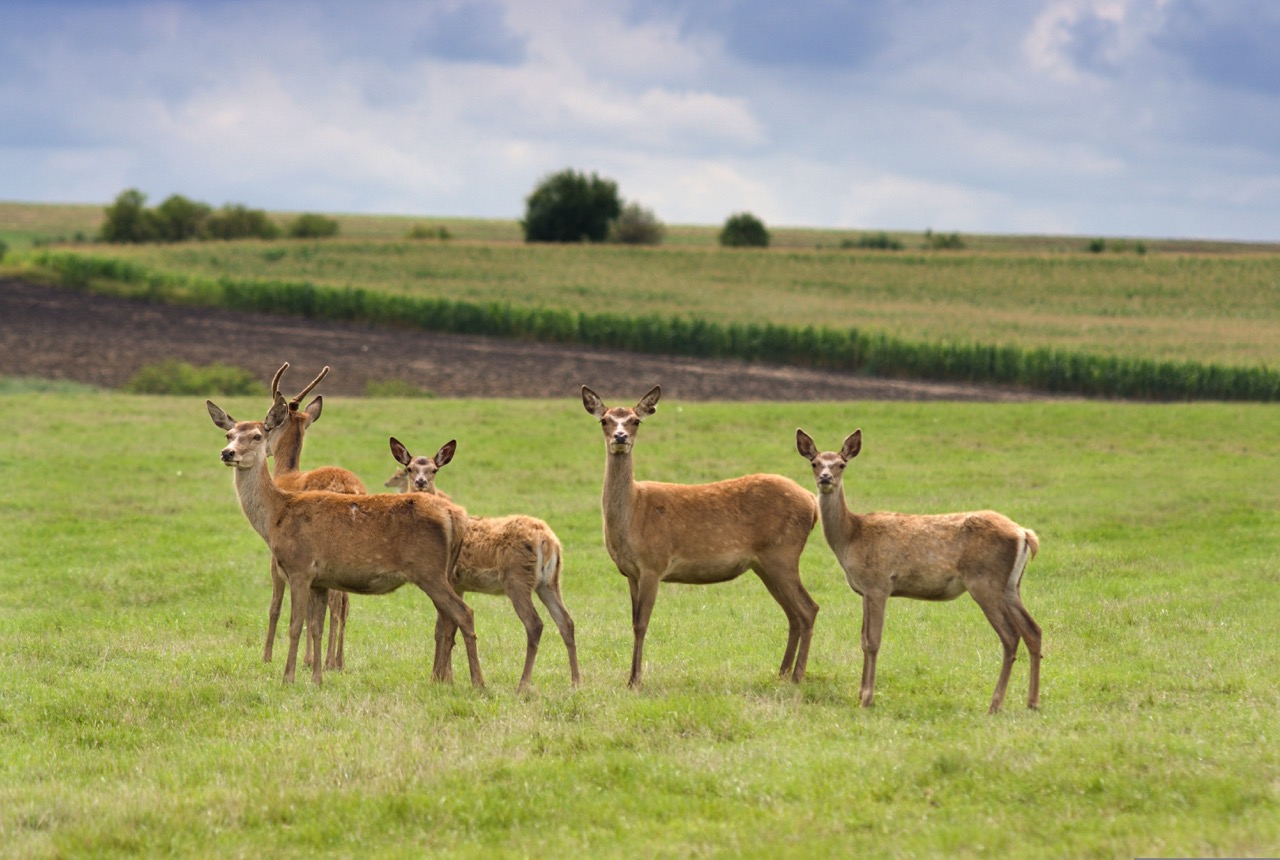
<p>Look in quiet valleys, woodland edges and less busy fringe areas. Dawn and dusk are best. Scan slowly and watch for movement at the edge of cover.</p>
<h3>Foxes</h3>
<p>Foxes are more likely near moorland edges, farmland boundaries, lanes and woodland margins. They are shy and usually seen briefly.</p>
<h3>Dragonflies and insects</h3>
<p>Streams, pools and wet ground are best in warmer months. Move slowly and watch sunny sheltered spots near water.</p>
<h2>Best times for wildlife on Dartmoor</h2>
<p><strong>Early morning:</strong> good for quieter wildlife, deer, rabbits, foxes and birdsong.</p>
<p><strong>Late morning:</strong> often better for buzzards and other birds of prey as warm air begins to rise.</p>
<p><strong>Dusk:</strong> useful for deer, foxes and rabbits, but plan your route carefully and avoid being caught out by darkness or poor visibility.</p>
<p><strong>Spring and early summer:</strong> best for birdsong, skylarks, meadow pipits and nesting activity.</p>
<p><strong>Autumn:</strong> quieter paths, softer light and better chances around woodland edges.</p>
<p><strong>Winter:</strong> fewer obvious sightings, but clearer views, ponies, ravens, buzzards and stark moorland atmosphere.</p>
<h2>Wildlife etiquette</h2>
<p>Give wildlife space. Watch from a distance and avoid chasing, feeding or crowding animals.</p>
<p>Do not feed Dartmoor ponies. Keep dogs under close control, especially near livestock and during bird nesting season. Stay on paths where possible in sensitive areas. Avoid disturbing ground-nesting birds, and never approach young animals.</p>
<p>A good wildlife sighting should feel like you were allowed to witness something, not like you forced it to happen.</p>
3moors Community
Recent conditions or questions about this walk?
Join the 3moors Community to ask about path conditions, parking, wildlife sightings and local tips.

 Wildlife
 Wildlife
 Wildlife
 Wildlife