We use essential cookies to keep the site working. Non-essential cookies help us improve your experience and understand how you use the site. You can accept or reject non-essential cookies at any time. Learn more
A realistic guide to seeing red deer and roe deer across Exmoor, Dartmoor, Bodmin Moor and quieter moorland edges.
Q&Aallall
TypeWildlife Guide
Q&A
Quick Answer
<p>Exmoor is the best place in the South West to see red deer, especially in autumn during the rut. Roe deer are more widespread and are more likely around woodland edges, quiet valleys, field margins, lanes and sheltered ground across all three moors.</p>
<p>Your best chances come early in the morning or near dusk. Use high ground, scan slowly, stay quiet, and look along the edges of woodland, bracken, valley sides and open slopes.</p>
Introduction
<p>Seeing deer on the moors is never guaranteed, and that is part of the appeal.</p>
<p>You may glimpse a stag standing on a ridge, a group of hinds moving across a valley, or a roe deer slipping silently back into cover before you have fully registered it. Most sightings are brief, distant or partly hidden. That is what makes them memorable.</p>
<p>Deer are not usually found by rushing from viewpoint to viewpoint. They are found by slowing down, watching the edges, and letting the landscape settle.</p>
<h2>Before you head out</h2>
<p>Deer are naturally wary animals. They notice movement, scent and noise long before most people notice them. If you want a better chance of seeing them, choose quieter routes, avoid busy times, and be prepared to stand still.</p>
<p>Binoculars help enormously. So does patience.</p>
<p>The best deer-watching walks are often not the longest ones. A short route with high ground, woodland edge, valley views and quiet stopping points can be far better than a busy trail across open ground.</p>
<h2>Red deer</h2>
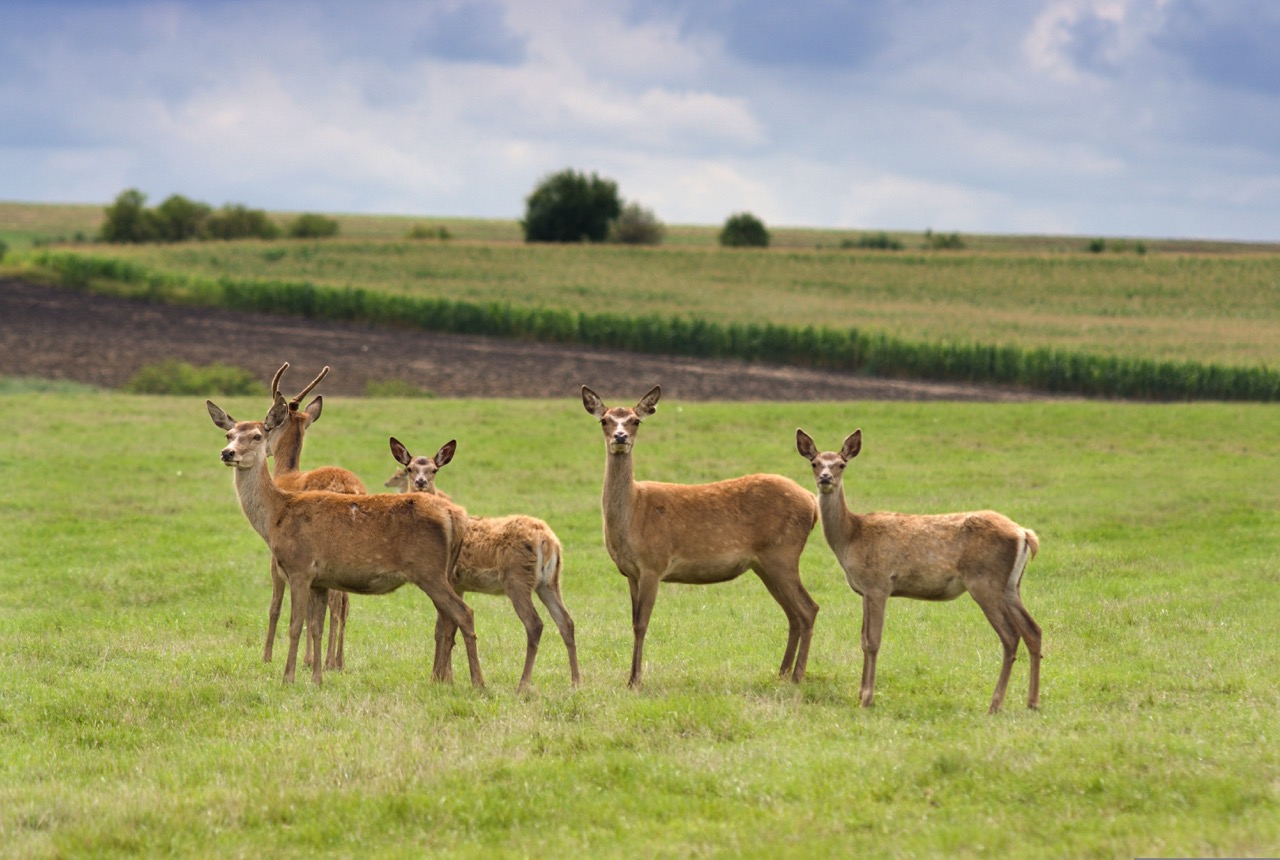
<p>Red deer are the great deer experience of Exmoor. They are Britain's largest wild land mammal and are especially associated with the open hills, wooded combes and quiet valleys of Exmoor.</p>
<p>They can sometimes be seen at distance on open slopes or moving between cover. In autumn, the rut makes them far more noticeable, with stags roaring, posturing and gathering hinds.</p>
<p>Red deer are powerful wild animals. Watch from a distance and never try to approach, especially during the rut.</p>
<ul><li><strong>Best place:</strong> Exmoor</li><li><strong>Best habitat:</strong> open slopes, wooded valleys, moorland edges, quiet combes</li><li><strong>Best time:</strong> early morning, dusk, autumn rut</li><li><strong>Look for:</strong> groups of hinds, stags on ridges, movement along valley sides</li></ul>
<h2>Roe deer</h2>
<p>Roe deer are smaller, more secretive and easier to miss. They are often seen alone or in pairs, usually near cover. They favour woodland edges, hedgerows, field margins, scrub, lanes and quieter valley sides.</p>
<p>Roe deer are more widespread than red deer and may be encountered around Dartmoor, Bodmin Moor and Exmoor, especially where moorland gives way to farmland, woodland or sheltered ground.</p>
<p>They rarely stand around for long. Often, all you see is a quick shape crossing a track, a pale rump disappearing into cover, or a head lifting above grass before vanishing.</p>
<ul><li><strong>Best place:</strong> woodland edges and moorland fringes</li><li><strong>Best habitat:</strong> field margins, lanes, scrub, valleys, woodland edge</li><li><strong>Best time:</strong> dawn and dusk</li><li><strong>Look for:</strong> sudden movement near cover</li></ul>
<h2>Exmoor</h2>
<p>Exmoor is the strongest deer landscape in the South West, particularly for red deer. Its mix of open moor, steep combes, wooded valleys, farmland edges and quiet high ground creates excellent deer habitat.</p>
<p>The key is to use viewpoints carefully. From higher ground, scan slopes, valley sides and woodland edges slowly. Deer may be far away and still difficult to notice at first.</p>
<p>Autumn is the most famous season because of the red deer rut, but deer may be seen at other times of year too, especially early and late in the day.</p>
<ul><li><strong>Best for:</strong> red deer, autumn rut, valley watching</li><li><strong>Where to focus:</strong> open slopes, wooded combes, quieter high ground, valley edges</li><li><strong>Tip:</strong> use binoculars and scan slowly before moving on</li></ul>
<h2>Dartmoor</h2>
<p>Dartmoor is not as strongly associated with red deer as Exmoor, but deer are still present in suitable areas, especially around quieter valleys, woodland edges, plantations, field margins and fringe habitats.</p>
<p>On Dartmoor, deer sightings are often less predictable. You are more likely to see them away from busy tors and car parks, particularly where open ground meets cover.</p>
<p>Dawn and dusk are best. In the middle of the day, deer may remain hidden or keep to quieter ground.</p>
<ul><li><strong>Best for:</strong> roe deer and occasional deer sightings around quieter edges</li><li><strong>Where to focus:</strong> woodland edges, valleys, farmland margins, less busy routes</li><li><strong>Tip:</strong> watch the boundary between open moor and cover</li></ul>
<h2>Bodmin Moor</h2>
<p>Bodmin Moor can also produce deer sightings, particularly around quieter fringes, wooded edges, field boundaries and sheltered valleys. The open high moor may feel empty, but deer may use the surrounding edges where cover and feeding areas meet.</p>
<p>As with Dartmoor, sightings are more likely when you slow down and pay attention to transition zones rather than only scanning the open centre of the moor.</p>
<ul><li><strong>Best for:</strong> roe deer around edges and quieter valleys</li><li><strong>Where to focus:</strong> woodland margins, lanes, field edges, sheltered ground</li><li><strong>Tip:</strong> early morning or dusk gives the best chance</li></ul>
<h2>Best time of day</h2>
<p>Early morning is usually one of the best times to see deer. The landscape is quieter, light is softer, and deer may still be moving between feeding and cover.</p>
<p>Dusk can also be excellent, especially around woodland edges and valley sides. However, moorland can become difficult in poor light, so plan your route carefully and do not rely on phone signal alone.</p>
<p>During the day, deer are harder to see. They may be resting in cover, keeping to shaded ground, or staying well away from busy places.</p>
<h2>The autumn rut</h2>
<p>The red deer rut is one of the great wildlife events of the South West, especially on Exmoor.</p>
<p>In autumn, stags compete for hinds. You may hear roaring across valleys or see stags posturing at distance. It is dramatic, but it is also a sensitive time for the animals.</p>
<p>Keep well back. Do not approach roaring stags. Do not block their route or try to get closer for photographs. Use binoculars and enjoy the experience from a safe, respectful distance.</p>
<ul><li><strong>Best season:</strong> autumn</li><li><strong>Best place:</strong> Exmoor</li><li><strong>Watch for:</strong> roaring stags, hinds gathering, distant movement on slopes</li><li><strong>Important:</strong> never approach rutting deer</li></ul>
<h2>How to improve your chances</h2>
<p>Use high ground to scan wide areas. Look slowly across slopes, valley sides, woodland edges and field margins. Do not just look for whole animals. Look for shapes, movement, ears, antlers, pale rumps or a line of backs moving through grass.</p>
<p>Stop often. Deer may already be there before you notice them.</p>
<p>Keep your outline still. Avoid sudden arm movements. Speak quietly. If you are with others, pause together rather than spreading out noisily.</p>
<p>The best sightings often happen when you stop trying too hard and simply watch.</p>
<h2>Signs deer may be nearby</h2>
<p>You may not always see deer, but you can often notice signs that they use an area. Look for:</p>
<ul><li>Narrow tracks through grass or bracken</li><li>Droppings on paths or field edges</li><li>Flattened resting areas</li><li>Hoof prints in mud</li><li>Rubbed bark or frayed vegetation</li><li>Sudden alarm movement from woodland edges</li></ul>
<p>Do not leave paths or damage habitat looking for signs. Observe from existing routes where possible.</p>
<h2>Deer watching etiquette</h2>
<p>Deer are wild animals and should be treated with respect.</p>
<p>Keep your distance. Do not follow or chase deer. Do not approach stags during the rut. Keep dogs under close control. Avoid blocking an animal's escape route. If deer become alert, stare directly at you, stamp, bark, or move away, you are too close.</p>
<p>A good deer sighting should not change the animal's behaviour.</p>
<h2>Photography tips</h2>
<p>A distant deer photographed calmly is better than a close image gained by disturbance.</p>
<p>Use a zoom lens if you have one. Keep still, avoid sudden movements, and take photographs from paths or public access areas. Early morning and evening light can be beautiful, but do not stay out late without proper route planning.</p>
<h2>Seasonal notes</h2>
<p><strong>Spring:</strong> deer may be harder to see as vegetation grows, but early mornings can be rewarding.</p>
<p><strong>Summer:</strong> sightings are often early or late, with deer retreating into shade and cover during the day.</p>
<p><strong>Autumn:</strong> the red deer rut on Exmoor is the main seasonal highlight.</p>
<p><strong>Winter:</strong> clearer views through bare trees and quieter landscapes can improve visibility, especially around woodland edges.</p>
3moors Community
Recent conditions or questions about this walk?
Join the 3moors Community to ask about path conditions, parking, wildlife sightings and local tips.
 Wildlife
 Wildlife
 Wildlife
 Wildlife